NEW VIDEO: Ensemble Variances perform Manoa by Thierry Pécou

Ensemble Variances recently visited Seattle as featured guest artists on Joshua Roman‘s Town Music at Town Hall series. Before the show, the musicians gave Second Inversion an exclusive performance of a piece that was not on the program – Thierry Pécou’s Manoa – featuring the low, lush sounds of the bass flue, bass clarinet, and violoncello. Not only did the musicians play their instruments brilliantly, they swirled around the stage in beautiful, barefoot motion. We hope that you enjoy this special performance!

Notes on Manoa, courtesy Continuum Contemporary Music:

“For centuries, the mythic Amazonian city of Manoa has kept its secrets hidden from the many explorers who have zealously sought to find even a trace of its existence. Running throughout the work, there is one musical phrase the instrumental trio plays in unison to symbolize the ideal splendour of Manoa and its golden King  – El Dorado. On several occasions this phrase moves toward its own disappearance as its slowly fades and finally winks out, like a mirage. Built upon the question-and-answer motif of the songs of the Goahibo, an indigenous culture of the Oronoco, the score calls for the instrumentalists to move, particularly the flutist and clarinetist, linking the intertwined instrumental game with the body game of the native cultures. Anchor to the earth, beacon from space, spiral movements, alternating steps, the piece is a dance whose music unfolds like the undulating leaves of a Mayan codez.”

Diary: How to Read John Cage – Part IV

by Maggie Molloy

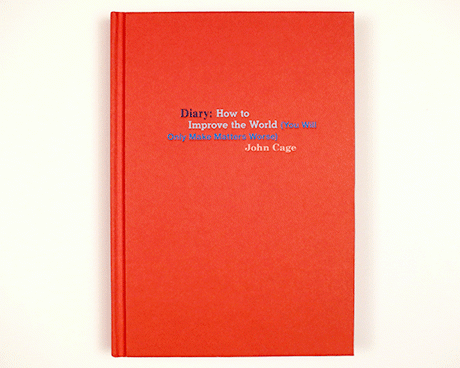
This post is part of a series on John Cages Diary: How to Improve the World (You Will Only Make Matters Worse). For earlier installments of the series, please visit: Introduction, Part I, Part II, and Part III.


JC Part IV Photo 2
To say that the avant-garde composer and iconoclast John Cage was a musical revolutionary would be a bit of an understatement. He was a pioneer of indeterminacy in music, a precursor to contemporary electroacoustic music, an innovator of musical instruments, and, perhaps most controversially, a philosopher of sound and silence.

He was much more than just a composer—he was a music theorist, a writer, an artist, and a thinker. He was a learned musician, and not just in the traditional Western sense. His interests extended far past the sphere of Western classical music and into music and art from around the world—particularly East and South Asian cultures.

Siglio Press Diary“Revolution,” he says in Part IV of his “Diary: How to Improve the World (You Will Only Make Matters Worse).” Then he pauses for a moment. “Two people making same kind of music is one music too many.”

As the title of the piece might suggest, revolution is a key theme throughout his diary—and Cage is not just talking about a musical revolution. The diary addresses social and political issues from across the spectrum, ranging from technology and environmentalism to poverty and violence. And in today’s day and age, those issues ring truer than ever.

“Civilization is Hamletized,” he says gravely, “(People are dying right and left): To be or not to be. That is the question.”

All whimsical Shakespeare references aside, the truth is saddening, sobering, and impossible to ignore. The all-too-frequent mass shootings, the constant wars, the terrorism—at times it feels as if hostility and violence have taken over our world, transforming our lives into a devastating drama. But when will the curtain finally close on this tragedy?

While Cage speaks of revolution almost exclusively in metaphors, analogies, and anecdotes, his optimism is still palpable—buried though it may be beneath his philosophical musings and fragmented memories. He must ultimately have faith in the future—why else would he write a five-hour diary on how to improve the world?

“If the situation is hopeless, we have nothing to worry about,” he says softly.

In other words, we worry because there is still hope; we worry because we haven’t given up yet. We know that we can still create a healthier, happier, and more peaceful world We can do it through art: through connecting with one another and inspiring one another—through understanding our world as it is, and through working together to make it better.

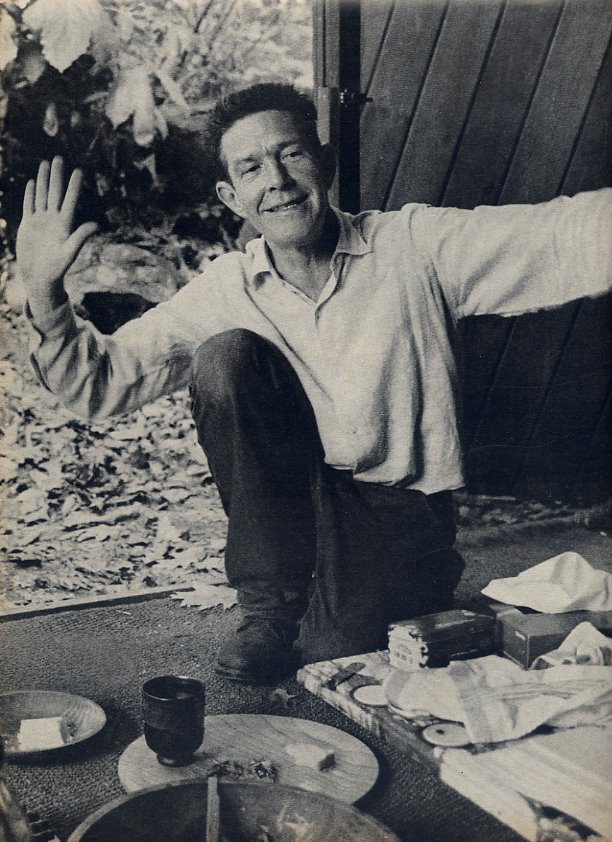
JC Part IV Photo 1

Image courtesy of the Vogue Archives

“Hands aren’t possessive,” Cage says calmly. “They belong to the same body. They taught us art was self-expression. You had to have ‘something to say.’ They were wrong: you don’t have to say anything. Think of the others as artists. Art’s self-alteration.”

Art is not solely in expressing oneself but in changing oneself—in growing, learning, collaborating with others, and gaining new perspectives. Art exists in creating community.

My former oil painting instructor used to tell me: “Once you finish your painting and you release it out into the world, it’s not yours anymore—it belongs to those who look at it.”

Art is not restricted to the hands that create it but rather, art changes and evolves as it continues to inspire new ideas and interpretations from its audiences. Each viewer will gain something different from a single work of art—and in that regard, the artwork itself opens a wealth of possibilities for the community that views, listens to, and engages with it.

“Spent several hours searching through a book trying to find the idea I’d gotten out of it,” Cage says blandly into my left ear. “I couldn’t find it. I still have the idea.”

When we engage with a piece of art, music, or literature, it sparks new ideas within us—and often even revisiting the same artwork multiple times will create an entirely new constellation of thoughts and emotions. And with advancements in technology, we now have infinite sources of art, knowledge, and inspiration at our fingertips at any given moment. Nowadays, it’s easier than ever to share our creations, collaborate with others, and make music and art accessible for all.

“Computers’re bringing about a situation that’s like the invention of harmony,” Cage says. “Sub-routines are like chords. No one would think of keeping a chord to himself. You’d give’t to anybody who wanted it. You’d welcome alterations of it. Sub-routines are altered by a single punch. We’re getting music made by man himself: not just one man.”

All of this technology, all of this music, and all of this art is in our grasp—and we can use it to start a revolution. We can use it as a catalyst for action, and we can use it as a catalyst for positive change.

“The mind, like a computer, produces a print-out,” Cage says. “It’s on the palms of our hands.”

Go to the next installment: Diary: How to Read John Cage – Part V

Five World Premieres: Q & A with Paul Taub

by Jill Kimball

For most classically-trained musicians, performing a world premiere is the exception. But for flutist Paul Taub, it’s the rule.

Taub, a Cornish College of the Arts professor and well-known Seattle-area performer, has been a proponent of new music for decades. Over the years, he’s performed and commissioned countless premieres. But this week, he’s taking it a step further.

On Friday at 8pm, Taub has organized a concert of made up exclusively of world premieres. The show will feature flute chamber works by five area composers–Tom Baker, Andy Clausen, David Dossett, Jessika Kenney and Angelique Poteat–and will shine a spotlight on a handful of world-class local performers, including Taub himself. The concert is part of the Wayward Music Series at the Good Shepherd Center’s chapel performance space. If you go, bring a $5-$15 suggested donation.

I asked Taub a few questions about the pieces he commissioned, and his answers are below.

paultaub
What inspired you to do a whole concert of world premieres?

My musical life—as a student, an educator, member of ensembles, professional organizations, circles of colleagues and friends—has often centered on new works and their creators and interpreters. And my relationships and interactions with composers have been highlights of my career. In my thirty-six years in Seattle, I have participated in hundreds of commissions of new music. This project gave me a chance to create opportunities for five unique composers to write works for me, in a chamber setting. The works you will hear on this program will contribute significantly to the general repertoire for the flute in chamber music. They are also gifts to the Seattle music-loving community, brought together through its interest and support and enjoy­ment of these engaging and inspiring composers. For me, the final gift is to be able to prepare and perform these new works with some of my favorite colleagues – Laura DeLuca, clarinet; Walter Gray, cello; Joe Kaufman, contrabass; Cristina Valdes, piano; and Matthew Kocmieroski, percussion!

You’ve heard and performed lots of new music. What do you think makes a new piece really good?

That’s a tough question! People have such contrasts in taste, stylistic preference… What one person considers a masterpiece someone else will find trivial, or boring. I consider myself a musical omnivore in terms of style so I can only answer the question more “generally” by saying that what I really, really like is music that grips me both emotionally and intellectually. Somehow the perfect balance between those two elements makes for a great piece.

Why did you choose these five composers?

[These composers] have been invited to participate in this project because of the high artistic quality of their work, the diversity of their styles, the varied stages of their career trajectories, and above all, because their music truly speaks to me and to the public.

The variety of musical styles is a key element of the project. Baker and Kenney are well-established “mid-career” composers, with impressive resumes and works that have been played internationally. Poteat, in her late 20s, is emerging as a significant voice in the Seattle and national music world, with recent pieces commissioned by the Seattle Symphony. Emerging composers Dossett and Clausen (whose band The Westerlies has taken the jazz world by storm), are recent college graduates (Cornish College of the Arts and the Juilliard Jazz Program). The composers’ musical styles are varied and contrasting, with influences as diverse as jazz, electronics, Persian modes, classical music and improvisation.

What does the rest of this concert season have in store for you?

I’m especially looking forward to a few events. I’ll be playing a solo by Estonian composer Helena Tulve with the Seattle Modern Orchestra on February 20; touring the Northwest with a program of Brazilian flute and piano music with pianist/composer Jovino Santos Neto (Portland, Methow Valley, Seattle and Bellevue) in late February/early March; and taking the lead in a concert of music by Janice Giteck on April 12 at Cornish.


ALBUM REVIEW: “The Source” by Ted Hearne

by Maggie Molloy

downloadtedhearne

Ted Hearne – photo by Nathan Lee Bush

Some musicians are inspired by history, literature, nature, art, or even philosophy—but American composer and vocalist Ted Hearne prefers to get his inspiration straight from the source.

The primary source, that is. Never one to shy away from the political, Hearne’s compositions tend to favor preexisting, primary-source texts portraying the tragic, troubled, and otherwise politically-turbulent parts of America’s recent history.

His latest album, aptly titled “The Source,” takes as its basis the Iraq War Logs and Afghan War Diary—two of the biggest leaks in U.S. military history. Hearne matches the massive scope and political significance of these documents by creating a likewise chaotic, dense, passionate, and poignant patchwork of musical maximalism.


The album is an oratorio of sorts, based on Private Chelsea Manning (formerly Bradley Manning) and her disclosure of hundreds of thousands of classified documents to WikiLeaks in 2010. Manning—who was 22 years old at the time and stationed in Iraq—was reported to the authorities by Adrian Lamo, an online acquaintance and former hacker. Manning had spoken to Lamo about a number of taboo topics, both political and personal: the document leaks, life in the Army, U.S. foreign policy—but also about her personal feelings, her gender identity, and her hopes that her actions would create “worldwide discussion, debates, and reform.”

In 2013, Manning was sentenced to 35 years in prison for espionage, theft, and computer fraud, as well as numerous military infractions. Shortly afterward, she made public her transgender status and her intent to transition to a woman.

Suffice it to say, there are countless political, social, cultural, and personal threads woven throughout this historic event—and Hearne explores as many as he can in just over one hour. Scored for five vocalists, interactive auto-tune, electronic processing, and small chamber ensemble, the album features the vocals of Hearne himself along with Mellissa Hughes, Samia Mounts, Isaiah Robinson, and Jonathan Woody. Their voices, auto-tuned and processed in real time, take on an eerily mechanical effect, underscoring the technological aspects of the leaked documents in addition to the political.

Ted Hearne sings a sparse, live version of “Criminal Event” 

Mark Doten provides the chilling patchwork libretto, drawn from various primary-source texts dating from 2005-2010—including the leaked documents, the conversations (both political and personal) between Manning and Lamo, and selections of interviews, radio, social media, and popular music of the period.

download (19)

Librettist Mark Doten

The result is an abstracted and completely idiosyncratic musical mashup which exists somewhere between the very separate realms of classical collage, fringe theatre, rock opera, and robotic electronic. Bouncing violently back and forth between a thousand different musical worlds, Hearne explores the full range of human emotion through a fragmented recap of both political and personal wars.

Shards of text and melodic fragments are layered, transformed, and repeated again and again, circling into a frenzied tornado of sound and emotion that refuses to settle down for more than a moment at a time. And while it’s difficult to find communicative meaning amidst of the crescendoing chaos and confusion, the emotions behind the music are perfectly tangible and utterly visceral.

Because ultimately, “The Source” does not tell a linear story—it takes a snapshot of our world, in all its political, social, and cultural complexity. It does not offer up a solution or remedy but rather, it leaves the listener with a whirlwind of reflections and questions that echo long after the oratorio has ended.

Listen to the Girls: Q & A with Angelique Poteat

by Jill Kimball

Angelique Poteat

Composer Angelique Poteat. Photo: Hayley Young

We in the world of music are often thankful for this increasingly digital world. It allows us to access new music from all over the globe, to communicate with musicians and music appreciators who live thousands of miles away, and to find inspiration in countless eras, countries, and languages.

But for many young women, globalization has its drawbacks. It allows us to obsessively compare ourselves with other women, some of whom we know and others whom we’ve never met. It invites anonymous bullying in comment forums and objectification in the media. And for many teenagers, it turns the schooltime popularity contest into a 24/7 battle.

“We have this global access, so we can see what’s going on all over the world,” says Seattle-based composer Angelique Poteat. “When you hear about women in the media, you can see that people are constantly expecting more from women. You’re expected to do it all…family, work, et cetera.”

Poteat wanted to know how teen girls felt about society’s high standards for them, both online and in real life. She surveyed a handful of teens who sing in the Northwest Girlchoir, and the answers she got were so stunning that she set the words to music with the help of grants from the Seattle Office of Arts & Culture and 4Culture.

On Wednesday, November 18, members of the Northwest Girlchoir get to do something they’ve probably never done before: sing a piece set to words they wrote themselves. The Girlchoir premieres Poteat’s five-movement work, Listen to the Girls, alongside the Seattle Collaborative Orchestra at Seattle’s University Christian Church. You can buy tickets right here.

I asked Poteat a few questions about the project, and her answers are below.


Where did you get the inspiration for Listen to the Girls?

I noticed that all this stuff kept coming up in the media about young women and self esteem and unrealistic standards that girls are being held up to. Rather than take the media’s word for it, I wanted to get the girls’ opinions. I came up with a questionnaire and gave it to Seattle-area middle and high school girls. I asked things like, “Who are your role models? Do you have a fear of failure? Where does it come from? How does criticism influence the decisions you make? What are the pros and cons of using social media?” I used all of this information and came up with text for a piece of music. I scored it for large orchestra with a girlchoir, so I could have girls actually singing the words of girls.

Members of the Northwest Girlchoir.

Members of the Northwest Girlchoir.

What kinds of things did the girls say in the survey?

You’ll be able to hear it all in the piece. In the first movement, you’ll hear their responses to the question, “Who are you?” They answered, we’re redheads, nerds, geeks, we like contact sports, we’re adopted, we like film and anime. Stuff you’d hope young women would be interested in.

In the second movement, we find out who their role models are. You’ll see that it’s women who are strong, kind, smart and honest, who inspire and change, who fearlessly speak their mind and stand up for their beliefs.

The third and fourth movements are about doubt and social media. There’s an internal conflict here: the girls want to know what their friends are doing, they never want to miss out on anything. But they also feel like they have to stand up to the expectations of their friends, they have to change the way they look or behave to get approval.

In the last movement, they sing about the pressure to succeed in a competitive world where value is placed on perfection. But what is perfection? Are we supposed to be attractive or smart? Can’t we be both? It ends really triumphantly. The girls are determined to say they’re not a stereotype, they’re not objects, they’re working harder for people to accept them as they are.

What does it sound like?

I wanted to write something that was more relevant to the girls, so it’s got a bit of an energetic, perhaps lightly pop-ish feel to it. The first movement is really fiery, with fast stuff weaving in and out. There’s a moment with a grooving bass line. Second movement is kind of an off-kilter waltz. The third movement is mostly an orchestra movement, with long lines, rich harmonies, and changes in mood. The fourth movement is about social media, so it’s kind of mechanical, almost like you’re sitting at a computer and you’ve got this frantic energy. In the last movement about societal pressure, it’s very march-like and strict, and then there’s a very grand conclusion.

What will be different about this new generation of women?

Today we have global access, so we can see what’s going on all over the world. And because of that, we can see that women are so completely varied. These girls feel like it’s okay to be an individual, but they also see that people are expecting more from them than before. I think it’s really hard to deal with that pressure. We’ve all felt it.

Of all the classical music performed today, only 14 percent is composed by women. How does it feel to be in the minority?

I don’t know what it feels like to be a male composer, but it does feel curious to be a certain minority in my field. I always feel really weird when I get programmed for one of those concerts showcasing female composers, because you’ll never see a program called “Music of Male Composers.” Luckily, if you’re listening to the music and you don’t know who wrote it, it’s just music. I’ve never felt that being a woman is really holding me back.

What kind of music do you usually compose?

Music for large orchestra is my main focus right now. Earlier this year, the Seattle Symphony premiered a piece I wrote, and that was so exciting for me. I’ve always been influenced by jazz, rock and roll, and 20th century masters like Bartók and Messiaen. All those old dead guys used to write music inspired by whatever was popular in their day, and I think it’s wonderful that composers are trending toward that again.

What did you want to communicate by calling your piece Listen to the Girls?

There are so many places on the internet and in real life where people try to guess what girls and women are thinking. Instead of guessing, why don’t we just listen? Open up your ears, get rid of the biases and expectations, and just hear what these women have to say.