

Second Inversion hosts share a favorite selection from their weekly playlist. Tune in on Friday, September 28 to hear these pieces and plenty of other new and unusual music from all corners of the classical genre!
Richard Reed Parry: For Heart, Breath and Orchestra (Deutsche Grammophon)
Christopher Cerrone: How to Breathe Underwater
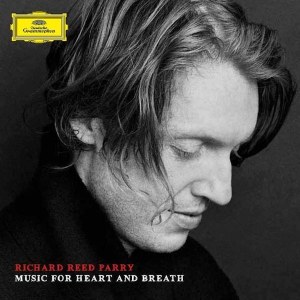 I have to admit: this Staff Pick was a tough choice for me. It was a toss-up between Richard Reed Parry’s For Heart, Breath and Orchestra, and Christopher Cerrone’s How to Breathe Underwater. In one corner, a piece by a guy from one of my favorite bands, wherein he had musicians and the conductor listen to their own heartbeats through stethoscopes and asked them to play along as closely as possible to their own heartbeats—a beautiful existential notion and a beautiful thing to listen to.
 In the other corner, a piece that’s kind of about depression, which is based on a Jonathan Franzen character from the book Freedom, of whom Franzen said, “[she] was all depth and no breadth. When she was coloring, she got lost in saturating one or two areas with a felt-tip pen.” If you are not weeping by the end of that sentence and by the end of this heartbreakingly hopeful piece, check your pulse, man. Ultimately, I loved them both so much that I had to just close my eyes and pick one. But…oops! I wrote about both of them. Now you’ll never know which one I picked! – Dacia Clay
Tune in to Second Inversion in the 11am hour today to hear these pieces.
Michael Gordon: Beijing Harmony (Cantaloupe Music)
Seattle Symphony; Pablo Rus Broseta, conductor
 “Every city produces its own set of harmonies,” Michael Gordon writes in his program note for this piece. In Beijing Harmony, those chords are dazzling and majestic, shimmering magnificently across the orchestra. The piece was inspired in part by Echo Wall, a part of the Temple of Heaven in Beijing where sounds echo from one side of the structure to the other. In performance, the wind and brass players are spread out across the stage—and when you listen with headphones, the music echoes from left to right and back again, all around and through you. – Maggie Molloy
Tune in to Second Inversion in the 5pm hour today to hear this piece.
Pauline Oliveros: Lear (New Albion)
Deep Listening Band

Way out on the northeastern tip of the Olympic Peninsula, nestled amid the sprawling and historic Fort Worden State Park, is a massive cistern, nearly 200 feet in diameter and over 14 feet deep. There’s nothing that quite compares to the immersive 45-second reverberation that echoes across this cistern—which is what made it the perfect location for Pauline Oliveros and her Deep Listening Band to record their self-titled album. Accordion, trombone, didjeridu, keyboards, and electronics somehow merge into one cohesive, meditative soundscape that lulls you straight into sonic hypnosis.
– Maggie Molloy
Tune in to Second Inversion in the 7pm hour today to hear this piece.

 Fantasie Negre is such a cool piece, a fascinating mix of romantic era Western European influence and African American spiritual—it’s almost as if Liszt visited the American South and immediately rushed to a piano to interpret the melodies he heard. Fantastic gospel-like moments seep through dazzling displays of technique. It’s even more impressive when you think about all the things Price had to overcome just to compose: a black woman born in Little Rock, Arkansas, she attended New England Conservatory in 1906 but had to pass as Mexican in order to avoid abuse. Though she returned to Arkansas and married, she moved her family to Chicago to flee lynchings; her husband eventually became abusive and she filed for divorce, a rare step for a woman of her time. Despite these difficulties, her prodigious talent produced 300 works in her lifetime.


 I love this music! I’ve never heard anything like it. ElSaffar has fused together a lot of different musical traditions in this, but what stands out to me most are the jazz and the Middle Eastern sounds. ElSaffar is the child of an Iraqi immigrant and an American. He was born outside of Chicago, and grew up listening to his dad’s jazz collection. His first musical training was in a Lutheran church choir. Iraqi music came later for him—in 2001 he used the money he got from winning a jazz trumpet competition in to go to Iraq and study something called maqam music, and he spent the next five years studying with Iraqi masters in the Middle East and Europe. Anyway, I love how these traditions come together in his music so effortlessly to make something new. –
  Second Inversion hosts share a favorite selection from their weekly playlist.
  “Listen to everything all the time and remind yourself when you are not listening,” Pauline Oliveros said in her 1998 keynote address at the ArtSci98 symposium.
 Michael Hammond’s recording project No Lands opens it’s album Negative Space with a confusingly-titled track. Despite being titled “Icefisher,” this piece brings a distinct sense of warmth. The slow, bendy chords are reminiscent of surf rock, while the heavy electronic static might be a sonic translation of the sensation of relaxing outdoors on an evening that is too hot. The end result? This track makes me want immediate access to a cold drink and a lawn chair. –
 It’s always fascinating for me to hear the atonal landscape of György Ligeti applied to vocal works—for me, it magnifies the majesty and magic that is a somewhat lesser characteristic of his instrumental compositions that I know and love. Lux Aeterna is a highly difficult work for 16-part mixed choir that uses constantly shifting rhythms and high notes for all vocal parts to create a floating, ethereal feeling. Stanley Kubrick was attracted to its celestial sound,


 “Kaleidoscope” is one of my top three songs from Nils Frahm’s latest album All Melody. The album itself features a wider instrumental palette compared to Frahm’s earlier work, which focused mainly on piano, yet he maintains the same exploratory spirit and continues to give his works space to evolve. “Kaleidoscope” is a great example of that as it features the human voice, lots of plinky synth, and a pipe organ (which Frahm himself helped build!) among other instruments. The textures combine slowly and create a warm and gratifying listen, making “Kaleidoscope” a great starting point for anyone unfamiliar with Frahm’s repertoire. –
