by Jill Kimball
For most classically-trained musicians, performing a world premiere is the exception. But for flutist Paul Taub, it’s the rule.
Taub, a Cornish College of the Arts professor and well-known Seattle-area performer, has been a proponent of new music for decades. Over the years, he’s performed and commissioned countless premieres. But this week, he’s taking it a step further.
On Friday at 8pm, Taub has organized a concert of made up exclusively of world premieres. The show will feature flute chamber works by five area composers–Tom Baker, Andy Clausen, David Dossett, Jessika Kenney and Angelique Poteat–and will shine a spotlight on a handful of world-class local performers, including Taub himself. The concert is part of the Wayward Music Series at the Good Shepherd Center’s chapel performance space. If you go, bring a $5-$15 suggested donation.
I asked Taub a few questions about the pieces he commissioned, and his answers are below.

What inspired you to do a whole concert of world premieres?
My musical life—as a student, an educator, member of ensembles, professional organizations, circles of colleagues and friends—has often centered on new works and their creators and interpreters. And my relationships and interactions with composers have been highlights of my career. In my thirty-six years in Seattle, I have participated in hundreds of commissions of new music. This project gave me a chance to create opportunities for five unique composers to write works for me, in a chamber setting. The works you will hear on this program will contribute significantly to the general repertoire for the flute in chamber music. They are also gifts to the Seattle music-loving community, brought together through its interest and support and enjoyment of these engaging and inspiring composers. For me, the final gift is to be able to prepare and perform these new works with some of my favorite colleagues – Laura DeLuca, clarinet; Walter Gray, cello; Joe Kaufman, contrabass; Cristina Valdes, piano; and Matthew Kocmieroski, percussion!
You’ve heard and performed lots of new music. What do you think makes a new piece really good?
That’s a tough question! People have such contrasts in taste, stylistic preference… What one person considers a masterpiece someone else will find trivial, or boring. I consider myself a musical omnivore in terms of style so I can only answer the question more “generally” by saying that what I really, really like is music that grips me both emotionally and intellectually. Somehow the perfect balance between those two elements makes for a great piece.
Why did you choose these five composers?
[These composers] have been invited to participate in this project because of the high artistic quality of their work, the diversity of their styles, the varied stages of their career trajectories, and above all, because their music truly speaks to me and to the public.
The variety of musical styles is a key element of the project. Baker and Kenney are well-established “mid-career” composers, with impressive resumes and works that have been played internationally. Poteat, in her late 20s, is emerging as a significant voice in the Seattle and national music world, with recent pieces commissioned by the Seattle Symphony. Emerging composers Dossett and Clausen (whose band The Westerlies has taken the jazz world by storm), are recent college graduates (Cornish College of the Arts and the Juilliard Jazz Program). The composers’ musical styles are varied and contrasting, with influences as diverse as jazz, electronics, Persian modes, classical music and improvisation.
What does the rest of this concert season have in store for you?
I’m especially looking forward to a few events. I’ll be playing a solo by Estonian composer Helena Tulve with the Seattle Modern Orchestra on February 20; touring the Northwest with a program of Brazilian flute and piano music with pianist/composer Jovino Santos Neto (Portland, Methow Valley, Seattle and Bellevue) in late February/early March; and taking the lead in a concert of music by Janice Giteck on April 12 at Cornish.


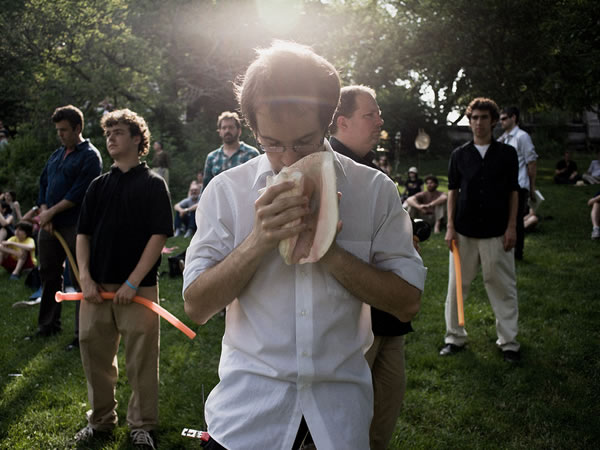
 Inuksuit is a 79-minute masterpiece written for 9 to 99 percussionists composed by John Luther Adams. The title refers to a type of stone landmark used by native peoples of the Arctic region; listeners discover their individual listening points as they, too, move freely during the performance. This work is designed to heighten our awareness of the sights and sounds that surround us every day, and deeply influenced by the composer’s belief that “music can contribute to the awakening of our ecological understanding. By deepening our awareness of our connections to the earth, music can provide a sounding model for the renewal of human consciousness and culture.” Adams has notated in Inuksuit that the piece should only be performed outdoors. The piece uses a mix of standard and less common instruments, including glockenspiel, toms, cymbals, conch shells, whirly tubes, vuvuzelas, and sirens.
 My biggest inspiration for producing this piece was my experience at the Chosen Vale Percussion Seminar in the summer of 2014. Doug Perkins and Amy Garaphic are the organizers of this seminar, and also very involved with JLA and have produced a number of performances of Inuksuit. That summer, Adams was invited to be a composer-in-residence for the program and we had the privilege of playing through the percussion parts of his piece Sila: The Breath of the World before the premier performance at Lincoln Center. Sila is written for large ensemble and voices, so we only represented a fraction of the final product, and the experience was really moving for us all. I was able to learn about his experiences and inspirations first hand, and developed a deep interest in learning more and performing this major work for percussion.