by Jill Kimball
With Seattle’s ever-growing and ever-diversifying population, it’s easy to see why our city has become a top destination for up-and-coming composers, young musical talent, and adventurous concert formats. The 2015-16 season is so packed with new music concerts that, on most weekends, you’d need both hands (and maybe a few toes) to count them. From revitalized Britten to badass multimedia concerts to the classiest Bowie you’ve ever heard, there’s a little something for everyone. Read on for our top picks of the season.
The Town Music series at Town Hall Seattle, curated by our own Artistic Advisor Joshua Roman, is a bastion for cutting-edge music. The season kicks off with a young Russian violinist’s interpretations of Bach’s beautiful, complicated Sonatas and Partitas. And the rest of the season is anything but staid: it includes the premiere of a work composed over two continents, a dynamic performance of Britten’s second string quartet, and a new piece by Roman himself, featuring Pulitzer Prize-winning poetry by Tracy K. Smith and the up-and-coming soprano Jessica Rivera.
Another go-to destination for edgy music with global influences is the UW World Series, an arts season at Meany Hall featuring big names and even bigger ideas. This season is packed with exciting concerts that feature mainstays on the Second Inversion stream. In October, the ETHEL quartet teams up with Native American flutist Robert Mirabal for a concert focused on water’s essential role in all our lives. If drums and mallets are your thing, you must check out So Percussion’s set of modern classics by Reich, Cage, and more. For those who prefer concerts that combine edgy work with timeless pieces, go see the young, bearded Danish String Quartet (they take on music by Beethoven, Schnittke, and a composer from their homeland, Per Nørgaard), pianist Jeremy Denk (he’ll work in some Hindemith and Nancarrow between the Bach and Byrd), or the Daedalus String Quartet (a Huck Hodge world premiere is sandwiched between Beethoven chamber works). If you can’t make it to some of these much-anticipated concerts, don’t worry: we’ll have your back with a live broadcasts or a video from each one.
The UW World Series isn’t the only destination for new music on the University of Washington campus. The School of Music itself has an impressive lineup of concerts. On Halloween weekend, we’re excited to hear the Chicago-based Ensemble Dal Niente perform the works of Seattlites Huck Hodge, Joël-François Durand, and Marcin Pączkowski, among others. In late April, the Carnegie Hall resident ensemble Decoda caps off its weeklong UW residency with a Meany Hall concert of new and old music. And finally, some UW students pay homage to Harry Partch, who created new instruments along with new music, with performances of some of his work.
The UW isn’t the only higher education arts game in town, of course. Cornish College of the Arts is a wealth of compositional talent and its concert season, Cornish Presents, attracts world-class acts every year. Cornish teacher Wayne Horvitz starts off the new-music feast with his piece “Some Places are Forever Afternoon/11 Places for Richard Hugo,” performed with chamber groups Sweeter Than The Day and the Gravitas Quartet. A few days later, flutist Camilla Hoitenga teams up with composer and sound designer Jean-Baptiste Barrière for an electronic concert with video. In December, Paul D. Miller, better known as DJ Spooky, uses interviews from survivors of the Hiroshima and Nagasaki bombs to create a moving original composition. And for an ultimate exploration of music from both sides of the Pacific, stop by PONCHO Hall in November, when a famous gamelan ensemble joins four Seattle string players for a performance of new, local music.
Full-time locavores may not be satisfied until everything about the concert, from composer to performer to creator, is Northwest-based. If you want all local, all the time, your concert season destination should be the Universal Language Project. Founded by trumpeter and composer Brian Chin, the project draws on local talent to present a commissioned premiere in every concert. This season, we’ll hear music inspired by local landscapes written by Karen P. Thomas, Brian Cobb, and Tim Carey; music for strings performed by Seattle-based Scrape Ensemble; and an interactive concert with stunning visuals by Scott Kolbo.
And if that’s not enough to whet your new music appetite, the Seattle Modern Orchestra‘s upcoming season has even more new music. Each of its three main concerts features a premiere of some sort, from Orlando Jacinto Garcia’s From Darkness to Luminosity to an as-yet-unnamed work by Ewa Trębacz to the U.S. premiere of Anthony Cheung’s 2011 work Discrete Infinity.
In the last few years, Benaroya Hall has become an internationally recognized center for cutting-edge new music, from the avant garde to the crossover. If you’re into the former, you probably already know about the Seattle Symphony’s famed [untitled] series, which takes place in the Benaroya lobby fashionably late at night. This [untitled] season proves it means business with a season kickoff made up entirely of world premieres, then goes on to focus on New York City’s avant garde scene and an Arctic-themed piece by Pulitzer Prize-winning composer John Luther Adams. If the latter is more your taste, check out the undefinable Sonic Evolution series, which this season focuses on the way different artists influence each other across genres and the phenomenon of indie music and film.
Finally, if you’re looking to get some culture but indulge in musical guilty pleasures at the same time, your go-to season should be the Seattle Rock Orchestra‘s. The ensemble that famously covers popular music on orchestral instruments has put together a killer 2015-16 series, which includes a David Bowie showcase, a collection of Mowtown music, and an evening devoted to Neil Diamond. A quintet from SRO also closes out Classical KING FM’s inaugural concert series with a very exciting Eastside concert featuring covers of Beck, Bjork, Radiohead, and more.
These are only a few highlights from an expansive, diverse, and exciting upcoming concert season. For a full listing of shows around the Northwest that’ll make you rethink classical, check our full event calendar.


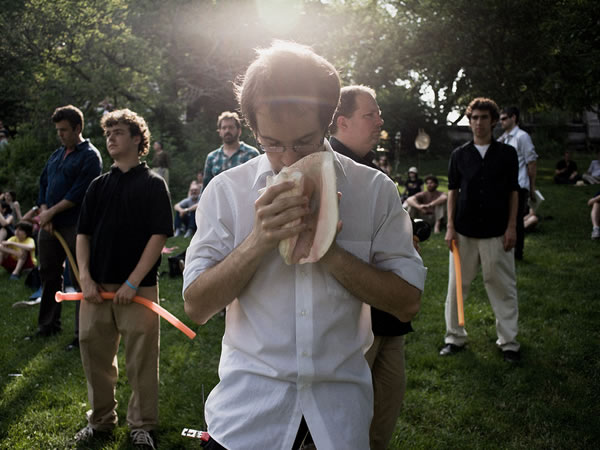
 Inuksuit is a 79-minute masterpiece written for 9 to 99 percussionists composed by John Luther Adams. The title refers to a type of stone landmark used by native peoples of the Arctic region; listeners discover their individual listening points as they, too, move freely during the performance. This work is designed to heighten our awareness of the sights and sounds that surround us every day, and deeply influenced by the composer’s belief that “music can contribute to the awakening of our ecological understanding. By deepening our awareness of our connections to the earth, music can provide a sounding model for the renewal of human consciousness and culture.” Adams has notated in Inuksuit that the piece should only be performed outdoors. The piece uses a mix of standard and less common instruments, including glockenspiel, toms, cymbals, conch shells, whirly tubes, vuvuzelas, and sirens.
 My biggest inspiration for producing this piece was my experience at the Chosen Vale Percussion Seminar in the summer of 2014. Doug Perkins and Amy Garaphic are the organizers of this seminar, and also very involved with JLA and have produced a number of performances of Inuksuit. That summer, Adams was invited to be a composer-in-residence for the program and we had the privilege of playing through the percussion parts of his piece Sila: The Breath of the World before the premier performance at Lincoln Center. Sila is written for large ensemble and voices, so we only represented a fraction of the final product, and the experience was really moving for us all. I was able to learn about his experiences and inspirations first hand, and developed a deep interest in learning more and performing this major work for percussion.