by Maggie Molloy
Walking into the Harry Partch Instrumentarium for the first time is a bit like walking into Willy Wonka’s Chocolate Factory—except Willy Wonka’s not a chocolatier, but a luthier of sorts. And Charlie’s not a young protégé, but a grown man named Charles Corey. He goes by Chuck for short.
There’s no candy or chocolate in this factory, but rather, the walls and floor are all covered in colorful, handmade musical instruments created out of wood and strings, gongs and glass, gizmos and gadgets. Oh, and everything you touch turns to microtonal melodies.

All Photos by Maggie Molloy
Chuck is the director and curator of the Harry Partch Instrumentarium, which has been in residence at the University of Washington since 2014. Partch was an innovative and iconoclastic composer, music theorist, and creator of musical instruments—and the Instrumentarium is devoted to preserving and performing his works.
Partch was a pioneer of new music; he was one of the first 20th century composers to work extensively with microtonal scales, creating dozens of incredible instruments specifically for the performance of his musical texts and corporeal theatre works.
Through research, instruction, and performance, Chuck shares Partch’s music and instruments with, well, anyone who is interested. Next Tuesday, April 26, he presents a concert of Partch’s music at Meany Hall, featuring local musicians, students, and community members who have studied the instruments with him over the past year.

“I have had the opportunity to work with Partch’s instruments for nearly half my life, and am still amazed by some of the sounds he creates in his music,” Chuck said. “Partch is best known for his just-intoned tuning system and the instruments he invented, but if he were not also a great composer I don’t think his work would have gained much of a following. For me, it is rewarding to perform his music and solve the problems his instruments present, and I remain impressed by his distinctive musical language.”
Chuck first learned about the instruments while doing his undergraduate studies at Montclair State University, which housed the instruments at that time. His instructor was Dean Drummond, a composer and protégé of Partch.
“As a young composer, I was captivated by these unique sounds and a tuning system that I had never heard of, and quickly decided I wanted to be as involved as possible with the Partch program,” Chuck said.
Of course, being the director of the Partch Instrumentarium is no small commitment. Outside of teaching and performing, Chuck also takes care of all of the tuning, maintenance, and repairs on all of the instruments. Just to give you an idea, there are over 50 instruments in the collection—some with as many as 72 strings!
Aside from the peculiar tunings, each instrument also has its own unique performance idiosyncrasies.
 “Some of the instruments require an unusual performance technique and many of the instruments have a complicated tablature, so learning the music can be a challenge,” Chuck said. “That said, it can be particularly rewarding to learn the idiosyncrasies of these instruments and discover how to draw just the right sound out.”
In addition to curating, directing, teaching, performing, and maintaining the instruments, Chuck also provides guided tours of the instruments by appointment. He was kind enough to show me around the Instrumentarium and let me see, touch, play, and take photos of every single instrument in the room.
Please, allow me to introduce you to just a few of them:
 Diamond Marimba: This instrument is a physical manifestation of one of Partch’s most crucial theoretical concepts: the “tonality diamond.” Built in 1946, the instrument contains all twelve of Partch’s primary tonalities, each laid out in a series of thirds. It’s used as a prominent percussion instrument in many of his works.
 Gourd Tree: Built in 1964, the Gourd Tree is comprised of 12 temple bells attached to gourd resonators, each of which hangs suspended from a eucalyptus branch. (Yes, a eucalyptus branch.) The instrument is often played in conjunction with Partch’s Cone Gongs, which are made out of nose cones from airplane fuel tanks.
 Cloud-Chamber Bowls: Partch’s most iconic instrument, the Cloud-Chamber Bowls are made up of large glass gongs of varying sizes suspended in a wooden frame and played with mallets. Partch initially created the instrument in 1950 using Pyrex carboys discarded by the Radiation Laboratory at the University of California, Berkeley.
 Chromelodeon: The colorful Chromelodeon, built in 1945, is an adapted reed organ modified to conform to Partch’s tonality system. The instrument plays a 43-tone per octave scale, as opposed to a typical Western keyboard, which plays 12 tones per octave. In addition to a standard keyboard and a collection of stops, the Chromelodeon also includes an additional keyboard of Partch’s own creation called the “sub-bass,” located in the upper left corner of the instrument. Both keyboards have colored and numbered labels representing ratios of the tuning system. Oh, and also: the player has to furiously pump two foot pedals throughout the entire performance in order fill the organ’s bellows and create sound.
 Kithara II: Towering at nearly seven feet tall, the Kithara II requires the performer to stand on a riser in order to play it. Built in 1954, the instrument has twelve sets of six strings which correspond to Partch’s primary tonalities; four of these sets employ Pyrex rods as movable bridges. The Kithara II is also Chuck’s personal favorite instrument in the collection.
 Surrogate Kithara: As the name suggests, the Surrogate Kithara was originally invented as a substitute for Partch’s original Kithara, and was created when he began writing music for the instrument that was too difficult for one person to play. The Surrogate Kithara features two sets of eight strings, each with a Pyrex rod that serves as a movable bridge.
 Bamboo Marimba II (Boo II): Affectionately dubbed “Boo II,” the Bamboo Marimba II (built in 1971) consists of 64 tubes of mottled Japanese bamboo organized into six ranks. Each tube is open on both ends, and tongues are cut into the bamboo at approximately 1/6 of the length of the tube in order to produce a harmonic at 6/5 of the fundamental pitch.
 Bass Marimba: Built in 1950, the Bass Marimba features 11 bars made of Sitka spruce. Just to give you an idea of the massive size of this instrument, the top of the bars are five feet above the floor, and the player must stand on a riser six feet wide and over two feet tall in order to play it. Each bar is situated over an organ pipe which serves as a resonator, and the lowest bar corresponds to a C2 on piano which, for those of you who don’t play piano, is pretty darn low. The instrument can be played with mallets or by slapping the bars with the pads of your fingers.
 The Spoils of War: Created in 1950, this instrument takes its name from the seven artillery casings that hang from the top of the instrument. The instrument also includes four Cloud-Chamber Bowls, two pieces of tongued bamboo, one woodblock, three steel “whang guns,” and a guiro. Just think of it as a Harry Partch drum-set of sorts.
 New Harmonic Canon I: Built in 1945, the New Harmonic Canon I is a 44-stringed instrument with a complex systems of bridges. It was built specifically to accommodate a second tuning, allowing the performer to play in either one or both of the different tunings simultaneously. The strings are tuned differently depending on the piece, and are played with fingers, picks, or in some cases, mallets.
 Harmonic Canon II: Nicknamed the “Castor and Pollux,” the Harmonic Canon II (built in 1953) features two resonating boxes with 44 strings across the top. Bridges are placed beneath the strings specifically for the tuning of each composition. Like all of Patch’s Harmonic Canons, the instrument may be played with fingers, picks, or mallets.
 Adapted Guitar II: The ten-string Adapted Guitar II is a steel-string guitar which is played with a slide. Partch first began experimenting with adapted guitars in the 1930s, and by 1945 he began using amplification for them. The ten strings of the Adapted Guitar II are typically tuned either to Partch’s “otonality” or “utonality” (terms Partch used to describe chords whose pitch classes are the harmonics or subharmonics of a given fixed tone). Thankfully, the headstock is specially designed to allow the player to change the tuning within seconds.
So there you have it—a little taste of the magical and mysterious musical inventions of the Partch Instrumentarium. In order to fully understand, you’ll have to see and hear them for yourself next Tuesday. After all, the instruments are meant to be played.
“Physical possession of scores and instruments is meaningless unless the knowledge, the usages, the traditions, the ethos, the daimon that underlie and permeate them are somehow present,” Partch wrote in a 1967 statement to UCLA. “If my music is considered important by some future generation, these realities are basic. If it is not, my instruments become a pile of sculptural junk, and the scores fragments in a whirlwind.”
But these instruments are so much more than just a pile of junk, and this concert is a testament to the significance of Partch’s innovations in 20th century classical music. Partch may have died in 1974, but his musical legacy lives on in the hands of anyone who picks up his instruments.
 “These musicians have been working very hard to learn new instruments, new music, and new ways of performing,” Chuck said, “And there’s a great satisfaction in sharing something so unique with a new audience.”
And trust me, these instruments are nothing if not unique. To some, the far-flung musical contraptions of the late Partch may look like the work of a mad scientist—but I prefer to think of them as the work of a musical scientist. And Harry Partch was one hell of a Willy Wonka.
The Music of Harry Partch will be performed on Tuesday, April 26 at 7:30 p.m. at the University of Washington’s Meany Theater. For tickets and additional information, please click here.

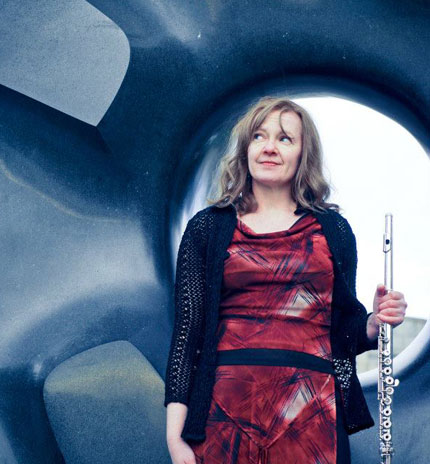
 House of Doors is a concerto for flute and orchestra which will be premiered by Merrie Siegel and the Northwest Symphony Orchestra under the baton of Anthony Spain on Saturday, April 30 at 8pm. It was composed in the last 6 months, and it’s the first piece she’s written for flute that she is not premiering, which presented some challenges. “I had to see if my notation, my ability to communicate my ideas, worked. When I premiere my own piece, I just play what was in my head in the first place and I’m not even looking at the page. But now I have to see if it works!”


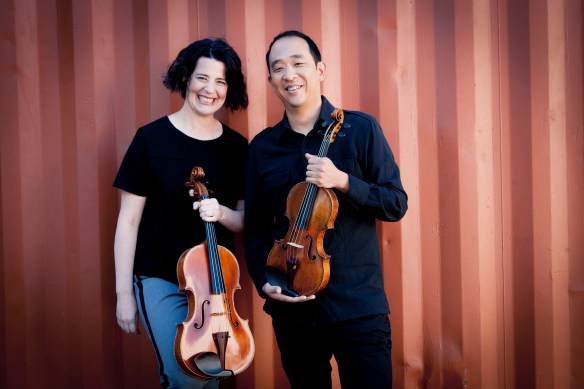

 Karin Stevens:
