by Maggie Molloy
This Saturday, the circus is coming to town—the Musicircus, that is. Come one, come all for a most unusual evening of art, dance, music, and chaos.

Created by the avant-garde and always-iconoclastic composer John Cage in 1967, the
Musicircus is more of a “happening” than a traditional classical music concert. The score invites any number of performers to perform any number of pieces (musical or otherwise) simultaneously in the same place.
And this Saturday, Seattle-based percussionist and Musicircus ringmaster Melanie Voytovich has planned a multimedia presentation of this innovative work at Town Hall.
The John Cage Musicircus will feature over 40 musicians, dancers, performance artists, and poets performing pieces written (or inspired) by Cage and his explorations into the avant-garde. Woven in among the chaos are live performances of many of Cage’s best-known works, including the Sonatas and Interludes for prepared piano, In a Landscape for (unprepared) piano, Child of Tree for amplified cactus, Third Construction for unorthodox percussion instruments, Cartridge Music for amplified small sounds, 45’ For a Speaker for spoken voice, and other works of all styles and artistic disciplines.
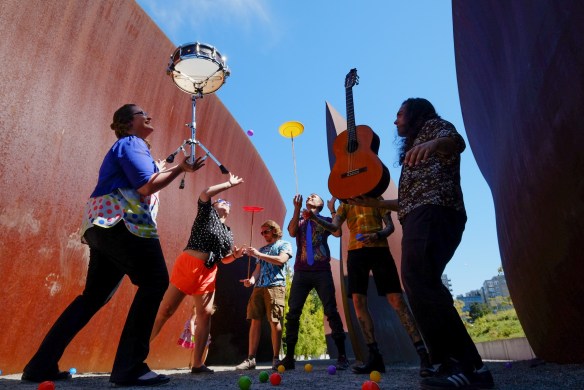
Performers will be stationed all over Town Hall, with audience members encouraged to explore how the sonic and visual experience shifts as they wander freely throughout the circus, gawking at the oddities within. Like much of Cage’s work, the event erases the boundary between performers and audience members, beckoning even the most ordinary among us to run away and join the circus.
And so without further ado, allow me to introduce you to just a few of this weekend’s circus performers:
 Name: Melanie Voytovich
Performing: John Cage’s Third Construction and Composed Improvisation for snare drum
Describe your pieces in one word:
Third Construction: Historic
Composed Improvisation: Exploration
What makes your pieces unique? Cage composed Third Construction in 1941 during his time at Cornish. Through this work (and others in his Construction series), he sought to recreate the effects of tonality and harmonic progression upon traditional aspects of musical form—but using only non-pitched percussion instruments. The result was what Cage called a “micro/macrocosmic structure”: a musical form in which the grouping of units of time was the same on the small and the large scale.
Third Construction calls for four performers and a large assortment of exotic and unorthodox instruments, including a teponaxtle (Aztec log drum), quijadas (jawbone rattle), lion’s roar (a washtub with a small hole through which a rope is noisily pulled), and an assortment of cymbals, shakers, claves, tom-toms, and tin cans. By exploring these otherwise unconventional percussive colors and timbres within a controlled musical structure, Cage creates a work that is endlessly inventive—yet surprisingly unified.
Composed Improvisation for snare drum alone is similarly oxymoronic. Composed in 1987, the piece was composed using chance procedures derived from the I Ching: an ancient Chinese classic text that is commonly used as a divination system. The “score” for Composed Improvisation is literally just two pages of instructions which build the structure to the improvisation (number and duration of sections, use of implements, preparations, etc).
 Name: Ania Ptasznik
Performing: John Cage and Lejaren Hiller’s HPSCHD, live coded
Describe your piece in one word: Transparent
What makes your piece unique? In the year when HPSCHD first debuted, computers were in their infancy.
What was extremely complicated to do then is surprisingly simple now. This performance, among other things, is a reflection on the evolution of technology and the changes that have taken place since the work was first created.
Live coding is the act of composing music with computer code. Unlike Ed Kobrin, the original computer programmer behind HPSCHD, one can now create music in real time, on the fly. As I execute functions based the patterns of I Ching hexagrams, the code will be available for everyone to see. I intend to bring the audience into the bare, yet elegant language of the computer while providing a subdued backdrop to a room of human performers. What makes this piece unique, I think, is in the dualities that take place: between head and heart, “high art” and debauchery, visibility and invisibility, and human and machine.
 Name: Kerry O’Brien
Performing: Alvin Lucier’s Silver Streetcar for the Orchestra and John Cage’s Diary: How to Improve the World (You Will Only Make Matters Worse)
Describe your pieces in one word: Shimmering
What Makes Your Pieces Unique? Alvin Lucier’s Silver Streetcar for the Orchestra (1988) is a solo for amplified triangle. Typically heard as part of an orchestra, the triangle is lucky to be struck once or twice each performance. There’s value in this: triangles can teach patience. But the triangle has other lessons to teach. In Silver Streetcar, Lucier instructs a percussionist to examine this instrument thoroughly, discovering the peculiar ways it can clang and quiver, reverberate and sing. With one hand, I’ll strike the triangle, varying the speed, intensity, and location of my striking, while with my other hand, I’ll dampen, mute, and manipulate the triangle to create further variations. As it turns out, there’s a world of complexity inside the shimmer of a triangle.
Every so often, I’ll take a break from triangle playing to read the first few installments from John Cage’s Diary: How to Improve the World (You Will Only Make Matters Worse)—a mashup of musings that may shimmer with relevance (or shimmer with contradiction) given America’s recent politics. If you listen closely, you might hear some of these musings amidst the Musicircus chaos.

Name: ilvs strauss
Performing: John Cage’s Lecture on Nothing
Describe Your Piece in One Word: Wordy
What Makes Your Piece Unique? I’ll be using Cage’s text as a starting point for discourse, both literal and physical.
 Name: Michaud Savage
Performing: John Cage’s Eight Whiskus, Aria, and 8 Mesostics Re: Merce Cunningham
Describe your pieces in one word: Someantics
What makes your pieces unique? These pieces speak to Cage’s interest in disparity and cohesion, seen realized in three inventive approaches: sketch, collage, and notation.
 Name: Tom Baker
Performing: The Cage Elegies (original work inspired by Cage)
Describe your piece in one word: Elegiac
What makes your piece unique? The Cage Elegies is a “conversation” between myself and John Cage. The piece uses Cage’s recorded voice as its main material, around which the electric guitar circles and interacts.
It is in three movements, entitled: 1) Nowhere 2) Middle 3) Questions, with improvisations as prelude, interludes, and postlude. Many aleatoric procedures were brought to bear on the composing of this work, including the spoken text and length of all sections.
 Name: Jesse Myers
Performing: John Cage’s Sonatas and Interludes (for prepared piano)
Describe your piece in one word: Ever-changing
What makes your piece unique? The piano preparation process and sounds in this music are always changing. The music is a process in itself which transports the listener through a series of moods based on Indian aesthetics called ‘rasas.’ This music is alive as the sounds, preparations, music, and process is ever-changing.
 Name: Bonnie Whiting
Performing: John Cage’s Third Construction and 51’15.657″ for a Speaking Percussionist (an original, solo-simultaneous realization of Cage’s 45′ for a Speaker and 27’10.554″ for a Percussionist)
Describe your pieces in one word: Third Construction: Joyous; 51’15.657″ for a Speaking Percussionist: Multiplicity
What makes your pieces unique? Cage’s 45′ for a Speaker and his 27’10.554″ for a Percussionist are vintage pieces: music from the mid-50’s and part of a series of timed works that he enjoyed mixing together and referred to in notes and letters as “the ten thousand things.” A culmination of 14 months of work and study, this version is the first to feature one performer executing both pieces in their entirety.
Cage subjected several of his lectures to chance procedures, and the result is his quirky and imaginative 45′ for a Speaker. Additionally, this particular version of Cage’s 27’10.554″ score is a very faithful realization, focusing on a performer-determined search for most uniquely beautiful and interesting sounds: a fusion of traditional percussion instruments as well as an array of found-objects, non-percussive sounds, and electronic sounds.
This idea of simultaneity: of layering rather than true interpolation is one of the most fascinating branches of Cage’s output. He stumbled upon it in his work with collaborative (and life) partner dancer Merce Cunningham. In some ways, this realization of these pieces is a microcosm of the (later) Musicircus idea, making it a great fit for this event.
 Name: Stacey Mastrian
Performing: John Cage’s Experiences No. 2 for voice, The Wonderful Widow of Eighteen Springs for voice and closed piano, A Chant with Claps for voice and hand claps, and selections from Song Books for voice with or without theatre and electronics
Describe your pieces in one word: Eclectic
What makes your pieces unique? The first three pieces I will perform come from the 1940s—early in Cage’s output—when the voice appears in a simple and unaltered manner but is paired in unusual ways, whereas the last grouping of pieces spans the artistic and stylistic gamut, employing speaking, singing in various modalities, other noises, and electronics.
Experiences No. 2 (1948), for solo voice to text by e. e. cummings, was originally written for a dance by Merce Cunningham. Cage writes a straightforwardly beautiful melody that is interspersed with measured silences, and the singer can choose a comfortably low key in which to perform the work. This performance will feature nine dancers from Souterre, with world premiere choreography by Eva Stone.
A Chant With Claps (194?) exists only in manuscript form, and C.F. Peters and the John Cage Trust have graciously granted me permission to perform this rarity. This very brief, unpublished work bears the dedication “For Sidney,” which likely refers to ethnomusicologist Sidney Cowell, the wife of Cage’s former teacher, Henry Cowell.
Guitarist Mark Hilliard-Wilson and I will perform a version of The Wonderful Widow of Eighteen Springs (1942), with alliterative, imagery-rich text fragments from James Joyce’s Finnegan’s Wake that describe the infant Isobel; Joyce himself said this passage was inspired by a piece of music. Cage’s piece has a rather conventionally notated melodic line, but it is composed of only three pitches, which gives it a chant-like quality.
Song Books (1970) embrace far more than singing. In this iteration I will be performing Solos for Voice No. 7 (which involves me building an object resembling a wigwam out of toothpicks and tissues), No. 43 (I utilize electronics and improvise a duet with myself), No. 53 (I vocalize in ten different styles and five languages), No. 57 (I must achieve immobility), No. 71 (I write a card with note or sketch in ink), and No. 78 (I take off my shoes and put them back on).

Name: Michael Schell
Performing: John Cage’s Cartridge Music
Describe your piece in one word: Noisy
What makes your piece unique? A milestone of live electronic music and a classic of indeterminate notation, this uncompromising work from 1960 directs the performer(s) to use ceramic phonograph cartridges with various objects other than a conventional stylus. These objects are then “played” by the performers, along with auxiliary sounds created by attaching contact microphones to various objects, the resulting mix being amplified and projected through loudspeakers.
Performers build their score independently using Cage’s graphic pages and transparencies. The result is a sound world built from typically “undesirable” sonorities (hum, white noise, mechanical shuffling), small sounds (sounds of soft amplitude that take on very different characteristics when greatly amplified), and sounds that partake of more conventional meaning (such as toys or standard musical instruments played unconventionally and amplified using contact microphones). What gives the work coherence is the common electromechanical origin of its sound sources, and the consistent, largely non-metric, rhythmic milieu enforced by its unconventional notation and performance directions.
In other words: this is a rare example of an indeterminately-notated, non-improvisational composition that has a recognizable character and always comes out sounding good.
 Name: Maggie Molloy
Performing: John Cage’s Dream and In a Landscape for solo piano, and an original zine titled Diary: How to Read John Cage
Describe your pieces in one word: Translucent
What makes your pieces unique? Dream and In a Landscape are both pretty tame by Cage standards: there are no chance operations, no graphic notations, no amplified cacti, no screws or bolts inside the piano. In fact, each of these pieces is comprised of just a handful of notes and a whole lot of sustain pedal. The melodies drift slowly and freely from one hazy note to the next, with the pedal blurring all of it into a beautifully simple and ethereal dreamscape. And although these pieces are certainly a far cry from most of Cage’s more daring compositions, they are still unmistakably Cagean: the gently meandering melodies evoke his quiet nature, his slow, thoughtful manner of speaking—his utter willingness to lose himself entirely in sound.
If Dream and In a Landscape are explorations of Cage’s character, then my next piece is an exploration of his mind. Diary: How to Read John Cage is a zine I created in response to Cage’s monstrous five-hour art piece, Diary: How to Improve the World (You Will Only Make Matters Worse). Written and recorded in the years leading up to Cage’s death, the Diary’s contents range from the trivial details of everyday life all the way to the vast expanse of history, philosophy, and global politics—and all with an idiosyncratic dose of humor and wit. Over the course of eight weeks, I read and listened through Cage’s entire Diary and created my own personal diary tracking the experience. Copies of my John Cage Diary zine will be available free of charge at the Musicircus.
The John Cage Musicircus is Saturday, Nov. 19 from 7-10 p.m. at Town Hall Seattle. Second Inversion’s Maggie Molloy will present a pre-concert lecture at 6:30 p.m. For tickets and additional information, please click here.