The Fourth of July is almost upon us, and you know what that means: parades, picnics, and barbeques abound! And while hot dogs, fireworks, and flag-covered clothing are a (somewhat) relevant expression of American independence, our county has a whole lot more than just cured meats and corny t-shirts to be proud of.
 Which is why this summer, the Seattle Symphony is turning off the barbeque and turning up the music with Tuning Up!: a two-week festival celebrating American musical creativity in the 20th and 21st century. This star-spangled celebration features nine concerts which traverse America’s vast musical landscape, from jazz to Broadway, avant-garde to minimalism, classics to Hollywood, and much more.
So whether you crave the jazzy grooves of George Gershwin or the swinging blues of Duke Ellington, you can hear it all during the Tuning Up! Festival. Maybe you prefer the massive soundscapes of John Luther Adams, the hypnotic minimalism of Philip Glass, or the movie magic of John Williams—the festival has all that too!
Suffice it to say, Second Inversion is all over this festival. Come visit us at the KING FM table in the lobby at the following events for music, magnets, and other free swag!
Stage & Screen: From Appalachian Spring to the Red Violin
Thursday, June 23 at 7:30 p.m.
From stage to screen to concert hall, these giants of American music transcended borders and paved the way for generations to come. Among them is Florence Beatrice Price: the first African-American woman to be recognized as a symphonic composer. The Seattle Symphony pays tribute with a rousing orchestral rendition of her ragtime classic, Dances in the Canebrakes. Plus, dancers take to the stage alongside the Symphony for a performance of Aaron Copland’s famous folk-inspired and Pulitzer Prize-winning Appalachian Spring.
The program also features Leonard Bernstein’s elegant Divertimento for Orchestra, poignant movie music from Schindler’s List and The Red Violin, and a heartwarming tribute to the late Marvin Hamlisch who, among his many accomplishments in music, served as the Principal Pops Conductor at the Seattle Symphony from 2008 until his death in 2012.
The Light that Fills the World: A Meditation in Sound & Light
Thursday, June 30 at 7:30 p.m.
In the face of trauma and political turmoil around the world, Seattle Symphony offers an intimate meditation in sound and silence, light and dark. Julia Wolfe’s My Beautiful Scream, written after the events of 9/11, opens the program with a slow-building and softly illuminating agony. What follows is utter silence: John Cage’s famous 4’33”.
The program also features Pulitzer Prize-winner John Luther Adams’ immersive, Arctic-inspired soundscape The Light That Fills the World, the delicate breath of Morton Feldman’s Piano and Orchestra, and Philip Glass’ scientific salute, The Light.
Plus, the Symphony invites you to submit your own Glass-inspired photographs to be featured during the performance. Deadline for submissions is this Friday, June 24.
In the White Silence: John Luther Adams’ Alaskan Landscapes
Friday, July 1 at 10 p.m.
To say that composer and environmentalist John Luther Adams is inspired by nature would be a bit of an understatement. He spent much of his life composing from a 16×20 ft. one-room cabin in the Alaskan woods, creating large-scale soundscapes which blur the line between nature and man-made instruments.
In 2013, the Seattle Symphony commissioned and premiered John Luther Adams’ Become Ocean, a 42-minute meditation for large orchestra which went on to win a Pulitzer Prize and a Grammy Award.
And now, during this special late-night concert, the Symphony revisits one of Adams’ earlier explorations into sonic geography: the 75-minute soundscape In the White Silence. The piece unfolds slowly and patiently, translating the vast horizons of the frozen far north into a musical landscape of clean, radiant harmony and subtle transformation.
Looking for more in American music? Check out the Seattle Symphony’s Tuning Up! Festival Map below:


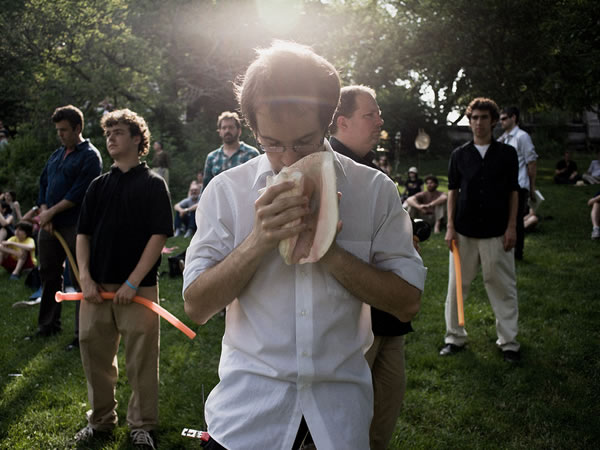
 Inuksuit is a 79-minute masterpiece written for 9 to 99 percussionists composed by John Luther Adams. The title refers to a type of stone landmark used by native peoples of the Arctic region; listeners discover their individual listening points as they, too, move freely during the performance. This work is designed to heighten our awareness of the sights and sounds that surround us every day, and deeply influenced by the composer’s belief that “music can contribute to the awakening of our ecological understanding. By deepening our awareness of our connections to the earth, music can provide a sounding model for the renewal of human consciousness and culture.” Adams has notated in Inuksuit that the piece should only be performed outdoors. The piece uses a mix of standard and less common instruments, including glockenspiel, toms, cymbals, conch shells, whirly tubes, vuvuzelas, and sirens.
 My biggest inspiration for producing this piece was my experience at the Chosen Vale Percussion Seminar in the summer of 2014. Doug Perkins and Amy Garaphic are the organizers of this seminar, and also very involved with JLA and have produced a number of performances of Inuksuit. That summer, Adams was invited to be a composer-in-residence for the program and we had the privilege of playing through the percussion parts of his piece Sila: The Breath of the World before the premier performance at Lincoln Center. Sila is written for large ensemble and voices, so we only represented a fraction of the final product, and the experience was really moving for us all. I was able to learn about his experiences and inspirations first hand, and developed a deep interest in learning more and performing this major work for percussion.