
Second Inversion hosts share a favorite selection from their weekly playlist. Tune in on Friday, June 16 to hear these pieces and plenty of other new and unusual music from all corners of the classical genre!
Daníel Bjarnason: “all sounds to silence come” (Bedroom Community)
 There is so much good music coming out of Iceland that sometimes it’s a challenge just to keep up with all of it. Icelandic composer and conductor Daníel Bjarnason is a staple on my personal playlist—his gorgeously textured, celestial soundscapes blur the line between classical and electronic musical idioms, drawing freely from the intellectual rigor of the classical tradition while living in the spontaneity and experimentalism of new music.
Scored for chamber orchestra and conducted by Bjarnason, “all sounds to silence come” is a two-movement bonus track released on his debut album Processions. The piece makes use of the orchestra’s entire timbral palette, drifting from a dramatic and densely textured first movement to a soft and ethereal second that hovers just above silence. The result is an immersive sound world that shimmers with color and sparkles with orchestral detail. – Maggie Molloy
Tune in to Second Inversion in the 2pm hour today to hear this piece.
Alyssa Morris: Four Personalities for Oboe and Piano (MSR Classics)
Michele Fiala, oboe; William Averill, piano

Have you ever wondered what the four personalities of Hartman’s Personality Profile would sound like as duets for oboe and piano?
Before reading this most people probably hadn’t wondered, but now it’s an intriguing proposition! American composer Alyssa Morris brings us Four Personalities for Oboe and Piano. She based the four-movement work on the four general categories associated with the Hartman test, which aims to assess the underlying elements that motivate individuals, then assigns them a color: Yellow is motivated by fun, White by peace, Blue by intimacy, and Red by power.
Each movement is entertaining, energetic, and expertly executed by oboist Michele Fiala and pianist William Averill. They capture not just the basic comic book hue of each color, but rather the full kaleidoscopic palette within each personality and clearly have a great time doing it. – Brendan Howe
Tune in to Second Inversion in the 3pm hour today to hear this piece.
Ben Lukas Boysen: Golden Times 2 (Erased Tapes Records)
 It occurs to me that this track could be heard as mournful or melancholy, but I have an alternative interpretation. Despite the Donnie Darko aesthetic, Golden Times 2 seems to be a relaxed and optimistic meditation. I especially love the extra-low bass that creeps around for most of the track and the swingy cymbal groove that completely transforms the vibe upon entry. Grab a cold beverage and a seat in the sunshine and enjoy!
– Seth Tompkins
Tune in to Second Inversion in the 7pm hour today to hear this piece.
Robert Beaser: Pag-Rag (Albany Records)
Christopher Janwong McKiggan, piano
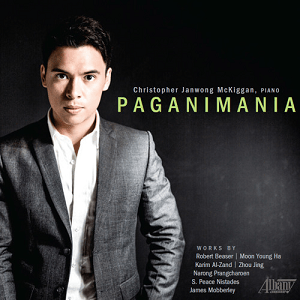 Pianist Christopher Janwong McKiggan was the 2009 collegiate gold medalist from the Seattle International Piano Competition. As he moves forward in his career, he is charting a path of new music, commissioning seven composers in 2012 to compose works for piano inspired by Niccolò Paganini’s 24th Caprice. Beaser’s Pag-Rag is both undeniably fun and a deliciously mean technical challenge for the pianist. A far cry from most listeners’ straightforward idea of a rag, this piece is full of lightning-fast changes of character and texture, giving it unexpected depth and variety. It’s a wonderful showcase of McKiggan’s playing. – Geoffrey Larson
Tune in to Second Inversion in the 9pm hour today to hear this piece.
 A survey of national anthems from nations all over the world confronted composer David Lang with a startling reality: the texts of these songs are generally quite violent. It seems that in the course of expressing national pride through song, we tend to reflect on the bloody struggle of war that gave us the freedoms we now enjoy.
 Celebrated Japanese composer Toru Takemitsu breathes a meditative second life into the tale of Moby Dick with his three-section work, Toward the Sea. In the final section, entitled “Cape Cod,” Michael Partington’s guitar gently chops and forms the New England seascape while Paul Taub’s airy alto flute responds as Captain Ahab’s ship, the Pequod.
 If you thought the theremin was only for corny sci-fi film soundtracks and intergalactic sound effects, think again. Carolina Eyck, one of the world’s foremost theremin virtuosi, has spent the past decade exploring and expanding the musical possibilities of this eerie electronic instrument.
 Turns out you can replace a synthesizer and a clavinet with a few reed instruments and you still have a song that’s funky as hell. Threeds Oboe Trio’s cover of Stevie Wonder’s classic “Superstition” shows off impressive technical ability and a rebellious sense of humor. “Superstition” has a driving bassline provided by clarinet and, since it swings just as hard as the original, it will have you smiling and grooving and bebopping before the oboes even kick in. –
 In recent years there’s been a notable resurgence of Baroque forms and instruments in contemporary classical music—but nowhere so convincingly as in Shara Nova’s Baroque chamber pop opera
 Here in Seattle, it FINALLY feels like spring has arrived… after a record-breaking-ly soggy winter (look it up). Still, I’ve been feeling some hesitation to go outside and reconnect with the glowing orb in the sky. If you, like me, could use a kick in the pants to “get out there,” this track could just do the trick. The lithe Appalachian flavors here are mixed with some decidedly more square music by English Renaissance composer William Byrd. Perfect!
 Boy, this is a crunchy piece. Wolfe uses dissonance throughout this ostinato-filled string quartet to propel the energy along, creating an unfolding sense of conflict. It makes sense: she composed the work while reading a book on American political history, where seemingly small incidents (often introduced in the book with the phrase “early that summer”) would snowball into major political crises. This piece was composed in 1992, but it still represents some music that instead of shying away from the dissonance of our current political climate, dives fully in and revels in it. –
  Valgeir Sigurðsson’s “Architecture of Loss: The Crumbling” is five minutes of bold, emotive, string-heavy resonance sweetened with silvery piano and sharpened by nearly subliminal scratches and creaks. The music is drawn from the concept of “formation and disintegration,” so the sparse notes and lingering strings serve the theme well. It’s a piece evocative of splintering glaciers: beautiful yet uneasy.
 Unlike some stuff we play on Second Inversion, Danny Clay’s “Two and Six” is an example of music best experienced in headphones. The interplay of harmonics between the two guitars is more engrossing and intimate in stereo, especially if the audio is piped straight to your brain. So, I advise you to put your cans on and chill out to this introspective conversation between twin electric guitars. Whether you need to focus or relax, this track is an excellent choice. –
  He’s one of the world’s foremost boundary-bursting minimalists; she’s a Grammy-winning pianist known for championing new music—it’s a match made in musical heaven. The world premiere recording of Terry Riley’s “Venus in ’94” sparkles under Gloria Cheng’s free-spirited fingers, which gracefully soar up, down, and around an utter obstacle course of intricate voicings and rhythms.