Staff & Community Picks: August 21

A weekly rundown of the music our staff and listeners are loving lately! Are you interested in contributing some thoughts on your favorite new music albums? Drop us a line!


Joshua Roman on Christopher Cerrone’s “The Night Mare”:

fcr162_cover.500x0“The Night Mare” by Christopher Cerrone is a piece which I had the immense pleasure of conducting on my first performance as a conductor with the Music Academy of the West in Santa Barbara, California.  This piece is for seven players and electronics and it’s a very good use of electronics, sort of creating this background against which the players punctuate with various sounds.  The piece itself is not so much about a nightmare, I think as about the process of piecing together the nightmare that you’ve just had.  You’re trying to figure out what you’ve heard – is it the sound of a train, is it the sound of a flute?  All of these things are all very hazy, it’s all about the blurred lines.  There may be a moment where everything comes together and starts to make sense, you know, as when you wake up and you start to piece together that this was in fact a dream, not reality… but that doesn’t hold for very long.  It’s a wonderful piece, very evocative, very scary, and I’m excited to share it with you.


Rachele Hales on Little King’s My Friend:

a2250470888_16

Indie Chamber Pop group Little King offers up thirteen charming compositions in My Friend.  The pieces are fairly short and all are so lovely and goofy that, when accompanied by Thomas Cruz’s beautiful lilting deadpan lyrics, it’s easy to imagine they could each be used as the score for a series of adorable animated short films.  The lolling woodwinds support the wackiness of the album while also lending earnestness and warmth.


Stephen Vandivere* on Charles Wuorinen’s Six Trios:

51G9K8FeRBLThe Trios by Charles Wuorinen were all composed in the early ’80s, and most of which include at least one brass instrument. My son, who played the trombone in high school and college, and took it up again a few years ago, heard this CD and had only one comment: “wow!”. This is more approachable, though still gnarly, than much of his earlier work I’ve heard. I have the intuition that more listening will eventually allow me to grasp the structure of the compositions. For now, I listen for fall and effect.

*Stephen Vandivere is a Second Inversion listener. We’d love to hear from you, too!

ALBUM REVIEW: ORBIT: Music for Solo Cello (1945-2014)

by Maggie Molloy

gNlB9Yz9-1500-1000

What do Jimi Hendrix guitar solos, György Ligeti sonatas, Shakespeare sonnets, and Spanish sarabandes all have in common? Each of them appears in one form or another on cellist Matt Haimovitz’s latest release, “Orbit: Music for Solo Cello (1945-2014).”

Sprawling in scope, “Orbit” is a three-disc compilation of music for solo cello featuring works by over 20 contemporary composers, 15 of whom are still living. The ambitious solo album is also one of the first releases on the new Pentatone Oxingale Series. This innovative new project is a collaboration between the Dutch classical music label PENTATONE and Haimovitz’s own  trailblazing artists’ label Oxingale Records, which he created in 2000 with his partner in life and music, composer Luna Pearl Woolf.

Clocking in at a hefty 3 hours and 45 minutes, the album features solo works that Haimovitz initially released on Oxingale as five thematic albums: “Anthem” (2003), “Goulash!” (2005), “After Reading Shakespeare” (2007), “Figment” (2009), and “Matteo” (2011). The album also includes two newly-recorded works: Philip Glass’s “Orbit” and a new arrangement by Woolf of the Beatles’ “Helter Skelter.”

Over the course of three discs, Haimovitz takes the listener on a musical odyssey through time and space, from minimalism to maximalism, tonal to atonal, folk to avant-garde, abstract to narrative, and everything in between.

The album begins with the title track, Philip Glass’s “Orbit.” Warm and achingly tender melodies evolve softly over the course of this seven-minute solo work, and Haimovitz crafts each note gorgeously.

He tackles a very different style of contemporary classical in his performance of Luciano Berio’s “Sequenza XIV,” a virtuosic piece with mesmerizing rhythms inspired by Sri Lankan drumming. Haimovitz bows, plucks, taps, twangs, slides, scrapes, and soars through a number of extended techniques before settling into silence.

Another memorable moment on the album is György Ligeti’s Sonata for Violoncello Solo, a piece Haimovitz worked directly with Ligeti himself to learn. The piece’s modal melodies and Hungarian profile make clear the influence of Bartók and Kodály, and Haimovitz brings out the complex polyphonic counterpoint beautifully. It is followed by a performance of Du Yun’s “San,” a piece which weaves musical fragments of Eastern mysticism and meditation into a mesmerizing yet haunting sound world.

Haimovitz also takes a crack at some contemporary popular music: the album includes his own cello arrangement of Jimi Hendrix’s famous “Star-Spangled Banner” performance at Woodstock. He snarls, growls, and wails through the Hendrix classic so convincingly that you’d almost expect him to have a whammy bar hidden somewhere on his cello. Haimovitz also takes on the Beatles’ loud, wild, and raunchy proto-metal anthem, “Helter Skelter.”

Over the course of disc two Haimovitz glides through the dramatic and dense melodies of Elliott Carter’s “Figment” (Nos. 1 and 2), the ethereal whispers of Salvatore Sciarrino’s “Ai Limiti Della Notte,” and the gorgeous cantabile lyricism of Luigi Dallapiccola’s “Ciaccona, Intermezzo e Adagio.”

But the most sentimental piece on the album is Woolf’s “Sarabande.” Derived from the Baroque Spanish dance form, the piece is also named after Haimovitz and Woolf’s child, who was lost mid-term in utero. The poignant and pensive work is both delicate and passionate, and Haimovitz brings it to life with remarkable timbral detail.

The third disc features three suites inspired by literature. The first is Ned Rorem’s “After Reading Shakespeare,” a suite in which each movement is based on a quotation from a Shakespearean play or sonnet—and the nine movements explores the romance, beauty, and balance of Shakespeare’s poetry without using a single word.

Inspired by Rorem’s work, Haimovitz commissioned two new suites based in literature by Pulitzer Prize-winning composers Paul Moravec and Lewis Spratlan. Moravec’s “Mark Twain Sez” takes the witty words of Mark Twain as the basis for an eight-movement exploration into the human condition, exploring themes of dreams, love, humor, insanity, mystery, and more.

The album comes to a close with Spratlan’s four-movement “Shadow,” a surreal musical reflection which takes the symbolist poetry of Rimbaud to a whole new world.

Because in the end, the musical possibilities for solo cello are about as numerous as the stars in the sky—and Haimovitz puts them all into “Orbit.”

Matt Haimovitz and Christopher O’Riley, from our field trip to the Tractor Tavern in Seattle on February 2, 2015

Staff & Community Picks: August 13

A weekly rundown of the music our staff and listeners are loving lately! Are you interested in contributing some thoughts on your favorite new music albums? Drop us a line!


Joshua Roman on Golijov’s Ayre:

71kEKXXvAAL._SX522_This is an amazing piece that I first stumbled upon several years ago and basically put on repeat.  It’s a unique set-up where you have things like a hyper-accordion, which is an invention by the player himself, Michael Ward-Bergeman.  He basically takes two inputs and puts them on either side of the accordion and creates this stereo effect with a machine that mixes them together to create the “hyper effect.” It’s kind of like an accordion on steroids and produces a lot of intense sounds. Golijov uses this to great effect to take you through different modes of musical communication.  It’s not stuck in style; it really goes all over the place, but all fits together very well and flows very naturally.  There are moments that are very touching and movements where you’ll think, “What the hell is going on?” but in a really great way.  It’s extremely exciting! Dawn Upshaw gives an incredible performance and allows herself to go to places that are just primal in nature.


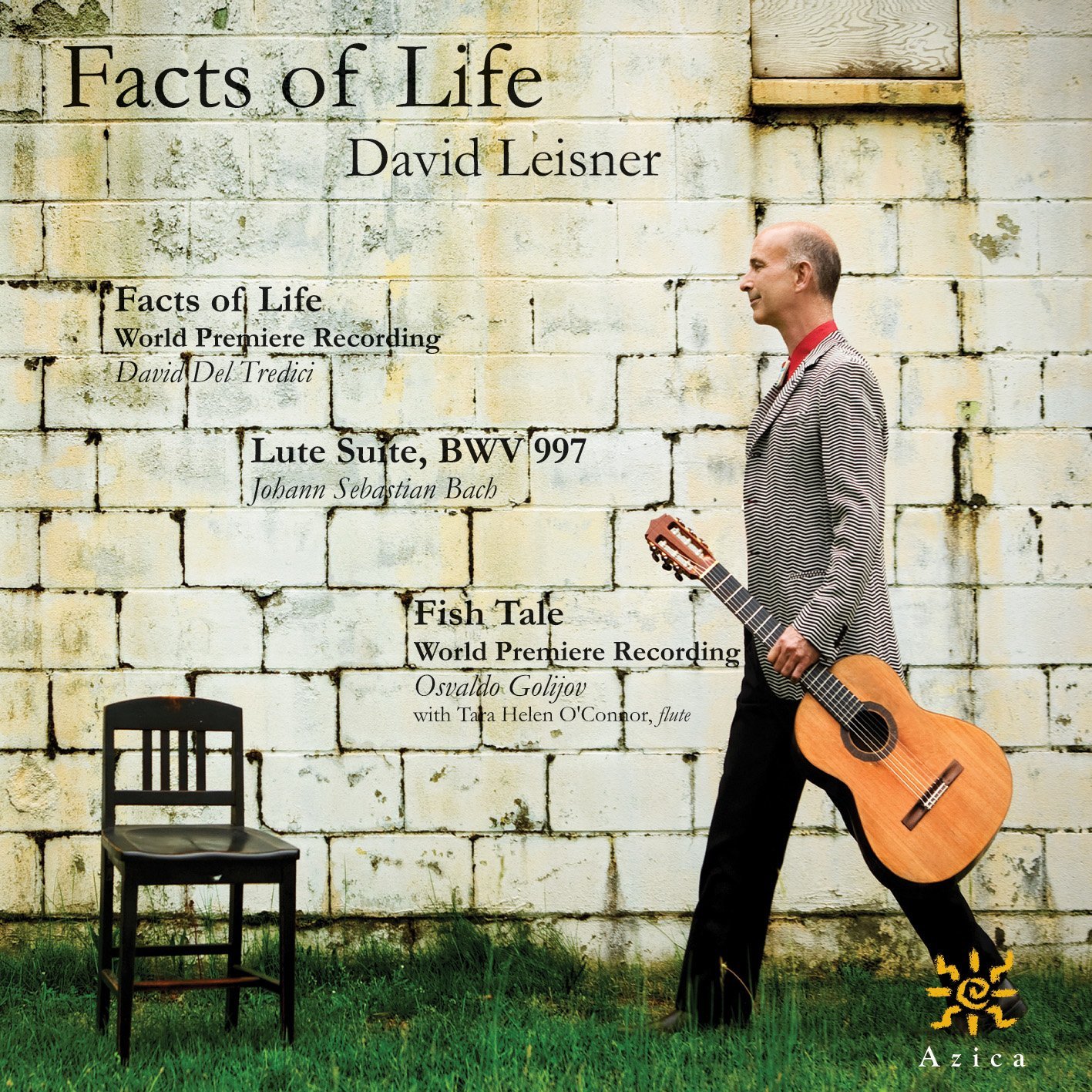
Jill Kimball on David Leisner’s Facts of Life

911XPzhwHeL._SL1417_Addiction. Heartbreak.  Disappointment. We’d like to brush all these things under a rug, but sometimes they’re the facts of life. Composer David del Tredici chose to place his negative life experiences at the forefront of his four-movement solo guitar work, “Facts of Life.” It’s just one of three pieces on an album featuring the virtuosic guitarist David Leisner. The piece transitions effortlessly from tango to fugue to some fantastically frenetic strumming. Another beautifully chaotic piece on the album is Osvaldo Golijov’s “Fish Tale,” a chamber piece about a sea creature who takes a trippy, Alice in Wonderland-like journey through the water. 


Geoffrey Larson on Ravi Shankar’s Symphony

854990001604This piece is something totally different: an orchestral work that is part symphony, part sitar concerto. Both a sitar master and long-time classical composer and collaborator, the late Ravi Shankar fashioned a four-movement work that brings Hindustani music to the Western orchestral ensemble. Pounding raga-like rhythms and dance figures can be found throughout, augmented by actual vocalizations by the LPO players in the final movement. The composer’s daughter, sitar virtuoso Anoushka Shankar shines in this live performance recording. Common practice period not spicy enough? These unique symphonic flavors might do the trick.

LIVE CONCERT SPOTLIGHT: Parnassus Project

Parnassus Project presents Ruminations on Friday, August 14 at 8pm at the Chapel Performance Space at the Good Shepherd Center in Wallingford.

11825631_872215252833818_1441493333469575647_n

Georgia O’Keeffe. Cow’s Skull: Red, White, and Blue, 1931

Parnassus Project has swept the Seattle area up in open arms since the summer of 2011, presenting concerts in restaurants (The Pink Door), art galleries (Design Commission), public parks (Tuesday lunch concerts at Westlake and Occidental parks), coffee shops (Roy Street Coffee & Tea, Zoka, Tully’s), libraries (Seattle Downtown branch), and… the list just keeps going! We admire Parnassus Project’s philosophy of bringing music to the people in intimate settings that encourage conversation and community, often in the presence of excellent food and beverage.


They’re also dedicated to presenting new works by up and coming composers and featuring local musicians, two additional things that instantly caught our attention! This Friday, August 14 at 8pm, Parnassus makes their second annual summer appearance on the Wayward Music Series at the Good Shepherd Center in Wallingford. This program, Ruminations, explores American music past and present through works of George Crumb, John Adams, and a world premiere by local composer Cole Bratcher.

Second Inversion is proud to be the media sponsor of this concert – we’ll be recording the concert for our 24/7 stream and online concert archives. Don’t miss the action live and in person – RSVP to their Facebook event! We’ll see you there!

Full program and performer line-up:

CRUMB//Eine Kleine Mitternachtmusik (A Little Midnight Music), 2001
ADAMS//Road Movies, 1995
BRATCHER//Jonah the Sinnerman, 2015 [World Premiere]
GOLIJOV//Tenebrae, 2002

Luke Fitzpatrick, Sol Im, violins//Rick Neff, viola//Haeyoon Shin, cello//Brooks Tran, piano


ALBUM REVIEW: Seattle Symphony “Dutilleux”

by Maggie Molloy

855404005072_SSM1007_Dutilleux_iTunesThe Seattle Symphony is no stranger to contemporary classical—earlier this year they earned a Grammy Award for their breathtaking recording of John Luther Adams’ innovative masterpiece “Become Ocean.” Over the years they have garnered international acclaim for their innovative programming, commissioning of new works, and extensive recording history—and they’re certainly not slowing down anytime soon.

The Seattle Symphony’s latest contemporary classical endeavor is a three-disc, multi-year recording project of all the orchestral works by the late French composer Henri Dutilleux. This August, they are releasing Volume 2 of “Dutilleux,” featuring a studio recording of the violin concerto “L’arbre des songes” (“The Tree of Dreams”) with violinist Augustin Hadelich and gorgeous live performances of “Métaboles” and Symphony No. 2 (“Le double”).

Under the directorship of French conductor Ludovic Morlot, the Symphony brings passionate virtuosity and drama to Dutilleux’s vividly colorful orchestration. In fact, Dutilleux’s refined ear for aural color and texture has led many to characterize him as the principal heir of Debussy and Ravel in the line of influential French composers. His music extends the legacy of these earlier composers while also adding a little more bite; his music’s rhythmic verve, dramatic urgency, and unapologetically frequent use of dissonance show clear ties to Bartók and Stravinsky.

But like the Impressionists, Dutilleux was also very inspired nature. His five-movement “Métaboles,” written in 1964, takes its title from the Greek metabolos, meaning “changeable.” Dutilleux cited the primary inspiration for the piece being the constant flux and ceaseless flow of nature—the ongoing transformations and metamorphoses of organic life.

The piece unfolds in five connected movements which musically imitate these evolutions. Each of the first four movements features a different family of instruments—woodwinds, strings, brass, and percussion—allowing the Symphony to fully showcase its incredible breadth of musical talent. From the straining sonorities of the first movement to the sweet lyricism of the second, from the jazzy brass of the third to the pointillist palpitations of the fourth, the Symphony passes through each transformation seamlessly. The wildly chaotic fifth movement brings the entire orchestra back together in a bold and thunderous finale.

Next on the album is Dutilleux’s 1985 violin concerto “L’arbre des songes” (“The Tree of Dreams”) featuring violinist Augustin Hadelich. Dutilleux strays from the typical three-movement concerto form, instead opting for four movements connected by three interludes. Hadelich flies furiously up and down the fingerboard through each of the four distinct movements, showcasing his stunning technique and beautiful tone.

The first movement is rich with gorgeous, long-breathed melodies that shoot straight up into the stratosphere. The second movement skitters and jitters across restless rhythms before transitioning to the wistful and rhapsodic dream that is the third movement. The piece ends with a wildly theatrical fourth movement that showcases Dutilleux’s brilliant orchestration and bold style. Each of the wide-ranging movements are connected by strikingly imaginative interludes—listen for the third, in which Dutilleux actually composed an episode that is meant to sound as if the orchestra is tuning and warming up!

“All in all,” Dutilleux wrote in a preface to his score, “the piece grows somewhat like a tree, for the constant multiplication and renewal of its branches is the lyrical essence of the tree.”

Evolution is a key theme of Dutilleux’s “Le double” symphony as well. He strayed from the standard symphonic procedure of juxtaposing musical themes, instead creating his symphony from the variation and transformation of short musical ideas. He also made innovative use of the orchestral timbres: within the full ensemble he created a smaller group of 12 instruments—oboe, clarinet, bassoon, trumpet, trombone, timpani, harpsichord, celesta, two violins, viola, and cello—creating in a sense two orchestras, hence the title “Le double.”

Written in 1959, the piece is reminiscent of a modern-day concerto grosso, but unlike the traditionally Baroque form, in “Le double” the smaller ensemble acts as a mirror or ghost of the larger one, creating a fascinatingly complex and richly textured musical panorama.

“I endeavored to avoid the stumbling block of the somewhat archaic form,” Dutilleux said. “The 12 musicians of the smaller orchestra considered separately do not constantly play the role of soloists; it is the mass they form that constitutes the solo element. This mass does not merely confront and dialogue with the larger formation, but at times fuses with, or superimposes itself upon the latter, leaving ample opportunity for polyrhyhthmics and polytonality.”

The Seattle Symphony dances with precision and grace through the dense textures and intertwined solos of the first movement, the delicately colored timbres and haunting lyricism of the second, and finally the convulsive rhythms and fascinating orchestration of the third. The piece ends with a deeply contrasting passage of slowly changing sonorities which spread up and down the orchestra’s pitch range before settling into a serene silence.

And after the full album’s 75 minutes of mesmerizing harmonies, remarkably complex rhythms, and brilliantly colored orchestral textures, that silence sounds beautifully crafted.