ALBUM REVIEW: A O R T A from Vicky Chow

by Seth Tompkins

Pianist Vicky Chow’s recent release A O R T A is above all else a triumph of curation. Chow’s performance, the editing, and the mixing are all laudable as well, but the real story of this album is the strength of the playlist and its presentation. A O R T A is a rare instance of an album in which the delivery of the audio itself contributes to the artistic goals of the project in a meaningful way.

sdut-bang-on-a-can-vicky-chow-2015oct21

Even before the music begins, curatorial strength shapes the album. A O R T A is packaged with only minimal notes and there is no explanation of the project’s genesis nor discussion of the artists involved or their biographies. While this may initially appear to be a simple stylistic choice in favor of minimalist packaging, after listening it is apparent that this lack of detail is, in actual fact, a bold statement about how well the music on this release hangs together. The lack of notes seen on A O R T A would diminish other albums, but in this instance, the dearth of information makes this release stronger. It is a symbol of how well-designed the album is as a whole, letting the music and its curation stand on their own.

However, if you are curious, a more detailed explanation of the release is available here.


Musically, the supreme design of A O R T A takes the shape of remarkable continuity between the first three tracks. These tracks, which encompass Christopher Cerrone’s Hoyt-Schermerhorn, Jacob Coopers Clifton Gates, and the first movement of Jakub Ciupinski’s Morning Tale, all for piano and electronics, flow seamlessly from each into the next. That is not to say that these pieces are continuous or homogenous; upon closer listening these tracks each yield interesting features deserving of investigation and fascination.

These first three pieces make up the programmatic section of the release. All three, while they do have their own individual characters, are touching meditations on real-world human experiences ranging from the concrete to the notional.

The smoothness with which the initial three tracks flow from one to the next is a perfect aperitif for the rest of A O R T A. Only when the second movement of Morning Tale arrives does this CD begin to deliver sequential sounds juxtaposed in a manner that obviously marks the beginning of a new track. This slight shift marks a turning point in this release; this is the point after which more surprising and disparate sounds can be expected.


Those disparate sounds take the shape of Molly Joyce’s Rave, and Daniel Wohl’s Limbs and Bones, all three of which explore different facets of the interaction of live piano with electronic sound. While these heady tracks are distinctly different from the first three pieces, they somehow fit together into the larger arc of this album. This continuity of artistic trajectory is further evidence of expert curation. These pieces, in this order, tell a story that is in and of itself a work of art.

Finally, A O R T A ends with Vick(i/y), by Andy Akiho. While the preceding six pieces lean toward the atmospheric, Vick(i/y) has a completely different character that trends toward immediacy. This piece was written for Vicky Chow (as well as for Vicki Ray – hence the title) and is the only piece on this release that is NOT for piano and electronics. Vick(i/y) is for prepared piano. Additionally, while the preceding pieces on A O R T A tend to individually remain within one or two sound areas, Vick(i/y) is a veritable symphony within a prepared piano. The extended range of sounds, combined with Chow’s presumed heightened intimacy with this music (which was written with her in mind), result in a piece that acts an exclamation mark. Vick(i/y) is Chow’s indelible signature at the end of an already markedly individualistic album.

avatars-000124977062-ffqmyg-t500x500

Even though A O R T A cycles through an expansive of range sounds and expressive modes, this disc never loses sight of the instrument at its center. Every bit of this music is completely focused on the piano, with all sounds either produced by or strongly referring to the instrument. Also always in sight here are the composers who inspired much of this music. Pieces on this album explicitly reference John Adams and John Cage while slightly more covertly recalling the music of Steve Reich, Erik Satie, and Thom Yorke.

A O R T A is packed with smart, fully-conscious music that is quite aware of the giants upon whose shoulders it stands. This awareness of the past, combined with bold steps toward the future and omnipresent consummate curation, results in a well-balanced and highly interesting release that is at once calming, stimulating, and invigorating.

a2214619028_16

Women in (New) Music: Two Women and an Opera House

by Elisabeth Blair, with introduction by Maggie Molloy

It’s been a few years since the Metropolitan Opera featured a work by a female composer—113 years, to be exact.

saariaho

That century-long drought ends this month with Finnish composer Kaija Saariaho’s L’Amour de Loin, running now through Dec. 29 at the Metropolitan Opera House in New York City. Dazzling melodies, lush orchestration, shimmering electronics, modern LED set designs, and a heartrending French libretto by Amin Maalouf come together to tell a stylized tale of the 12th century troubadour Jaufré Rudel.

But we can’t all be in New York City to see it—so Classical KING FM 98.1 is bringing you the next best thing: a live broadcast of the matinee performance this Saturday, Dec. 10 at 10 a.m. PST.

love-from-afar

L’Amour de Loin (French for “love from afar”) first premiered at the Salzburg Festival in Austria in 2000, and quickly went on to become one of the most acclaimed operatic works of the 21st century. Scored for just three soloists, chorus, and orchestra, the opera offers an intimate look at the enduring power and purity of true love.

“In the midst of composing it, I understood that it was also my story,” Saariaho said in an interview with the New York Times. “I was at once the troubadour and the lady, these two parts of me that I try to reconcile in my life. To write music, concentration is necessary; an interior hearing. To be a woman, to be a mother, one needs to be always available and busy. It’s difficult to have, at the same time, your feet on the ground and your head in the sky.”

It’s difficult for anyone—but especially for women, who have been systemically and institutionally excluded from composition and other leadership roles throughout history. Saariaho’s Metropolitan Opera premiere is a triumph for women everywhere who are fighting to have their music heard—a triumph made possible by the bold footprints of the women who came before us.

The first and only other woman to break the ranks forcefully enough to see her work performed at the Met was English composer and suffragist Ethel Smyth, with her 1903 opera Der Wald: a richly orchestrated folktale of two young lovers and the witch who comes between them.

And so, with the Met’s century-long spell of male composers finally broken, we wanted to take you back in time 100 years and give you a closer look at just what it took for Smyth to become history’s first female composer on the Metropolitan Opera stage.

ethel-smyth-with-hat

Ethel Smyth’s adulthood began with a well-orchestrated protest.  When she was 19, her father forbade her to go to Leipzig to study music composition. She responded by refusing church, musical participation at dinner parties, riding, and speaking. Eventually her father, having become so frustrated with her that he kicked her bedroom door until the panel was “all but penetrated,” relented—and gave up disallowing her much of anything ever again.

She continually found creative solutions to the restrictions placed upon women at the time. In 1878, still 19 and now victoriously arrived in Leipzig, she dressed up as an elderly lady in order to attend an evening concert unescorted. The costume included drawn-on wrinkles and a rented wig, and the ruse was a success. She was plainly unafraid of public humiliation—a valuable quality in a woman whose life’s calling forced her to overstep social mores each day.

ethel-smyth-with-dogs-2

A devout dog-lover, Smyth had a total of five dogs in close succession. Eight years before her death she devoted an entire book, Inordinate (?) Affection, to recollections of her animal companions that sometimes offer an unlikely and intimate view of the elite music world at the time.

In her memoirs she tells of a time that she spiritedly took up a dare and wore a French coachman’s hat while riding her bike down Piccadilly, leading her dog as she went. This may seem unremarkable now, but in the first decade of the 20th century, such a gender-bending public display was bold.

In a musical context she was also unafraid. In 1911 she put on a concert of her opera The Wreckers herself, stepping outside the main concert venues and securing a conductor, Thomas Beecham—who promptly forgot about this engagement. When it came time for the performance, he was nowhere to be found—so Smyth simply conducted the performance herself.

Combined with luck, money, and a high social status, these qualities—a refusal to engage with the male-determined status quo in the manner expected, boundlessly creative problem-solving, and bold ambition—helped her break through the ceiling of the classical music world.

But it was no easy task.

ethelSmyth’s memoirs recall a merry-go-round of failure, rejection, dashed hopes, extraordinary social maneuverings, disappointments, delays, cancellations, futile energies spent, promises broken, twists of fate, and every other kind of impediment, particularly in her fight to have her operas staged.

As she notes in one of her memoirs, What Happened Next, so many sudden, untimely deaths, dismissals and retirements occurred during or leading up to performances that she wondered whether her operas were cursed. Long-awaited contracts about to be signed would halt when the person responsible would be “swept off the scene by sudden illness.”

A producer in Germany, one Georg Pierson, had been working on the rehearsal sheets for a hoped-for premiere of Der Wald when he fell ill and soon thereafter died. (She wrote blithely but resignedly to her long-time companion Henry Brewster, “You will not be surprised to hear that I have killed Pierson.”)

derwaldpremiere

These events were generally disastrous for her plans, forcing her to start over, leverage new social capital, and follow what leads she could. She underwent trial after trial in this way, and her American adventure was no exception. Soon after she arrived for her five-week stay in New York City, Maurice Grau—the director of policy of the Metropolitan Opera House and the man who had booked Der Wald after its success at Covent Garden—died, after a brief illness.

By Smyth’s account, Grau’s successor was whiny, manipulative, and oppositional. In New York she also suffered from tonsillitis, a fever, and finally laryngitis, and she was only able to attend the final choral rehearsal. Although she granted that the press reviews were favorable overall, of the Met performance itself she remarked only, “I do not remember much about it except that the scene-painting and the quality of the orchestra were on a higher level than at Covent Garden and everything else far worse.”

The replacement director had also limited Der Wald’s run to just two performances in New York and one in Boston, and she felt she had travelled too far for too little return. She pronounced her consent to the New York City project as “one of the major foolish acts of my life.”
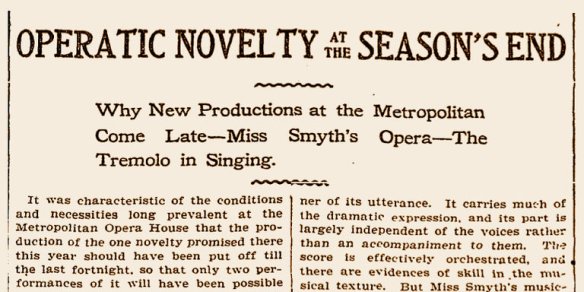
met-newspaper-clipping


“The cards put by kind Fate into [my] hands […] were good health, a fair dose of persistence and fighting instinct, and most important of all, a small independent income which rendered possible a continuous struggle for musical existence such as no woman obliged to earn her livelihood in music could have carried on.”

In her book Female Pipings in Eden, Smyth carefully details with typical clear-headedness how difficult a process it was for anyone, men included, to move a work from conception to performance. It began with writing the manuscript and parts, making costly engravings, and convincing publishers whom she suspected were of the opinion that “all this damned modern stuff ought to be put down by the police.”

If publication could be had, then a conductor was needed, and at the time conductors always worked with a committee of several dozen tradesmen, who avoided new music in favor of older, more crowd-pleasing stuff. Add to this already intimidating process the hassle of being a woman, and the obstacles became, as she points out, almost insurmountable.

“As things are today,” she wrote, “it is absolutely impossible in this country for a woman composer to get and to keep her head above water; to go on from strength to strength, and develop such powers as she may possess.”

Yet Ethel Smyth did the impossible, and even maintained a vibrant optimism while doing it. She delighted in the notion that any day now a “champion” of women in music, someone with all the power, will, and money necessary to make changes, would enter the scene. She suggested presciently that “the wireless, and future developments thereof that we cannot foresee, may help to break down many ancient taboos, this among the number.”

It is difficult to imagine maintaining such an optimism despite everything—and yet she did. But have we, who are swimming now in the internet and in globalism, yet arrived at that taboo-breaking moment?

Smyth was an exceptional human being and she broke exceptional ground in the face of great resistance. Yet it was apparently asking too much of society to invest in the talent, ambition, and vision of any other female opera composer in the past century who dreamed of a Metropolitan Opera debut.

smyth-saariaho

Thus we find ourselves at the end of a 113 year gap—the time between the staging of Ethel Smyth’s Der Wald and the current staging of Kaija Saariaho’s L’Amour de Loin—hoping that enough changes are taking place within the classical music world and society at large that we will not have to wait another century for the next woman composer to grace the stage.

Kaija Saariaho’s L’Amour de Loin runs through Dec. 29 at the Metropolitan Opera in New York City. KING FM 98.1 presents a live broadcast of the performance on-air this Saturday, Dec. 10 at 10 a.m. PST. Tune in at 98.1 or online at www.king.org.

Please click here for a full list of references.

2017 New Music Grammy Nominees

Extra! Extra! The 2017 Grammy nominees have been announced and we’re here to celebrate the discs that have been featured as our Album of the Week or in regular rotation on our 24/7 stream. Congratulations to all of the nominees!

2016 Second Inversion Albums of the Week

Best Chamber Music/Small Ensemble Performance

Steve Reich — Third Coast Percussion (Cedille)
Second Inversion Album of the Week February 15-19

51moxudgtlIn their new album, the quartet surveys the composer’s works for percussion over a four-decade span, beginning with the most recent: his three-movement Mallet Quartet. Composed in 2009, the work is scored for two vibraphones and two five-octave marimbas. Third Coast Percussion twirls effortlessly through the circling motives and interlocking canons of the two outer movements, transitioning seamlessly both in and out of the central slow movement. A stark musical contrast between the thinly textured, almost transparent middle movement against the persistent pulse of the outer two brings color and narrative to the piece. – Maggie Molloy

Best Chamber Music/Small Ensemble Performance

Serious Business — Spektral Quartet (Sono Luminus)
Second Inversion Album of the Week February 8-12

dsl-92198-coverSpektral’s new album, titled “Serious Business,” is anything but serious. The album comprises four different perspectives on humor through the lens of classical music, featuring three new works by living composers and one classic from that late, great father of the string quartet, Joseph Haydn.

But don’t let the lighthearted humor fool you—these guys are no classical music newbies. Comprised of violinists Clara Lyon and Austin Wulliman, violist Doyle Armbrust, and cellist Russell Rolen, the Spektral Quartet performs music from across the classical music spectrum. The group is committed to creating connections across the centuries and providing a discourse between the traditional classical canon and the, well, not-so-traditional contemporary classical canon. – Maggie Molloy

Best Music Film

The Music Of Strangers — Yo-Yo Ma & The Silk Road Ensemble (Sony)
Second Inversion Album of the Week July 25-29 (companion album to the film)

Sing Me HomeWe need music now more than ever—not as a distraction or an escape, but as a gateway toward experiencing our shared humanity. We need music to open our hearts, our ears, and our minds. We need music to connect us in ways which transcend language, religion, tradition, and geography.

That’s the idea behind Yo-Yo Ma’s Silk Road Ensemble, a global music collective comprised of performers and composers from over 20 countries throughout Asia, Europe, and North America. – Maggie Molloy

Best Large Jazz Ensemble Album

Real Enemies — Darcy James Argue’s Secret Society (New Amsterdam)
Second Inversion’s Album of the Week October 10-14

a2976727568_16Whether you’re a conspiracy theory junkie or a sideline skeptic, even the most patriotic of us loves a good old-fashioned conspiracy. Whether it’s the Watergate scandal or the inner-workings of the Illuminati, alien sightings or the mysterious murder of JonBenét Ramsey, we just can’t help but turn up our ears when we hear a juicy top-secret scheme.

And since we’re already listening, Brooklyn-based composer and bandleader Darcy James Argue decided to take our eavesdropping ears to the next level: his new album Real Enemies is a 13-chapter exploration into America’s unshakable fascination with conspiracy theories. Performed with his 18-piece big band Secret Society and released on New Amsterdam Records, the album traverses the full range of postwar paranoia, from the Red Scare to the surveillance state, mind control to fake moon landings, COINTELPRO to the CIA-contra cocaine trafficking ring—and everything in between. – Maggie Molloy


2016 albums in rotation on Second Inversion’s 24/7 stream

Best Surround Sound Album & Best Engineered Album, Classical

Dutilleux: Sur La Mêe Accord; Les Citations; Mystère De L’Instant & Timbres, Espace, Mouvement — Alexander Lipay & Dmitriy Lipay, engineers (Ludovic Morlot & Seattle Symphony) (Seattle Symphony Media)

mi0004097456

Best Contemporary Classical Composition

Winger: Conversations With Nijinsky — C. F. Kip Winger, composer (Martin West & San Francisco Ballet Orchestra) (VBI Classic Recordings)

winger-album-cover

LIVE VIDEO STREAM: “Blackbird, Fly” with Daniel Bernard Roumain and Marc Bamuthi Joseph

Join us tonight, Tuesday, December 6 at 7:30pm (PST), for a live video stream from Town Hall Seattle featuring composer and violinist Daniel Bernard Roumain with spoken word artist and arts activist Marc Bamuthi Joseph in “Blackbird, Fly,” a concert for voice, body, and strings. Together these two American sons of Haitian immigrants explore themes of family history, folklore, politics, and race, all of it coursing with the rhythm and energy of hip hop.

If you’re in Seattle, we’d love to see you there! Get your tickets here and be sure to hello at the broadcast table in the lobby.

Program Notes by Aaron Grad c/o Town Hall Seattle

Blackbird, Fly is the co-creation of Daniel Bernard Roumain and Marc Bamuthi Joseph, two powerhouse performers who demolish boundaries in their respective art forms. Roumain, otherwise known as DBR, combines his classical training in violin and composition with the energy of hip hop and pop music, whether he is accompanying Lady Gaga on American Idol or presenting a new orchestral piece at Carnegie Hall. Joseph is best known as a spoken word artist and a National Poetry Slam champion, but his career has spanned from acting on Broadway to arts activism in Oakland.

These two men, both born in the United States to Haitian immigrants, have used their personal histories and artistic talents as springboards to examine larger questions about our society’s past, present and future, especially as it relates to Black life in America. After coming together for a number of projects across the country, from the Atlanta Ballet to San Francisco’s Yerba Buena Center for the Arts, Roumain and Joseph distilled their collaboration into what they describe as “a concert for voice, body and strings,” a label that hardly captures the enormous range and impact of this evening-length duet.

Roumain’s music for Blackbird, Fly is a kaleidoscopic mixture of classical, rock and hip-hop sounds that he creates on several electric violins as well as piano and laptop. When he sends aggressive bow strokes through a heavily saturated distortion pedal, or when he holds the violin across his chest and strums it like a guitar, his sound and technique comes closer to Jimi Hendrix than any concert violinist. Other times he extracts a pure, clean tone from his violin, using subtle sound effects to thicken and amplify his musical gestures into textures that give the impression of an entire string ensemble playing.

Joseph’s words and expressive body movements likewise transcend any one style or narrative thread. Part storytelling, part folklore and part politics, his libretto touches on everything from fatherhood and friendship to mass incarceration and police bias, all infused with the fluid rhythms of hip-hop and spoken word. He introduces an international perspective, with vignettes that recall visits to Haiti, Paris, Tokyo and Senegal. There is also a deep sense of history as he reflects back on figures such as Huey Newton and Martin Luther King, Jr.

Blackbird, Fly is awash in paradox: It is personal but universal; it is high art and pop culture; it is unflinchingly honest and still joyful and optimistic; it is tender and vulnerable and outrageously powerful and virtuosic all at the same time. This is a performance that might generate more questions than answers, but isn’t that exactly what we need today if we hope to understand each other and ourselves?

© 2016 Aaron Grad.

ALBUM REVIEW: MeiaMeia from Arcomusical

by Maggie Molloy

It doesn’t take a lot to make beautiful music—in fact, sometimes all it takes is one single string.

3-greg-and-alexis-playing

The Afro-Brazilian berimbau is, quite literally, a musical bow: it’s comprised of a long, thin wooden branch strung with a single metal wire and a hollow, open-backed gourd resonator. It’s played with a thin stick, a small basket rattle, and a small coin or stone.

Often used as musical accompaniment for the Afro-Brazilian martial art capoeira, the instrument arcs like a bow and arrow but plays like—well, nothing you’ve ever heard before. Which raises the question: why haven’t you ever heard it before?

Arcomusical is a nonprofit organization that advocates for the artistic advancement of the berimbau and related musical bows through composition, performance, publication, research, and community. To date, Arcomusical has created over 30 new works for the berimbau—and counting.

Most recent among them is a 12-work chamber music cycle titled MeiaMeia: New Music for Berimbau. Composed by Artistic Director Gregory Beyer and his former student, Alexis C. Lamb, the album’s title is Portuguese for “HalfHalf,” as in “six of one, a half dozen of the other”—six pieces by each composer.

2-projeto-arcomusical-sextet-photo-2

MeiaMeia is brought to life by Beyer and Lamb’s world music sextet Projeto Arcomusical, whose hand-painted instruments sport a Piet Mondrian-esque design created by their bandmate Daniel Eastwood. Clocking in at just over an hour, the chamber cycle makes its way through a wide spread of solos, duos, trios, quartets, quintets, and sextets, each exploring the unique timbral colors and textures of this inimitable instrument.

The result is a collection of pieces which draw on influences ranging from the minimalist musings of Steve Reich to the folk tunes of Béla Bartók, traditional capoeira music to palindromes and numerical patterns. Pieces blend patiently into and out of one another, enfolding the listener in a meditative trance.

And yet, that trancelike soundscape is bursting with color. The musical language is at once playful, rhythmic, buoyant, and beautiful—ostinati bounce energetically from one player to another, pitches bend back and forth, hocketed melodies echo above gentle glissandi, and kaleidoscopic melodies circle and expand in ever-changing patterns.

As a listener, it’s easy to lose yourself in that ever-evolving soundscape—but Projeto Arcomusical doesn’t miss a beat. The sextet is so tuned in to one another that at times it becomes difficult (if not impossible) to tell where one instrument ends and another begins. The players are so precise, so blissfully engaged with their instruments and one another that the individual pieces and the individual players melt away, and you begin to discover the uniquely captivating character of the instrument itself.

Sure, it may only take a single string to make music—but as Projeto Arcomusical demonstrates, it takes also takes a whole lot of patience, passion, and precision.

5-instruments-1-crop