NEW VIDEO: Berceuse by Melia Watras

by Maggie Stapleton

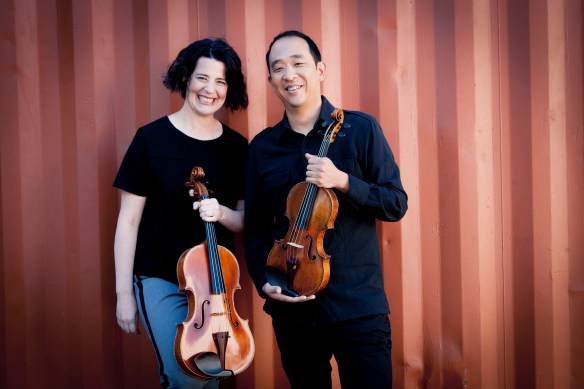
It’s no secret that we’re big fans of husband and wife duo Michael Jinsoo Lim and Melia Watras. They’re one half of the Corigliano Quartet, whose recordings are often heard on our 24/7 stream, we’ve featured them on our weekly program The Takeoverreviewed Melia’s latest Sono Luminus album Ispirareand most recently we hosted them in our studios to record a video of Melia’s composition, Berceuse. This piece showcases Melia’s composer-performer role and the beauty of a relationship between two people share a life in and outside of music.

“Berceuse for violin and viola is an adaptation of the original voice and viola version of the piece, which I wrote for the fantastic folk singer Galia Arad. The piece first took shape while I was practicing the exquisite fourth movement lullaby of Robert Schumann’s Märchenbilder. Galia’s folk style was very much in my mind as I composed.

Violinist Michael Jinsoo Lim and I have been performing together since we met in our freshman year at Indiana University, so it was a natural fit to adapt Berceuse for violin and viola. Mike also exchanged bow for pen, as the author of the text for the vocal version of the piece.” – Melia Watras

Michael and Melia are integral to the (new) music community in Seattle – Michael as Concertmaster of the Pacific Northwest Ballet and Melia as Associate Professor of Viola and chair of Strings at the University of Washington. Both actively perform in other venues around the Northwest and are always pushing the boundaries of what music and art can be.

Melia&Mike2015 Michelle Smith-Lewis


To see more videos produced by Second Inversion, check out our video page!

CONCERT PREVIEW: (re)MOVE: (re)TURN: Q&A with Karin Stevens

by Maggie Molloy

Throughout history, we have used the term “Mother Earth” to draw connections between the life-giving power of woman and the world, recognizing both as a source of life, love, and nourishment, both literally and figuratively.

And yet, throughout history we have also abused, neglected, and exploited both woman and the earth. We have inflicted countless physical, political, social, and symbolic injustices upon them, stripping them of their strength, power, and personal value again and again.

That is the premise behind Seattle-based dancer and choreographer Karin Stevens’ newest work, titled (re)MOVE: Back Toward Again the (re)TURN Facing. It is a 70-minute dance featuring music by three Seattle composers: Wayne Horvitz, Michael Owcharuk, and Nate Omdal. The work premieres this weekend with three performances at Velocity Dance Center on Capitol Hill.

All photos: Karen Mason Blair

Full of turbulent exchanges, (re)MOVE: (re)TURN pulls from thousands of years of scientific, philosophical, and spiritual writings on connections between women and the earth. Five female dancers from the Karin Stevens Dance company (KSD) weave patterns of separation and alliance, drawing connections between our bodies and the lands we inhabit.

We sat down with Stevens to talk about music, dance, women, and the rest of the world.

Second Inversion: How did (re)MOVE come about, and what was your inspiration for making contemporary composition such a prominent part of this project?

Karin Stevens Dance 2Karin Stevens: The choice to support live playing of the music with the dancing is more than a very cool experience for the viewer; it is a practice of listening, being open and in the now as a dancer, like no other time. And, there is nothing like the relationships that are built with the musicians and composers in these live music and dance projects.  

I can’t say that I was strategic in planning this evening-length dance weaved together with the three composers works, but that each part came at me and grabbed me to come into existence. I create my work through massive amounts of improvisation that I video tape. The movement guides me into form and meaning. The music by each composer came to me in different ways and spoke to me through kinetic images/ideas that emerged as I listened, about what this work was meant to be. It delight me that this work that came forward with such feminist and feminine voice reclamation is danced with the sounds by these three lovely male composers! 

SI: Can you tell me a bit more about the musical compositions in (re)MOVE?

KS: Composers Michael Owcharuk (thank you to 4 Culture for the grant for this new composition!) and Nate Omdal have written two gorgeous and unique works for KSD, that I have weaved together with a work by Wayne Horvitz to create re(MOVE). I am especially honored to work with Wayne Horvitz’s music. He is a hero to all of us. The music, These Hills of Glory (NEA American Masterpiece), is EVERYTHING I love about contemporary classical music: unique and imaginative compositional voice; disparate pairing of composed and improvised scoring (in this work); spaciousness and density of sound; daring rhythmic complexity; a diverse and unpredictable aural journey that connects with all of my senses.

SI: What inspires you most about classical music, and contemporary classical music specifically?

KS: I am a daughter of KING FM. For as far back as I can remember my Dad had it playing in the car, out in the garden, on our boat and in various rooms throughout our house. In fact, my parents live in Montana now and my dad still plays KING FM 24/7 from his home office computer! The soundtrack of my life was classical music.

I also had marvelous music experiences in graduate school at Mills College where I was introduced to even more music, especially contemporary classical music. I am extremely grateful to Second Inversion—a service of KING FM—and their effort to bring my work in dance with contemporary classical music to the public! I have long felt dance should be appreciated like great music. The abstraction, complexity, beauty, and texture should be as meaningful through movement as we have allowed it to be through sound.  

SI: In your writings, you discuss some of the specific injustices women face throughout the world, including sexual violence, female infanticide, female genital mutilation, removal from any possibilities of social and financial advancement, sexual exploitation and slavery, and much more. Can you tell me a bit about the broader feminist threads present in (re)MOVE?

KS:
This work is personal and it is feminist. It is a work for this eleventh hour time for the earth and for humanity. It is an art and practice of movement in contemplation of transcendent injustices, specifically in this work as it concerns women and the earth. 

Releasing myself from the tyranny of false beliefs, from the forces that denigrate the voice of the feminine, from the hegemony of my current cultural place, I (re)MOVE again in each (re)TURN to truly (re)BIND bones and tissues like a spiritual ligament to the essence of what really matters. As Pierre Teilhard de Chardin once said, “Driven by the forces of love, the fragments of the world seek each other so that the world may come into being.” These fragments of imagination here seek out what is being (re)FORMed and (re)TURNed. This movement flows toward hope through this turbulent exchange with our time and awakening. It is a movement of love.

Karin Stevens Dance 3

SI: (re)MOVE is also extremely spiritual. What were some of the spiritual and philosophical inspirations in creating this work?

KS: My readings in quantum entanglement, physics, general systems theory, and evolutionary biology have taken me into areas where the spiritual, philosophic, and the scientific interchange strengthen, rather than oppose each other. At the heart of this interchange is our movement that reconnects us with the natural world, with our self, with each other and with our evolution in this cultural time.

My personal religious experience has led me to deep questions about the absence of the feminine in the Abrahamic religions, and the egregious effect this has had on the evolution of our collective body and the earth, particularly in the West. Studies in Taoism, the Tao Te Ching, Five Elements/Movements and yin/yang theory of Chinese philosophy have given me a lovely place to explore ideas that heal the cracks in my Judeo-Christian experience.

In these spiritual philosophies I sought new movements I could repurpose toward my own becoming. I found connection: between human, heaven and earth; to the root of all the universe for which we belong; and to the “primal mother” that enthralls my curiosity and imagination.

Karin Stevens Dance FlyerSI: What are you most looking forward to with this premiere?

KS: It is a great honor to be able to raise enough money to work with live, local, and NEW music as a choreographic/movement artist. There are so many talented composers in Seattle plugging away, as I am, to make the music they are compelled to make. I feel a propulsion to get their work heard as much as I want to get my dances seen.

For more information about the project, please visit Karin Stevens’ blog series using the following links: Part I, Part II, and Part III.

Performances of “(re)MOVE: (re)TURN” are this Friday, April 22 at 7:30 p.m., Saturday, April 23 at 7:30 p.m., and Sunday, April 24 at 6:30 p.m. All performances are at Velocity Dance Center on Capitol Hill in Seattle. For tickets and information, please visit this link.

REVIEW: Trance Frendz by Olafur Arnalds and Nils Frahm

by Maggie Molloy

trancefrendz-teaser

Some people like to go out on Friday nights. Ólafur Arnalds and Nils Frahm like to stay in and make music.

Though both are prominent composers, pianists, producers, and performers in the new music world, they prefer to spend their evenings off creating, well, even more music. I guess you could say they’re more than just musical collaborators—they’re best friends. Or rather, best “frendz.”

“Trance Frendz” is the title of the pair’s newest set (the term “album” is firmly rejected by both Frahm and Arnalds), which features music from an evening of improvisation at Berlin’s Durton Studio. It began as a video session of the two performing an improvised duo, in promotion of a different album titled “Collaborative Works: An Evening with Ólafur Arnalds and Nils Frahm.”

But instead of ending the session after the first take, the two continued to improvise throughout the night, ending up with a number of new pieces written and recorded on the fly, with no overdubs and no edits.

What started as a short promo video quickly turned into a 45-minute studio film titled “Trance Frendz,” and the music was included as a second disc in their “Collaborative Works” album.

And now, “Trance Frendz” has officially been released as its own separate CD and vinyl.

Each piece in the set is named after the time in the night when it emerged, with the mood clearly modulating throughout the hours. And yet, the pieces all blur together, unified by the relaxed mood, organic movement, striking intimacy, and genuine honesty behind each one.

“We meet because we’re buddies and we’ve known each other for a long time,” Frahm said in an interview with the Boiler Room. “We eat pizza, drink some beers, stay up way too long and try new things for fun. Everything that we put out is basically just a byproduct of us spending time together and geeking out on music.”

The improvisations are slow-moving and patient, at first led primarily by twinkling piano melodies. But as the night wears on, the delicate piano motives gradually expand to feature growling organ basslines, rumbling drones, and some serious synth.

As the pair continues wandering into the early hours of the morning, the shimmering hum of the piano returns to the forefront with a series of whimsical music-box-worthy melodies, complimented by sweet, subtle vocal humming atop the creaking of antique piano lids and tape recorders. The set comes to a close with soft, hazy piano melodies sparkling amidst a nocturnal calm.

“This music is not the most catchy, not the most hit-you-in-the-face festival-kicking song of the year, or a declaration of: ‘Look at me. Watch how great I am,’” Frahm said. “It unfolds over time, is a little more rich—and I like that kind of humbleness about it.”

It’s the perfect soundtrack for a quiet night in with a friend—charming, sincere, organic, and ambient.

“Ultimately, the fun is in there,” Arnalds said. “The video is a testament to that. It’s in those sessions, in the recordings, and in our friendship.”

STAFF PICKS: Friday Faves

Second Inversion hosts Seth, Geoffrey, and Maggie M. each share a favorite selection from the Friday 4/15/16 playlist! Tune in at the indicated times below to hear these pieces. In the meantime, you’ll hear other great new and unusual music from all corners of the classical genre 24/7!

Lisa Bielawa: “Hurry” from The Lay of the Love (Innova)

915_cover

Lisa Bielawa’s Hurry is a breathless recounting of the composer’s impressions of a Boris Pasternak poem, translated to English from the original Russian. I love how Bielawa seamlessly transitions from the sparse, bare and wide-open chamber music textures of the work’s opening sections to the larger, lyrical, almost orchestral sounds later in the piece. It’s an all-star cast on this recording, featuring some of my favorite powerhouse musicians such as pianist Benjamin Hochmann and clarinetist Anthony McGill. – Geoffrey Larson

Check out the first stanza from Boris Pasternak’s poem:

Hurry, my verses, hurry; never
have I so needed you before.
Round the corner there’s a house
where the days have broken rank.
Comfort there’s none and all work’s stopped
and there they weep, ponder and wait.

Tune in to Second Inversion in the 2pm hour today to hear this recording.


Shara Nova: “A Whistle, A Tune, A Macaroon” from yMusic’s Beautiful Mechanical (New Amsterdam)

homepage_large.cbf92e9bComposer, songwriter, and mezzo-soprano extraordinaire Shara Worden recently changed her name to Shara Nova—and it couldn’t be more appropriate. In Hebrew, Shara means “song”—a pretty serendipitous name for a singer-songwriter—and in Latin, Nova means “new.”

Throughout her career as a full-time contemporary classical chameleon, she has recreated herself and her music again and again, exploring the furthest reaches of the classical genre. She’s created and fronted her own avant-garde rock band, My Brightest Diamond, composed and starred in her own 21st century baroque chamber opera, “You Us We All,” and collaborated with composers and artists as diverse as the Decemberists, Sarah Kirkland Snider, Sufjan Stevens, Colin Stetson, David Byrne, and many, many more.

“A Whistle, A Tune, A Macaroon” showcases a collaboration with another powerful force in contemporary classical: yMusic. Though we don’t get to hear any of Nova’s vocals on this track, her soaring, songlike melodies and keen ear for experimentation are unmistakable in this composition. Exotic flute and clarinet idioms dance above pizzicato basslines to create a new work that is every bit as whimsical as its title. Suffice it to say, it’s a new song you do not want to miss. – Maggie Molloy

Tune in to Second Inversion in the 4pm hour today to hear this recording.


Matt McBane: “imagining winter” from Build (New Amsterdam)

build-buildViolinist and composer Matt McBane’s ensemble Build is a favorite of mine. This week, I’m pleased to present you with their track imagining winter, composed by McBane. I’ve been very busy lately, so I’ve been focused on keeping my head down and digging in to make it through to Memorial Day weekend.  That is why I connected with this particular piece this week; this music seems to be the sonic equivalent of my recent state of mind. More generally, with characteristics of minimalism, cinematic music (a la Les Triplettes de Belleville), and subdued jazz elements, this piece is an excellent soundtrack for your solitary urban adventures, whether that means a focused day at the office or a surreptitious exploration of forbidden places. – Seth Tompkins

Tune in to Second Inversion in the 6pm hour today to hear this recording.


New Music: There’s an App for That!

by Maggie Molloy

New Music AppsThe average American spends nearly five hours a day on their smartphone. That’s about a third of their waking life.

What could we possibly be doing for all that time? Well, usually we’re just wasting it—we’re scrolling through our Facebook feed to pass the time on a long bus ride, Snapchatting our friends from across the room during a TV commercial break, Instagramming our afternoon coffee, or checking for new matches on Tinder.

So much time wasted swiping left, right, upside down, right-side up—which is why I figure if we’re going to spend hours on our phone each day, we should at least make it worth our while. Why not spend that time improving our rhythm, enhancing our musical knowledge, exploring new music, or listening to some of the greatest artists and thinkers of our time?

Next time you find yourself stuck on a long bus ride, bored during a commercial break, or sitting alone in a crowded café sipping your coffee, turn off your social media and engage with these new music apps:

Second Inversion App

Okay, so this one’s an obvious pick—but here’s why: our app gives you on-the-go access to our carefully-curated 24/7 live stream, expansive video archive, on-demand concert recordings, new music event calendar, Joshua Roman blog posts, album reviews, and much more. You can also create a “Favorites List” of pieces you hear on the stream, or even set a custom alarm clock so that you can start each day with the latest in contemporary classical!

SI AppAnd rest assured, there are no commercials, no top 40, no corny talk radio—just 24/7 new and unusual music from all corners of the classical genre. Oh, and did I mention it’s FREE?

John Cage Apps

The 20th century composer and iconoclast John Cage is most famous for two main contributions to the classical canon: 1) his “silent” composition, titled 4’33”, and 2) his prepared piano pieces. The John Cage Trust has created apps out of both.

John Cage 4'33"Cage’s three-movement 4’33″ is perhaps his most famous composition, teaching audiences that there is really no such thing as “silence,” but rather, the sound of the world around us is music in and of itself. In the app, you can capture your own three-movement performance of the ambient sounds in your environment, then upload and share that performance with the world. You can also listen to others’ performances, and explore a worldwide map of ever-growing performance locations. But here’s the coolest (read: geekiest) part: the app features a recording of the ambient sounds at play in Cage’s last New York apartment, which he found a source of constant surprise, inspiration, and delight.

John Cage Prepared Piano

Cage threw a wrench in the Western classical tradition (literally) when he invented the prepared piano in 1940. By placing everyday objects such as screws, bolts, and pieces of rubber between the strings of a grand piano, he created an entire percussion orchestra within a single instrument. Now, you can create your own entire percussion orchestra—within a single smartphone. Choose from dozens of sampled sounds of a piano prepared with the actual materials used by John Cage in the preparations for his Sonatas and Interludes, then record your performance and share it with the world!

bitKlavier Prepared Digital Piano App

Composer and electronic musician Dan Trueman gave the original 20th century prepared piano a 21st century facelift last year when he created the prepared digital piano. Instead of bolts and screws stuck between the piano strings, virtual machines adorn the virtual strings—transforming the piano into an instrument that pushes back, sometimes like a metronome, other times like a reverse delay. The virtual strings also tighten and loosen on the fly, tuning in response to what is played. And in true 21st century fashion, you can download the prepared digital piano as an app, plug it into your MIDI keyboard, and create your own compositions.
bitKlavier

Third Coast Percussion Apps

John Cage Quartet AppPercussionists are on their game when it comes to new music apps. Third Coast Percussion actually has three: John Cage Quartet, the Music of Steve Reich, and Resounding Earth.

The John Cage app is based on his 1935 Quartet, which is scored for “any four instruments or sounds.” With this app, you can choose from a variety of pre-recorded sounds or record your own sounds to create a custom version of the piece!

The Steve Reich app allows you to create your own music using compositional techniques made famous by this minimalist composer, including phasing, additive processes, and canons. You can even record and sample your own sounds to make it truly your own!

Steve Reich App

Resounding Earth is the title of a 2012 composition written by composer Augusta Read Thomas for Third Coast Percussion. In the piece, the group performs on over 125 bells from all over the world. This app allows you to explore the incredible sounds and history of many of the bells featured in the composition, enriching your own knowledge of percussion practices around the world!

Resounding Earth

Unsilent Night App

Unsilent NightPhil Kline’s Unsilent Night is an electronic composition written specifically for outdoor performance in December—but you and your friends can perform it anytime of year (as long as you have smartphones). Participants each download one of four tracks of music which, when played together, comprise the ethereal Unsilent Night.

Gather up as many friends as you can around a pile of boomboxes, speakers, or any other type of portable amplifiers, and instruct everyone to hit “play” at the same time. Then walk through the city streets creating an ambient, aleatoric sound sculpture filled with shimmering bells and time-stretched hymnal melodies.

Steve Reich Clapping Music App

In 1972, minimalist composer Steve Reich composed a piece using very minimal musical means: just two people, clapping. Sounds simple, but it’s actually pretty difficult: two people clap the same short rhythmic pattern, with one repeatedly shifting their pattern by a beat until the two patterns align again. This app allows you to test your own rhythm by tapping in time with Reich’s constantly shifting pattern, gradually progressing through all of the variations.

Steve Reich Clapping MusicChoose from “easy,” “medium,” “hard,” or “practice” modes to up your rhythm game—if you achieve a high score, you can enter into a competition for the chance to perform the work live. And, you can also take part in a research project which investigates how people learn rhythm.

PhonoPaper App

Okay, so this one is about 30 percent Russian spy cryptology but 100 percent awesome nonetheless. The idea was inspired by old Soviet technology that uses visual codes for sound synthesis. Here’s how it works: PhonoPaper is essentially a graphical representation of sound (this can be music, a human voice, etc.); in other words, it is the two-dimensional audio barcode of the sound.

PhonoPaper

This app allows you to 1) generate your own PhonoPaper by converting a recorded sound into image, and 2) use your phone camera as a real-time PhonoPaper-code reader, to convert the image back into sound. How cool is that? You can even use the code reader to convert graphical representations of musical scores back into music—check out their site for some examples using pieces by Bach, Mozart, Lully, and more!

So whether you’re secret coding your latest symphony, clapping through a Steve Reich simulator, or just kicking back and listening to the Second Inversion stream, there’s so much music to be heard! Why waste time on social media when you have all these incredible new music apps at your fingertips?