

Second Inversion hosts share a favorite selection from their weekly playlist. Tune in on Friday, September 28 to hear these pieces and plenty of other new and unusual music from all corners of the classical genre!
Richard Reed Parry: For Heart, Breath and Orchestra (Deutsche Grammophon)
Christopher Cerrone: How to Breathe Underwater
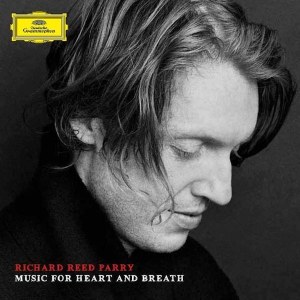 I have to admit: this Staff Pick was a tough choice for me. It was a toss-up between Richard Reed Parry’s For Heart, Breath and Orchestra, and Christopher Cerrone’s How to Breathe Underwater. In one corner, a piece by a guy from one of my favorite bands, wherein he had musicians and the conductor listen to their own heartbeats through stethoscopes and asked them to play along as closely as possible to their own heartbeats—a beautiful existential notion and a beautiful thing to listen to.
 In the other corner, a piece that’s kind of about depression, which is based on a Jonathan Franzen character from the book Freedom, of whom Franzen said, “[she] was all depth and no breadth. When she was coloring, she got lost in saturating one or two areas with a felt-tip pen.” If you are not weeping by the end of that sentence and by the end of this heartbreakingly hopeful piece, check your pulse, man. Ultimately, I loved them both so much that I had to just close my eyes and pick one. But…oops! I wrote about both of them. Now you’ll never know which one I picked! – Dacia Clay
Tune in to Second Inversion in the 11am hour today to hear these pieces.
Michael Gordon: Beijing Harmony (Cantaloupe Music)
Seattle Symphony; Pablo Rus Broseta, conductor
 “Every city produces its own set of harmonies,” Michael Gordon writes in his program note for this piece. In Beijing Harmony, those chords are dazzling and majestic, shimmering magnificently across the orchestra. The piece was inspired in part by Echo Wall, a part of the Temple of Heaven in Beijing where sounds echo from one side of the structure to the other. In performance, the wind and brass players are spread out across the stage—and when you listen with headphones, the music echoes from left to right and back again, all around and through you. – Maggie Molloy
Tune in to Second Inversion in the 5pm hour today to hear this piece.
Pauline Oliveros: Lear (New Albion)
Deep Listening Band

Way out on the northeastern tip of the Olympic Peninsula, nestled amid the sprawling and historic Fort Worden State Park, is a massive cistern, nearly 200 feet in diameter and over 14 feet deep. There’s nothing that quite compares to the immersive 45-second reverberation that echoes across this cistern—which is what made it the perfect location for Pauline Oliveros and her Deep Listening Band to record their self-titled album. Accordion, trombone, didjeridu, keyboards, and electronics somehow merge into one cohesive, meditative soundscape that lulls you straight into sonic hypnosis.
– Maggie Molloy
Tune in to Second Inversion in the 7pm hour today to hear this piece.

 Andy Akiho is rapidly becoming one of the most interesting movers and shakers in the contemporary music world, and his piece for prepared piano Vick(i/y) is one of my favorites. The piece doesn’t limit itself to the usual prepared sounds of clanging and crashing and twanging, but uses normal piano sound as a sort of through-line to tell its story. Andy says that this alternation of prepared sounds and conventional sounds represents a “consistent, yet fading image of a forgotten dream.” Andy is a percussionist, and it’s the percussive sounds of Vick(i/y) that define the piece. There is also a really cool music video that transports the piano into natural locations, and features an Andy Akiho cameo. –
  A near-mythic musical encounter happened on Coney Island in the summer of 1986. Two of the 20th century’s most iconoclastic musical philosophers, John Cage and Sun Ra, came together for a concert. For one night only, two artists from opposite ends of the avant-garde shared the same stage.
 As many people look toward a summer filled with long-distance travel, it’s nice to know that even the experience of riding inside the cabin of a commercial airliner has been used as fuel for new music. Nico Muhly’s Comfortable Cruising Altitude opens with a field recording taken from inside an airliner cabin. The piece explores the many layers that make up a typical airline trip, including complex contemplative feelings, the anxiety of waiting, and even a crying child. This work encapsulates the commercial air travel experience with striking poignancy, especially given its relatively short duration.
 Matt Marks called the album that this song is from (The Little Death: Vol. 1) his “post-Christian nihilist opera.” This almost spastically poppy track is poking fun at a mutually destructive relationship dynamic. In this case, a guy is placing a woman on a ridiculously high pedestal, telling her that he doesn’t have any fun on his own, that he needs her, and in his final appeal, that she is like a god to him. The more he entreats her, the meaner she gets, and the meaner she gets, the more desperate his attempts become.
 Second Inversion hosts share a favorite selection from their weekly playlist.
  “Listen to everything all the time and remind yourself when you are not listening,” Pauline Oliveros said in her 1998 keynote address at the ArtSci98 symposium.
 Michael Hammond’s recording project No Lands opens it’s album Negative Space with a confusingly-titled track. Despite being titled “Icefisher,” this piece brings a distinct sense of warmth. The slow, bendy chords are reminiscent of surf rock, while the heavy electronic static might be a sonic translation of the sensation of relaxing outdoors on an evening that is too hot. The end result? This track makes me want immediate access to a cold drink and a lawn chair. –
 It’s always fascinating for me to hear the atonal landscape of György Ligeti applied to vocal works—for me, it magnifies the majesty and magic that is a somewhat lesser characteristic of his instrumental compositions that I know and love. Lux Aeterna is a highly difficult work for 16-part mixed choir that uses constantly shifting rhythms and high notes for all vocal parts to create a floating, ethereal feeling. Stanley Kubrick was attracted to its celestial sound,
 I’m listening to this piece again as I write. It sounds like spring in a meadow on a parallel planet—one that’s a lot like ours, with all of the sweetness of plants and animals waking up from long winter’s naps, but with none of the Rite of Spring madness. It’s bright and peaceful and hopeful, and also brief, like having a flash of realization that the world is amazing when it wants to be. The piece comes and goes that quickly. I like this piece even more knowing that Max Richter’s impetus for writing the album was that he was trying to regain the appreciation he’d once had for Vivaldi’s Four Seasons by digging into the work, recomposing it, and interpreting what he found at its heart. The idea that you can breathe life into things in your world which have become familiar and dull by reframing your own point of view is a powerful one. Plus, I’m a sucker for music
  It’s always a joy when you encounter an instance of an artist putting forth a very specific idea with which you connect, especially if that idea is one that has made you feel isolated in the past. I had this perpetually rare and delightful experience as I discovered Christopher Cerrone’s South Catalina this week. Specifically, I have a long-running and deep personal connection with a feeling Cerrone outlines as an inspiration for this piece: the strange mix of enchantment and oppression that a consistently sunny climate can catalyze in people unfamiliar with that type of environment. –
 Joan La Barbara spoke up for experimental vocalists everywhere with her witty response to mezzo-soprano Cathy Berberian’s scathing critique of avant-garde vocal music. Berberian, who interviewed La Barbara during the intermission of one of her concerts, dismissed extended vocal techniques as at best “research” and at worse the work of “freaks” who can’t actually sing.

 Brimming with whimsy and wistful nostalgia, Angélica Negrón’s La Isla Mágica combines punchy, video game-worthy electronics with double bass, percussion, and ambient vocals. Performed here by Eleonore Oppenheim on her debut solo album Home, her bass swings, sways, and dances amid a swirl of technicolor electronics. At times it sounds almost
  I seriously can’t get enough of these works by Gabriela Lena Frank, with all their vibrant colors and stunning rhythmic character. Gabriela was born in the US to parents of Peruvian/Chinese and Lithuanian/Jewish ancestry, and much of her music is influenced by her heritage. Danza de los Saqsampillos is inspired by the Peruvian “saqsampillo,” a rambunctious jungle-dweller with a characteristic jumping two-person dance. This performance from the Alias Chamber Ensemble album Hilos is the version for two marimbas.
 David Bowie once said that “Ashes to Ashes” represented his own feelings of inadequacy about his work not having much importance. Until “Ashes to Ashes” was released in 1980, much of Bowie’s music was cloaked in concept and personas so the vulnerability and maturity of this song was, among other things, his way of closing that chapter and moving on.
  This is exactly what waiting in the rain for snow sounds like.