ALBUM OF THE WEEK: Anja Lechner and François Couturier’s Moderato Cantabile

by Maggie Molloy

lechner-coutourier

“I believe that the music belongs to the true interpreter, the true artist,” said 20th century Spanish composer and pianist Federico Mompou. “Here is the music. What does it suggest to you?”

German cellist Anja Lechner and French pianist François Couturier took that challenge head-on in their new album, “Moderato cantabile.”

In addition to featuring compositions by Mompou, the album also includes works by two other influential 20th century scholars and composers: the Armenian priest, singer, musicologist, and composer Komitas and the Greco-Armenian philosopher and spiritual teacher George Ivanovitch Gurdjieff. The spiritual implications of these treasured works are counterbalanced by three of Couturier’s own new compositions which also appear on the album.

cover

Though “Moderato cantabile” is Lechner and Couturier’s first recording as a duo, they have worked together over the past 10 years in music projects such as the Tarkovsky Quartet, created to celebrate the works of Russian filmmaker Andrei Tarkovsky, and “Il Pergolese,” in which they reimagined the music of Neapolitan composer Giovanni Battista Pergolesi as improvisational works.

For their first album together, the two carefully selected a rich palette of pieces featuring elements of folk melodies, Eastern music, spiritualism, minimalism, improvisation, and even jazz. It’s unusual to come across an album with such a vast range of musical inspirations, yet “Moderato cantabile” spins them together seamlessly.

The album showcases both the individual musicianship of each performer as well as their complex musical understanding of each other. Together they bring out the warmth, sincerity, and vibrant colors of each piece.

Mompou’s compositions show an Impressionist influence, softly blending melodies into sparkling mystical images. His “Canción y danza” begins with delicately shimmering piano motifs which later give way to a lyrical cello melody. The piece then transitions into a folk dance, adopting a lively and spirited cello part over a percussive piano backdrop.

Lechner and Couturier also bring to life Mompou’s “Música Callada,” a gentle meditation on the interplay between sound and silence. A simple but thoughtful piano part gently supports the delicate, introspective cello melody. The piece is slow but deliberate; each note is patient and perfectly-crafted, enchanting the listener with each and every melodic gesture.

The duo’s performance of Komitas’s “Chinar es” again toys with elements of folk melodies. Komitas was one of the first music scholars to notate secular Armenian folk songs, and “Chinar es” was one of them. The piece switches back and forth from repetitive piano motifs glimmering above a rhythmic cello bass part to gorgeously resonant cello melodies singing over top of a textured piano backdrop. The result is a timeless and captivating glance into the Armenian folk music tradition.

Gurdjieff’s featured compositions give the album a slightly Eastern sound. Gurdjieff was not a formally trained musician; most of his music was composed of central Asian folk melodies he hummed from memory to composer Thomas de Hartmann, who then transcribed and harmonized them.

His “Sayyid chant” showcases an ethereal, Eastern lyricism woven together with glistening piano phrases and rich, graceful cello melodies, while his “Hymn No. 8 Night Procession” features elegant piano melodies circling around deep, growling cello phrases to create a dark and dramatic ambience.

The album’s more historic works are balanced by a few of Couturier’s own contemporary compositions. The pieces showcase his studies in both classical and jazz, as well as his ear for improvisation. Couturier’s “Voyage,” features warm, ringing cello melodies over softly pedaled piano harmonies.

By contrast, his rhythmic “Soleil Rouge” experiments with elements of dissonance and jazz, while “Papillons” abandons conventional cello techniques in favor of an airy, hollow sound and sparse piano texture. The soft melodies and unique timbres flirt with silence throughout the piece, giving it an unmistakably modern sound.

Lechner’s and Couturier’s interpretation of all the works on the album show a deliberate emphasis on melody and lyricism. The two truly took their time with each piece, their patience and attention to detail ensuring that each and every note echoes with perfect resonance.

LIVE CONCERT SPOTLIGHT: January 29-February 2

by Maggie Molloy

This week’s spectacular music calendar has everything from Schnittke to Stockhausen to saxophone quartets and more!

University of Washington’s Modern Music Ensemble Winter Concert

invertedgroupaerial

As millennials, the students of UW’s Modern Music Ensemble (Inverted Space) know a thing or two about new music. This Thursday, they are presenting a winter concert featuring a wide spectrum of works by contemporary composers.

The colorful program starts off with George Crumb’s “Dream Sequence (Images II),” an ethereal sound tapestry written for violin, cello, piano, percussion, and an off-stage glass harmonica. The students will also perform Alfred Schnittke’s poignant and powerful Piano Quintet, which was written in memory of his mother. Karlheinz Stockhausen’s serial “Kreuzspiel” and Jacob Sundstrom’s “no comment from the Grey Room” round out the program.

The performance is this Thursday, Jan. 29 at 7:30 p.m. at the Floyd and Delores Jones Playhouse Theater at University of Washington.

Ivan Arteaga’s Neijing Ensemble

Ivan-Arteaga_0-600x400

What could be better than the sweet and sensual sound of a solo saxophone? Four saxophones at once. This weekend, Seattle saxophonist Ivan Arteaga’s Neijing Ensemble is presenting a series of new improvisational pieces for saxophone quartet.

The ensemble began as something of a saxophone jam circle, which inspired Arteaga to begin creating gestural and improvisational pieces for the group. The quartet has since expanded their repertoire to include a wide range of musical influences. This performance features an arrangement of an Alban Berg string quartet as well as arrangements of American folk songs by Arteaga, Levi Gillis, and Luciano Berio. Three acoustic bassists will join the ensemble to perform two original compositions by Arteaga.

The performance is this Friday, Jan. 30 at 8 p.m. at the Chapel Performance Space at the Good Shepherd Center in Wallingford.

Byrd Ensemble Presents “In Memoriam: Hallock and Tavener”

df53bd99107249c7e980fcf912652ec3

Most Seattleites are familiar with the Sunday night Compline at St. Mark’s Cathedral—but are they familiar with the composer who started it all?

Peter Hallock was a composer and liturgist who founded the Compline Choir at St. Mark’s Cathedral, where he served as organist and choirmaster for 40 years. This weekend, Seattle’s own Byrd Ensemble will pay tribute to the late Hallock by performing several of his best choral works—and what better place to sing them  than in St. Mark’s Cathedral? The concert will also honor John Tavener, another late, great composer of religious works.

The performance is this Saturday, Jan. 31 at 7:30 p.m. at St. Mark’s Cathedral.

Matt Haimovitz and Christopher O’Riley Present “Beethoven, PERIOD.”

20140108_jbl_HaimovitzOriley_686

Forget the conventional concert-going experience of strict seating, formal attire, and refined performance etiquette. Next week cellist Matt Haimovitz and pianist Christopher O’Riley are bringing the sophistication of Beethoven to a whole new concert setting—Seattle’s own Tractor Tavern.

Following their collaboration on “Shuffle.Play.Listen,” an album exploring the evolution of music post-iPod, Haimovitz and O’Riley are now returning to the very beginnings of the cello and piano genre. In support of their new album, “Beethoven, PERIOD.,” the two will be performing Beethoven’s Sonatas and Variations on period instruments of the early 19th century. The repertoire provides unique insight into Beethoven’s life and work, and the informal setting allows for a contemporary spin on your favorite classics.

The performance is this Monday, Feb. 2 at 7 p.m. at the Tractor Tavern in Ballard.

ALBUM OF THE WEEK: Jake Schepps Quintet: “Entwined”

by Rachele Hales

jake-schepps-quintet

When I saw Jake Schepps’ latest album sitting in the review pile I chuckled a little remembering an old joke told to me by a friend after I chose the music of Earl Scruggs and Ricky Skaggs as accompaniment on our long road trip:

Friend: Can you read music?

Banjo Player: Not enough to hurt my playing.

Schepps didn’t start playing the banjo until he was 21, which is ancient considering most classical virtuosos are practically born playing their instrument.  Why the banjo?  In an interview with the Wall Street Journal Schepps says, “There are a lot of guitar players out there, but the banjo is different.”

Entwined is not his first ambitious banjo project, but he’s done something unique here by commissioning classically-trained composers to write music meant for a traditional bluegrass string band (banjo, guitar, violin, mandolin, and bass).  The result is progressive, mature, and fun to listen to.  “Everybody wrote pieces to their personalities,” says Schepps, “and I think that this variety really makes a big statement about how much potential there is with the string band for playing new music.”

Like what you hear? Buy it here!

The disc opens with Flatiron, a set of eight pieces composed by Marc Mellits that start with exuberance and capriciousness before relaxing into poise and serenity.  He takes us out of the series with “Dreadnought,” a lively piece that will make you want to grab a pair of spoons and play along on your knee.

Matt McBane is up next with Drawn, a beautiful five-movement composition in which gentle strumming gets stretched almost to minimalism.  Drawn takes typical bluegrass style out of its stiff denim jeans and lets the bareness of it spin and sway across an expansive wilderness.

Matt Flinner, a banjo prodigy and acclaimed mandolin player, returns us to the spirit of bluegrass in Migrations.  He’s ramped up classic Appalachian folk elements and created pieces more balladic than anything else on Entwined.

Gyan Riley concludes the album with something distinct.  Stumble Smooth, which Schepps calls “the burliest piece of music I’ve ever worked on in my life,” draws influence from bluegrass for sure, but also from modernism and free jazz.  The slow buildup highlights the percussive capabilities of the banjo before the piece evolves into what sounds like a fun, frenzied jam session.

Entwined is an adventurous project that champions the versatility of the bluegrass ensemble.  Schepps and his collaborators have given us a loosened-up bluegrass collection that even modern classical lovers will enjoy.  The only question I have is… have you hugged your banjo today?

LIVE CONCERT SPOTLIGHT: January 22-27

by Maggie Molloy

This week’s music calendar features everything from blindfolded musicians to Babylonian goddesses!


Pink Martini with the Seattle Symphony

Dream_A_Little_Dream_picnic_2_large-700x525

Portland is known for its unique and diverse music scene—Courtney Love, Elliott Smith, and the Decemberists are just a few Portland natives who come to mind—but nothing is quite like Portland’s Pink Martini.

Pink Martini is a 12-piece band that draws musical inspiration from around the world. With a unique fusion of classical, jazz, and old-fashioned pop influences, the group strives to create beautiful and inclusive music which transcends the boundaries of language, geography, politics, and religion.

This week Pink Martini is coming to our neck of the woods to perform two concerts with the Seattle Symphony. They will be joined by the Von Trapps, a family who is famous for their spot-on sibling harmonies, rich musical arrangements, and multilingual repertoire. Did we mention they’re descendants of the Trapp Family Singers, whose lives were the inspiration for “The Sound of Music”?

The performance is Thursday, Jan. 22 at 7:30 p.m. at Benaroya Hall.


Heather Bentley’s “The Ballad of Ishtar”

even-smaller-tunnel-original-600x400

Opera is among the oldest vocal musical forms still prevalent today in Western classical music. However, this weekend Seattle musicians are putting a contemporary spin on this classic art form with composer Heather Bentley’s “The Ballad of Ishtar,” an original electroacoustic, semi-improvised opera which experiments with new sounds, new instruments, and a new story.

The opera responds to our worldwide rape culture crisis through a new musical language. It tells the story Ishtar, the Babylonian goddess of love, war, and sex, who is so disgusted by rape culture that she travels to the underworld and back to discover why humanity deserves any intimate connection at all.

Bringing this story to life is a fabulous cast of Seattle musicians, including singer and clarinetist Beth Fleenor as Ishtar, performance artist okanomodé as Asu Shu-Namir, and singer Jimmie Herrod as the Queen of the Underworld. The instrumental ensemble features saxophonist Ivan Arteaga, violist Heather Bentley, trumpeter Ahamefule J. Oluo, guitarist Trey Gunn, bassist Evan Flory-Barnes, and guitarist Michaud Savage. Electronics, amplification, and live processing will be done by composer and sound artist William Hayes.

For a preview of some of the artists, please listen to Heather and Beth’s installment of Second Inversion’s “The Takeover”


The opera will be performed this Thursday, Jan. 22, Friday, Jan. 23, and Saturday, Jan. 24 at 8 p.m. at the Chapel Performance Space at the Good Shepherd Center in Wallingford.


Music of Remembrance: Commemorating the 70th Anniversary of the Liberation of Auschwitz

memorial-candle

Some moments in history are too powerful, to sobering, and too significant to be put into words. Art is simply the only way to fully express the emotional gravity of such moments. Next week, Music of Remembrance will present a free concert honoring the 70th anniversary of a very crucial moment in history: the liberation of Auschwitz-Birkenau, the largest Nazi death camp.

The musical program will feature works by composers whose lives were cut tragically short by Nazi persecution: Hans Krása, Gideon Klein, Viktor Ullmann, Ilse Weber, Carlo Taube, Robert Dauber, David Beigelman, and Dick Kattenburg. The concert serves as a reminder of their courage and creative spirit even in the face of such violent and catastrophic circumstances.

For a listen back to MOR’s November 2014 concert, take a listen to this Second Inversion broadcast hosted by Mina Miller:


The concert is next Tuesday, Jan. 27 at 5 p.m. at the Illsley Ball Nordstrom Recital Hall at Benaroya Hall.


Beth Fleenor’s Workshop Ensemble

Blindfolded_Ensemble1-600x400

Beth Fleenor’s Workshop Ensemble (WE) is good at listening. In fact, they’re so good at listening that they don’t even need to use their eyes—they choose to perform blindfolded.

WE is a 12-piece project that performs Fleenor’s chamber works, including her “20 Etudes for Blindfolded Musicians,” a series of exercises which help cultivate a deeper sense of ensemble intention and communication by heightening each member’s full body listening and awareness.

Next week, the ensemble will perform “SILT,” a 16-minute sonic meditation which is being released on Bunny Blasto Records. They will also perform a new work for blindfolded musicians.

The performance is next Tuesday, Jan. 27 at 8 p.m. at the Chapel Performance Space at the Good Shepherd Center in Wallingford.

ALBUM OF THE WEEK: “American Chamber Music” from Seattle Chamber Music Society

by Maggie Molloy
2015-Winter-Festival-Subscription-Image

The U.S. is home to many rich musical traditions. From jazz to country, funk to rock ‘n’ roll, and hip hop to house music, our country has made a name for itself as an innovative and imaginative purveyor of popular music.

But America has also made great contributions to the contemporary classical music genre. Though our country is often overshadowed by Europe’s vibrant and influential musical history, over the past century American composers have played an important role in shaping the future of classical music.

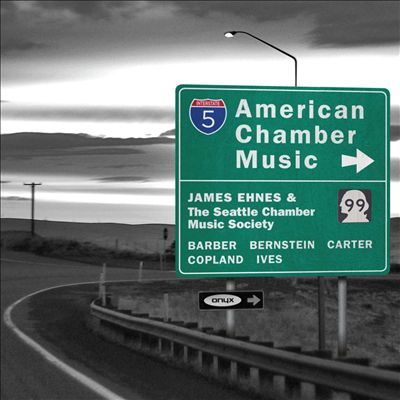
As such, this week’s album celebrates contemporary classical music a little closer to home: the Seattle Chamber Music Society performing an array of works by American composers.

MI0003772297

The album, titled “American Chamber Music,” features several musicians from the Seattle Chamber Music Society, including the group’s artistic director, renowned violinist James Ehnes. Recorded at the Seattle Chamber Music Society’s 2013 Summer Festival, the album is a compilation of works composed by Aaron Copland, Charles Ives, Leonard Bernstein, Elliott Carter, and Samuel Barber.

Ehnes and pianist Orion Weiss begin the album with Copland’s Sonata for violin and piano, a truly lyrical and theatrical work. Copland’s talent for composing balletic music is fully apparent in the piece’s gentle, glistening melodies and its poetic interplay between voices. Ehnes and Weiss play with the grace and elegance of dancers, transitioning flawlessly from the sweet and spirited Andante to the slow and somber Lento before closing with the sprightly, syncopated Allegretto.

Ives’s Largo for violin, clarinet, and piano is next on the program, catching the listener’s ear with its sweet, solemn piano introduction. The piece slowly builds in intensity with the addition of violin and clarinet, the music expanding into rich textures, striking harmonies, and unexpected syncopations before gradually retreating back to a soft, delicate ending.

The work is followed by Bernstein’s Trio for violin, cello, and piano, a theatrical piece with plenty of characters. The first movement features broad, beautiful violin and cello melodies soaring above sparkling piano harmonies. The second movement brings a change in texture, using pizzicato and stressed bowings to craft a busy, energetic soundscape. A lively, fast-paced, and purposeful third movement brings the piece to a dramatic close.

Carter’s “Elegy” for viola and piano is nothing short of enchanting. Violist Richard O’Neill and pianist Anna Polonsky perform the work with sincerity and tenderness, bringing to life melodies at once passionate and vulnerable. Their expressive and poignant performance makes it one of the album’s highlights.

The album finishes strong with Barber’s String Quartet in B minor, Op. 11. The musicians move gracefully through the first movement’s three themes: the first a dramatic motif presented by all four instruments in unison, the second a softer, chorale-like theme, and the third a tender, lyrical melody. The famous second movement features a slow, extended melody which moves through all of the instruments and climaxes dramatically at the quartet’s highest possible pitch range. The short but compelling closing movement brings the piece to dynamic and powerful end.

The passion and urgency of the quartet’s final movement serves as a beautiful, memorable coda for an album full of works by American composers whose determination and imagination helped pave the way for what contemporary classical music is today.