Diary: How to Read John Cage

by Maggie Molloy

This post is the first installment of a series on John Cage’s “Diary: How to Improve the World (You Will Only Make Matters Worse).” For future installments of the series, please visit: Part I, Part II, Part III, Part IV, Part V, Part VI, and Part VII.

John Cage 1

On my first day of college, I was a bright-eyed and bushy-tailed freshman scurrying to my first real collegiate music class: music composition. Smiling from ear to ear, I sat down between two friendly and amicable singer-songwriter types and took out my staff paper, ready to write beautiful melodies and heartfelt harmonies bursting with the truth and glory of a richly-crafted Western classical music tradition.

So imagine my surprise when I was greeted not with talk of Bach, Beethoven, Brahms, or even Berlioz—but with a two-hour introduction to the music and philosophical musings of a certain avant-garde iconoclast named John Cage.

There, on the first day of class, my composition professor performed Cage’s 40-minute utterly radical and unapologetically subversive “Lecture on Nothing.”

If you’ve never heard the piece, the title says it all: it is, quite literally, a lecture about nothing. The score is simply lines of words separated by seemingly arbitrary spaces, conveying vaguely Zen-like aphorisms and obsessive, repetitive observations.

And while it’s difficult to find communicative meaning amidst the tangled sentences (at least in any standard sense of the phrase “communicative meaning”), Cage did truly intend the work as a piece of music. Composed using a complex time length scheme and organized into 48 units of 12 lines and 48 measures each, Cage was deliberate and meticulous in the compositional process of this work.

And while—four years later—I still have no idea what the lecture actually means, I will never forget that performance. It made me feel a lot of things: puzzled, perplexed, vaguely annoyed—but also utterly engrossed and, surprisingly, inspired.

In retrospect, I’m sure the professor’s goal in showing us that work was to quickly and immediately dispel any preconceived notions we may have had about what is and what is not music; to jolt us out of the comfortable conviction that we, as aspiring composers, might fall back on the tried-and-true rules and forms of a historical musical tradition.

But regardless of his motives, that lecture has found its way into my subconscious, surfacing and resurfacing over the years in discussions of art, music, philosophy, and all things meta.

And it was precisely that lecture that piqued my interest in Cage’s other works—most notably, his monstrous five-hour art piece, “Diary: How to Improve the World (You Will Only Make Matters Worse).” The piece is a long-winded, slowly meandering poetic diary recorded by Cage himself a year before his death; a five-hour narration of fragmented thoughts, memories, quotes, convictions, and abstract philosophical insights.

Diary (Book)So this fall, I decided to embark upon the strange and unusual journey that is listening to Cage’s revolutionary ramblings for five hours—but before I could dive into this ambitious endeavor, I needed a musical score to guide me. I picked up the iconoclastic bible from Siglio Press, a trusted publisher dedicated to uncommon books that are best filed somewhere between art and literature—the books filled with knowledge and insight that transcends all possibilities of categorical book shelving.

Diary (CD)Armed with high-quality headphones and book in hand, over the course of the next eight weeks I will listen through each of the eight parts of Cage’s “Diary” and create my own personal diary tracking the experience.

So join me as I stumble through the zigzagging maze that is Cage’s musical mind—together, maybe we can make sense of it.


Go to the next installment: Diary: How to Read John Cage – Part I

ALBUM REVIEW: Rebirth of a Nation

by Maggie Molloy

81C42C1E-2581-45C0-8D43014E6E27B469

D. W. Griffith’s “The Birth of a Nation” was the first film in American history to be screened at the White House—and while that may seem like quite a triumph, the tale it tells is deeply tragic.

Released in 1915, the silent epic drama film is based on the novel and play “The Clansman” by Thomas Dixon, Jr. If the title didn’t already give it away, the film is three hours of racist propaganda portraying an extremely biased (and honestly, downright offensive) account of the American Civil War and Reconstruction era.

And it’s more than just a film: this movie helped lead to the creation of Hollywood—as one of the first pieces of sophisticated, mass-produced cinematic media, its message became embedded in our country’s history, art, and ethos. Its reverberations can be felt even now, 100 years later.

Electronic artist Paul D. Miller (better known as DJ Spooky, That Subliminal Kid) reflects on the cultural significance of this film in his large-scale multimedia performance piece, aptly titled “Rebirth of a Nation.” The ongoing interdisciplinary project includes a documentary film, site-specific performances around the world, and, most recently, a new album.

Recorded with the fearlessly experimental Kronos Quartet, “Rebirth of a Nation” is conceived as a remix and reimagination of Griffith’s original film. Miller remixed, remastered, and resynced the original score, taking a critical look at society’s racial politics and making a musical statement about it.

Kronos photographed in San Francisco, CA March 26, 2013©Jay Blakesberg

Kronos photographed in San Francisco, CA March 26, 2013©Jay Blakesberg

You can watch the trailer for the project here:

“We need more than ever to see the context that early cinema offers us,” Miller said. “As my old friend Saul Williams likes to say: Another World Is Possible. A remix of a film as deeply important and problematic as ‘The Birth of a Nation’ reminds us that, in the era of Trayvon Martin and Ferguson, many of these issues still linger with us at every level.”

The album itself retells the story through 19 short pieces for string quartet and electronics, creating a colorful, fractured, and fragmented collage of American History. Miller layers the classical strings with hip hop, folk, gospel, and blues elements, combines them with drum beats and electronic echoes, and resynthesizes them into a musical mashup of American history—thus expressing, without words, a history of racial (and musical) complexity that Griffith’s original film sought to suppress.

“Collage is the collective unconscious,” Miller said of his creative inspiration. “Sound is a phenomenon that’s totally open, so there are no real boundaries unless you make them. I like to think of all sound as just patterns, so there’s no reason to think we can’t just add patterns, subtract patterns.”

The result is a series of over a dozen unique soundscapes, each telling its own fragment of a larger story: the history of U.S. slavery and the ongoing struggle for racial equality. With ominous, grim titles like “Gettysburg Requiem,” “Ride of the Klansmen,” “Lincoln and Booth get Acquainted,” and “Ghost of a Smile,” Miller’s music tackles many of our country’s most challenging and emotionally-charged political issues. The pieces are haunting, often even hypnotic—but they certainly get you thinking.

Musically, Miller portrays Civil War and Reconstruction era America as a desolate electronic wasteland—but as he travels through this metallic and industrial landscape, he discovers and explores a number of hidden treasures: a soulful blues melody here, a folky harmonica riff there, an infectious hip hop beat beneath him or a trancelike drone just around the corner.

“From almost every angle, this kind of creativity celebrates collage, a willful breakdown of boundaries, and a playfulness that would aggravate almost anyone,” Miller said of his compositional process. “That’s kind of the point. That’s where I looked for inspiration.”

And it extends beyond music, too: the film and site-specific performances recreate the project again and again, making full use of the artistic possibilities of today’s digital age.

“Multi-disciplinary art is crucial these days,” Miller said. “It’s the way we live now. The year 2015 is science fiction for me, but we are still using the imagination of a different era to describe a cultural milieu that has evolved more rapidly than anyone anticipated. That’s kind of like using an old bicycle to race an F-34 Joint Strike Force fighter jet. It’s apples and oranges; it doesn’t make sense. That’s the paradox at the heart of my ‘Rebirth of a Nation’ film project.”

And in exploring this paradox, in critically examining that deep, dark part of American history that “The Birth of a Nation” portrays, Miller is able ultimately to offer a message of hope: We do have the power to reexamine and remix our past—and we likewise have the power to reform our present and our future.

“The realm of the possible is always greater than the realm of the real,” Miller said. “I try to navigate between the two: that’s art.”

ALBUM REVIEW: Nostalgic Synchronic by Dan Trueman

by Maggie Molloy

download (11)The avant-garde and always-iconoclastic composer John Cage shocked and intrigued audiences around the world when he invented the prepared piano in 1940. Presented with the challenge of writing dance music for a small stage with no room for a percussion group, Cage discovered it was possible to create an entire percussion orchestra with just a single instrument: a grand piano.

His creation was the prepared piano: a piano that has had its sound altered by placing everyday objects such as screws, bolts, and pieces of rubber on or between the strings.

“With just one just one musician, you can really do an unlimited number of things on the inside of the piano if you have at your disposal an exploded keyboard,” he famously stated.

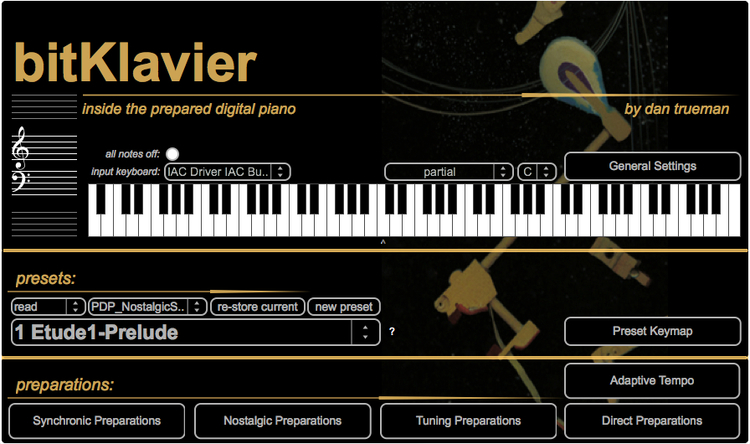
And it was precisely this notion of an exploded keyboard that inspired composer, fiddler, and electronic musician Dan Trueman to create a 21st century version of the instrument: the prepared digital piano.

download

“Like the prepared piano, the prepared digital piano feels like a piano under the hands and often sounds like one,” Trueman said. “But it is full of surprises; instead of bolts and screws stuck between the piano strings, virtual machines of various sorts adorn the virtual strings, transforming this new piano into an instrument that pushes back, sometimes like a metronome, other times like a recording played backwards. The virtual strings also tighten and loosen on the fly, dynamically tuning in response to what is played.”

His new album, “Nostalgic Synchronic,” explores the vast possibilities of the instrument through a series of eight etudes performed by percussionist and pianist Adam Sliwinski of Sō Percussion.

“My set of etudes, called ‘Nostalgic Synchronic,’ are inspired by the tradition of etudes by composers like Ligeti, Bach, Chopin,” Trueman said, “In that they’re meant to demonstrate the technical range of the instrument and the player, but also to stand on their own as compositions.”download5

The etudes make use of three major types of preparations designed by Trueman: synchronic, nostalgic, and tuning. And in true 21st-century fashion, Trueman has made these preparations available as an app (or as standalone software) for listeners to download and use on their own digital keyboards at home.

download (13)

In the synchronic preparations, any notes struck within a given chord are gathered and automatically struck on every tick of the keyboard’s digital metronome—until the player strikes a new chord, then the keyboard resets its metronome to that new time and new chord. The entire keyboard can function this way, or particular keys may be selected to be “synchronic,” allowing for an infinite number of accent patterns, melodies, beats, and chord combinations.

The nostalgic preparation is a reverse delay that is shaped and constrained by the prevailing metronome pulse: essentially, when a pitch is struck and released, the keyboard samples the note and plays it backwards so that it reaches its mirrored attack in sync with the next click of the metronome.

Last is the tuning preparation, which allows the player to switch freely between three different types of tunings during performance: standard equal temperament, just-intonation temperament, and what Trueman calls “partial tuning,” which is based in part on intervals drawn from the overtone series.

Sound complicated? Here’s a video with some simple examples: 

Dan Trueman – The Prepared Digital Piano from Troy Herion on Vimeo.

As you can imagine, these preparations allow for infinite musical possibilities—many of which are demonstrated in Trueman’s collection of etudes. From the persistent rhythm and the spacey, sliding sonic structures of “Prelude” to the repetitive melodic figures and jagged chord clusters of “Song,” each piece explores the breadth of textural and timbral possibilities on the instrument.

In fact, “Undertow” sounds almost as though the pianist is exploring the instrument for the first time—with fingers curious and gentle, listening intently to each note as the tunings echo and shift. By contrast, “Marbles” is a glitchy, jittery little jig that sounds almost like a toy piano or a vintage video game—that is, until the growling bass rolls in.

“Wallumrød” mixes jazzy riffs with the sonic sway and reverse fade-attack of the nostalgic preparations, while “Systerslått” takes its mysterious tunings, wobbly groove, and folky ornamentation from a Norwegian fiddle tune. The album ends with “It is Enough!” a slow and gentle tune that twinkles like a music box—you know, if that music box was filled with echoes of electronically-manipulated melodic fragments.

So forget what you know about classical harmonic progressions—you’ll find no reassuring V-I on “Nostalgic Synchronic.” But what you will find is someone willing to start all over, to rediscover a tried-and-true instrument and create something entirely new. After all, who says piano keys have to be just black and white?

ALBUM REVIEW: Eighth Blackbird’s “Filament”

by Jill Kimball

Forget J. S. Bach: Philip Glass is the new granddaddy of music…or so sayeth eighth blackbird in its latest album, Filament.

This new release from the Chicago-based contemporary music supergroup cleverly connects the groundbreaking repetitive structures in Glass’s music with American folk tunes, contemporary compositions, and poppy vocals. The album’s name is meant to conjure a mental image of musical threads linking all its performances, new and old.

In this case, “old” is a relative term. The nexus of Filament is “Two Pages,” written by Philip Glass in 1968. It’s a classic illustration of Glass’s signature repetition, a mind-bending 16 minutes of subtly changing patterns. The piece famously sounds meditative and nightmarish at the same time. It’s notoriously difficult for performers–the liner notes compare it to walking a tightrope “with no net below”–but the expert musicians here meet the challenge admirably, almost making it sound easy. Performing this piece alongside the sextet are organist Nico Muhly and guitarist Bryce Dessner (of The National), and it’s no coincidence that both of them are also featured composers on Filament.

In fact, the album opens with Dessner’s multi-movement piece Murder Ballades, inspired by folk songs about real and imagined killings that were passed down through many generations. The murder ballad tradition began in Europe, but Dessner’s piece focuses on the maudlin stories that originally come from early settlers in New England and Appalachia. Dessner chose to arrange three real ballads, “Omie Wise,” “Young Emily,” and “Pretty Polly,” all of which tell stories of love affairs turned violent. Imagine if someone took the music from a Ken Burns documentary and gave it a little edge, and you’ll have an idea of what these movements sound like. The other four ballads in the piece are Dessner’s original compositions, still clearly inspired by early Americana but more deconstructed and intense. In these four movements, Philip Glass’s repetitive, meditative influence is clearly felt.

FilamentComposers

Composers featured on Filament. Clockwise from top left: Nico Muhly, Philip Glass, Bryce Dessner, and Son Lux.

Nico Muhly’s piece, Doublespeak, is so closely linked with Two Pages that it’s as if Muhly managed to burrow directly into Philip Glass’s midcentury brain. Muhly wrote this piece for the composer’s 75th birthday celebration, so it’s fitting that he chose to salute a decade when “classical music perfected obsessive repetition,” as he puts it. You’ll hear snippets of 1970s staples like In C and Violin Phase flit in and out as the piece alternates between a fast-tempo frenzy and a slow, dreamy state.

As if there weren’t already enough threads connecting these three pieces, eighth blackbird rounds out Filament with a pair of works by Son Lux. The legendary pop-classical electronic composer took sound bites from the album and mixed in Glass-inspired vocals by Shara Worden, aka My Brightest Diamond. The result is a half-ambient, half-catchy five minutes that nicely break up the album’s studied repetition, which can be a little mentally taxing.

It goes without saying that the performance quality on this disc is top-notch, no less fine than any of eighth blackbird’s past albums. You’re luxuriously free to focus solely on the compositions themselves, all of which are worth contemplating at length. In an age when most albums’ connecting filaments are somewhere between ultrathin and nonexistent, it’s a pleasure to listen to a set of pieces with such close ties.