ALBUM REVIEW: Ispirare by Melia Watras

by Maggie Molloy

Think of the composers that have most inspired you. What is it about their music that makes your ears perk up, your heart soar, and your soul come alive? What is it about their music that makes you want to pick up an instrument and play something?

Press1
Violist Melia Watras asks all of those questions in her new album, “Ispirare”—but she also asks one more: what is the music that most inspired the composers themselves?

“‘Ispirare’ consists of contemporary music for viola and the pieces that inspired their creation,” Watras said. “I wanted to build a program around works that were not only engaging to perform and listen to, but also provided a creative spark for other composers.”

Watras has commissioned and performed numerous works by living composers throughout her career as a soloist, chamber musician, and recording artist—establishing herself as a very versatile violist in the contemporary classical music scene.

So who made it on Watras’s list of most inspiring contemporary composers? The album features works by George Rochberg, Atar Arad, Luciano Berio, and Shulamit Ran.

“Ispirare” begins with George Rochberg’s 1979 Sonata for Viola and Piano. Written late in his career, the piece is a lush tapestry of gorgeous melodies with clear ties to earlier composers. The first movement makes heavy use of chromaticism, extended tonality, and a unique harmonic language at times reminiscent of Bartók, while the dramatic, sweeping piano figures pay tribute to Richard Strauss. The soaring melodies and poignant lyricism of the second movement glide above jazz-infused harmonies, and the third movement ties the piece together with a neoromantic fantasia, an epilogue of sorts borrowing bits and pieces from the first two movements.

The piece that follows, “Caprice Four (George),” was inspired by Rochberg’s sonata, and even quotes part of it. Composed in 2003 by Watras’s former viola professor, Atar Arad, the piece is part of a set of viola caprices which Arad intended as “thank you notes to composers who graced us with great viola pieces.” With the exception of the opening phrase, the caprice is played entirely on the G string of the viola, with the instrument’s rich tone ringing and echoing unaccompanied. Intimate and exposed, the piece showcases the viola’s immense power and force as an instrument—and likewise Watras’s intensity and expressivity as a soloist.

In another cross-musical connection, Atar Arad’s daughter, singer Galia Arad, appears on the album’s next track: Luciano Berio’s “Black is the Color…” from his 1964 song cycle, “Folk Songs.” Composed for mezzo-soprano and small chamber group, the piece borrows from American, Armenian, Azerbaijani, and Italian folk traditions. Wistful viola motives and modal harmonies accompany Galia Arad’s gentle, daydreaming voice as she drifts through the sweet, simple, and sincere vocal melodies.

The song is so achingly beautiful, it’s no wonder it was the inspiration behind the next piece on the album, Shulamit Ran’s 2010 “Perfect Storm.” Watras commissioned Ran to compose a piece that made use of an existing work of her choice, and Ran chose to expand upon the viola motif in Berio’s song. The result is an unaccompanied viola solo which travels through a series of diverse musical landscapes: at times rocky, jagged, and intense, but at other moments sweet, shy, longing, and lyrical. It is (as the title suggests) the perfect storm: wind, rain, and rhythmic turmoil envelop the listener before the clouds clear, the pizzicato pitter-patter fades away, and they are left with a beautiful, airy silence.

The final and most experimental piece on the album is Berio’s 1985 “Naturale (Su Melodie Siciliane),” written for viola, percussion, and the recorded voice of a Sicilian folk singer. Recorded by the composer in Palermo, the voice belongs to Celano, whom Berio described as “perhaps the last true Sicilian storyteller.” The piece highlights the contrast between the highly refined classical transcription of folk songs with the raw and organic voice of a true folk singer. It’s the perfect ending to the album, as it juxtaposes, quite plainly, the musical inspiration itself with the music that it inspired.

And like all of the pieces on the album, “Naturale” illustrates the way musicians both inside and outside of the classical music sphere can teach one another, learn from one another, engage with one another, and ultimately, inspire one another.

PS, If you missed Melia’s edition of “The Takeover” with her husband Michael Jinsoo Lim, listen below!IMG_5874-Edit-Edit-Edit+copy

concert preview: Q&A with Dorothy Chang

by Maggie Molloy

In the world of classical composition, women who write music are far outnumbered by their male peers—and this imbalance is a sensitive issue for composers, musicians, and concert programmers alike.

Fortunately many music organizations are taking steps forward to break down assumptions and stereotypes within the music industry by highlighting the works of contemporary female composers. One such organization is Seattle’s own North Corner Chamber Orchestra (NOCCO).

01

Known for their dynamic performances and adventurous programming, NOCCO’s 2015-2016 season features works by three different American women composers. The first concert, taking place this weekend, features a performance of Dorothy Chang’s eclectic and expressive Virtuosities.

Second Inversion sat down with Dorothy to ask her five questions about Virtuosities, female composers, and NOCCO’s upcoming season.

download (35)

Second Inversion: What is the story or emotion behind Virtuosities, and how would you describe this piece?

Dorothy Chang: Virtuosities for string orchestra was commissioned by the Manitoba Chamber Orchestra in 2012 in honour of its 40th anniversary season.  Given the occasion, I was inspired to write a work that celebrates music history and tradition while also embracing the new and innovative.  Virtuosities seeks to draw connections between the music of the past and present, either through points of intersection or through sharply contrasting juxtaposition.

In the first movement, “To dream, perchance to fly,” a lightning-fast tempo and continuous, overlapping rising figures are meant to create a breathless, whirlwind energy, referencing elements of Baroque virtuosity within a contemporary context.   Beginning in B minor, the movement quickly becomes tinged with chromaticism, with juxtaposed layers of contrasting material, as if creating one big swirl of musical activity combining the old and the new.

The second movement, “Souvenir,” is intimate and lyrical, inspired by the slow movement of Vivaldi’s Violin Concerto in A minor.  In Vivaldi’s movement, I’m struck by how a simple texture achieves such poignancy and expressivity.  Similarly, in my own second movement, I tried to feature the beauty of a simple melody-and-chordal texture, enriched with an expanded sound palette of distinct colours and timbres.

In the final movement, “Mechanica,” an energetic walking bass serves a constant driving pulse over which a hodgepodge of various short musical quotes and other musical references are spliced, layered and woven together.


SI: How is this piece similar to and/or different from your other compositions?

DC: This piece is different from my other compositions in that it uses quotation, and it references Baroque and Classical music in a way that I haven’t done before in my other works.   The mixing of tonality and atonality is something I do explore often in my music, though in this work the two languages are presented more as a dichotomy rather than the blended mixture that I might use more typically.

Also, this piece is in three movements; the multi-movement form is typical of most of my compositions.  When starting a piece, I usually find I have a number of ideas I’d like to explore, and I’ve found the multi-movement form a good way to incorporate contrasting characters and materials within a single work.   I’m also drawn to exploring larger structures that can be built through the succession of multiple movements, and to shape the dramatic arc they form, as if creating a musical or emotional journey.


SI: What composers, artists, or styles of music most influence your work?

DC: I am inspired by and influenced by different types of music that I’ve heard, performed or studied from my childhood to the present.  My first exposure to classical music was from learning piano, so the influence of Romantic music, particularly piano repertoire, is strong.  Although my music might not sound very much like Brahms, Rachmaninoff or Schumann, there is a strong emphasis on melodic lyricism, sweeping Romantic gestures and rich harmonies.

The influence of popular music and, in certain works, Chinese music is also present.  Once I became aware of contemporary music, the composers whose music influenced me most included Debussy, Stravinsky, Lutoslawski, Takemitsu and Ligeti.  More recently, the music that inspires me is wide-ranging, and could include anything that happens to catch my ear, be it contemporary, popular, world music, etc.  The influences may not be immediately apparent in my music, but I am always consciously aware of their presence in my work.


SI: Three out of the four NOCCO programs this season feature American women composers’ works. Why do you think this is a significant programming decision?

DC: It looks like a great season, and I’m delighted to be in such good company!  The issue of women composers and programming continues to be a rather sensitive one (I remember becoming acutely aware of the issue as the only female in my graduate composition program years ago), and I have to say that I look forward to the day when the programming of music by female composers is something that happens spontaneously through the programming of good music, period.

I do think this is happening more and more, though one still comes across contemporary music concerts that include no music at all by women composers.  In this day and age, with so many talented women composers writing exciting, engaging, and unique music, it does perplex me how this is even possible.

As for NOCCO’s season: I’m thrilled to see such diverse and innovative programming.   I honestly don’t know if the programming was done specifically with the intention of featuring women composers, though I’m certainly excited that important and influential voices such as Laura Schwendinger and Joan Tower are included.  If the listener hasn’t had the opportunity to hear the music of these composers, it’s wonderful for NOCCO to bring it to a new audience.


SI: What do you hope audiences will take away from listening to Virtuosities?

DC: Virtuosities was written as a work that would bring together various old and new elements, and each movement reflects on this theme in its own way.  My hope is that the audience will connect with the music and the emotion and intention behind it:  the breathless energy and excitement of the opening movement, intimate lyricism broadening into lush gestures in the second movement, and the rhythmic drive and quirky turns of phrase in the closing movement.   This is a celebratory piece that I hope will engage the audience, and perhaps inspire them to hear both traditional and contemporary elements in a new context.


Performances are Saturday, Oct. 31 at 2 p.m. at University Christian Church in the University District and Sunday, Nov. 1 at 7:30 p.m. at the Royal Room in Columbia City. In addition to Dorothy Chang’s Virtuosities, NOCCO musicians will also be performing Alfred Schnittke’s Concerto for Piano and Strings (featuring pianist Cristina Valdés), Jacques Ibert’s Three Short Pieces for Wind Quintet, and Mozart’s Symphony No. 29. For additional information and tickets, visit NOCCO.org.

“Migration Series”: Q&A with Derek Bermel

In anticipation of Seattle Symphony’s first Sonic Evolution series concert, “Under the Influence Of Jazz,” we had a chance to talk to Derek Bermel about his piece, “Migration Series,” which will be part of a star-studded program. The concert is tonight, Thursday, October 29 at 7:30pm at Benaroya Hall. Be sure to stop by the KING FM/Second Inversion table and grab some swag!

poc4

Second Inversion: Do you think the fusion of genres in Seattle Symphony’s Sonic Evolution series is a good strategy to expand and diversify the audience?

Derek Bermel: Absolutely. I think when you can give audiences a hook to come see something they’re familiar with and then you hit them with something they’re not so familiar with, it’s a gentle way of exposing way them to music they might not know about.  I think it’s truly a groundbreaking series – I’ve been following what Seattle Symphony’s been doing for the last four or five years.  Ludovic Morlot and Simon Woods are looking at music and art holistically as it effects peoples’ lives and they’re looking at what’s going on locally and trying to build in pathways for people who are not normally familiar with symphonic music to get into the vibe.

jb1_2015_2016_4

Roosevelt High School Jazz Band, who will perform “Migration Series” with Seattle Symphony

SI: The title of tonight’s show is “Under the Influence of Jazz.” How has jazz influenced your composition style as a whole? 

DB: I grew up listening to and playing a lot of jazz, so there was a lot of influence right from the start. I was and still am a huge fan of Thelonious Monk and I remember walking into the record store as a kid and seeing a bright red record in the bargain bin and spending my allowance on it.  That record, “It’s Monk’s Time,” really blew my mind and changed my life.  It coincided with the time in my life when my grandma bought me a small, “honky tonk” piano and I immediately started imitating Monk’s playing on this piano.  It really worked on this piano because it had some keys that didn’t go down all the way and it went out of tune quickly, but I really got that stride and feel by imitating Thelonious Monk.  I also played clarinet and saxophone in the jazz band and was listening to a lot of Bill Evans, Charlie Parker, Coleman Hawkins, Duke Ellington.

jacoblawrence

Jacob Lawrence

SI: And how about the visual artistic influence of Jacob Lawrence? Tell us about your experience with his set of paintings “The Migration Series,” and how it influenced this composition.

DB: I first encountered the paintings when I was young, going into the city (New York) with my mom and saw the exhibit.  There was something about them that struck me in such a deep way. I think it was my connection to African American music and my friends and I saw something in the paintings that felt like music and felt like dance. They jump off the page and they’re very evocative of gesture, shapes, colors, and movement.  I was very drawn to these pictures and they stayed in my mind for many years.  When I started to write this piece, there was something about the form and the way I was writing that had kind of a mosaic quality. I wanted musical themes, approaches, and rhythms to come back during the piece, and for the piece to ebb and flow with this mosaic quality.

I’ve been lucky enough that the Seattle Symphony and Maestro Morlot are interested in having the images displayed along with the show.  It’s an idea that’s been brought up before, but this time it’s actually going to happen!  I’m very excited see how the piece will play with the images.  For me, the thrill is to introduce more people to this artwork as well.  It feels very powerful as an artist to be able to make a tribute to another artist that you admire so much and to let people know about it. A lot of people have gotten to know Jacob Lawrence’s work through my piece, so that’s very gratifying for me as an artist.

And for a taste of the piece and Derek’s insights about the structure of the piece, take a listen!

Diary: How to Read John Cage – Part I

by Maggie Molloy

This post is part of a series on John Cage’s “Diary: How to Improve the World (You Will Only Make Matters Worse).” To read the introduction to the series, click here

john cage, paris 1981

john cage, paris 1981


Listening to John Cage’s “Diary” feels vaguely like taking a hearing test at the doctor’s office. Sometimes he’s speaking into your left ear, sometimes your right. Sometimes his voice is distant, sometimes it’s right up behind you like that little moral conscience you just can’t get out of your head.

It’s not until six minutes in that he acknowledges this compositional decision—and even then only vaguely, indirectly, perhaps not even at all.

“We see symmetrically: canoe on northern Canadian lake, stars in midnight sky repeated in water, forested shores precisely mirrored,” he says calmly, slowly. “Our hearing’s asymmetrical: noticed sounds surprise us, echoes of shouts we make transform our voices, straight line of sound from us to shore’s followed by echo’s slithering around the lake’s perimeter.”

I suppose I’d never thought of hearing as asymmetrical—that is, until I found myself listening through Part One of John Cage’s eight-part “Diary: How to Improve the World (You Will Only Make Matters Worse),” leaning sideways slightly in my chair as I listened to his voice meander through my right headphone, the left headphone oddly empty, quiet.

Don’t you hate that feeling? When some crucial wire in your headphones breaks and they begin to only play music out of one ear? But these headphones are not broken; the sporadic shifting of Cage’s voice from one ear to the other, to both, to neither, is all part of the composition. Cage achieved this aural effect by changing the position of the microphone and the recording volume throughout the recording process. Not surprisingly, the visual counterpart for this piece is similarly warped.

In fact, reading the manuscript for Cage’s “Diary” is sort of like reading a scrapbook—each phrase in a different color, font, size, style. Each sentence just a short fragment depicting a distant memory or a larger poetic truth.

Excerpt

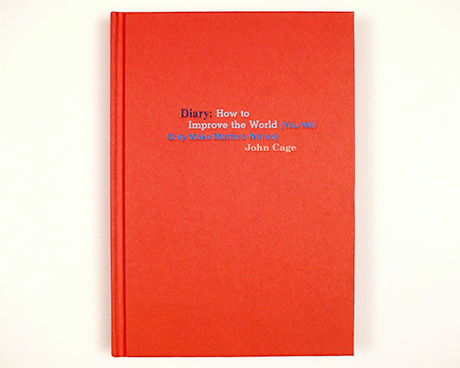
My trusted copy of the diary comes from Siglio Press, an independent publisher dedicated to uncommon books that live somewhere in the mystical realm between art and literature. The beautiful new edition from Siglio, published on Oct. 27, collects all eight parts of the diary for the first time, rendering the entire text in color.Diary (Book)

One of Cage’s most personal and prophetic works, “Diary” was composed over the course of 16 years and recorded in Switzerland a little over a year before his death in 1992. Cage had intended for the diary to have ten parts, though only eight were completed by the time he died.

He originally typed the score on an IBM Selectric typewriter, using chance operations to determine the word count, the application of various typefaces, the number of letters per line, and even the patterns of indentation. For this particular Siglio publication, co-editors Richard Kraft and Joe Biel also used chance operations to render the entire text in various combinations of the original red and blue colors, as well as to apply a single set of 18 fonts to the entire work.

For Cage, these chance operations, aural alterations, and visual variations are all part of the composition. After all, Cage was a pioneer of indeterminacy in music, with many of his most daring compositions leaving crucial musical choices to the whim of the performer, the environment, or even the audience—most famously, the score for his 1952 piece, “4’33”,” instructs the performer(s) not to play their instrument(s) at all during the entire duration of the piece, insisting that the sounds of the surrounding concert environment are in fact the music itself.

A common theme throughout Cage’s wide-ranging works is this notion of inclusion—the idea that the entire world is music and the performer, the audience, you, me, and everything around us are all involved in the composition.

“He wanted me to agree that the piano tuner and the piano maker have nothing to do with it (the composition),” Cage states in the diary, not specifying who “he” is. “The younger ones had said: Whoever makes the stretcher isn’t separate from the painting. (It doesn’t stop there either.)”

But where does it stop? For Cage, I suppose it never stops; the line between art and everyday life simply does not exist.

“Art’s obscured the difference between art and life,” he says. “Now let life obscure the difference between life and art.”

His diary’s discussion of art extends far past artwork itself, all the way into the trivial details of everyday life and back out into the vast expanse of history, global politics, philosophy, science, and society—all with an idiosyncratic dose of humor and wit.

“City planning’s obsolete,” he says slowly. “What’s needed is global planning so Earth may stop stepping like octopus on its own feet.”

And despite Cage’s deadpan delivery, I couldn’t help but smile. It’s Cage’s vivid imagination, sincere curiosity, and subtle charm that makes his diary a true work of art.

“They ask what the purpose of art is,” he says gently. “Is that how things are? Say there were a thousand artists and one purpose, would one artist be having it and all the nine hundred and ninety-nine others be missing the point?”

Go to the next installment: Diary: How to Read John Cage – Part II

ALBUM REVIEW: “you of all things” by Jodie Landau & wild Up

by Maggie Molloy

download (17)Most 23-year-old classical musicians are just beginning their careers: they’re fresh out of college, joining their first chamber groups or small-scale symphonies, maybe playing local concerts here and there, or preparing for grad school. But composer, vocalist, and percussionist Jodie Landau is not your typical 23-year-old.

download (35)He works with the acclaimed Los Angeles-based modern music collective, wild Up, as a performer, composer, and production manager. He’s toured and performed around the world, has collaborated with renowned classical and jazz groups alike, and recently even traveled to Iceland to collaborate on a concert and recording with Graduale Nobili (you know, the Icelandic choir that recorded and toured with Bjork for three years). As a solo performer, he sings while playing vibraphone and marimba.
Just consider that for a moment. How many vibraphonists or marimba players do you know? Probably not very many. And of them, how many sing while playing, compose their own music, collaborate with multimedia artists, and tour the world? Probably even fewer.

Did I mention Landau also recently released a new album with wild Up?

It’s called “you of all things,” and it features six vocal works by Landau, as well as works by Ellen Reid, Marc Lowenstein, and Andrew Tholl. In addition to composing over half of the works on the album, Landau also sings and plays vibraphone, crotales, bass drum, and piano on the recordings.

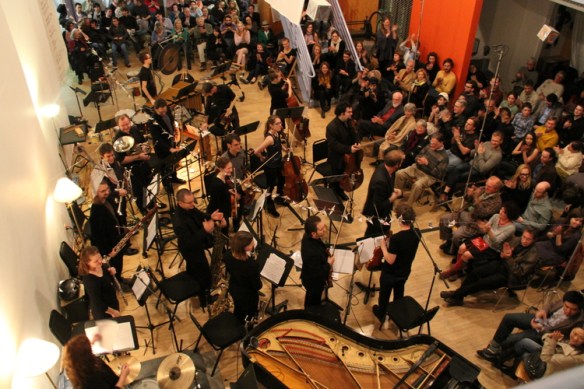
Of course, having an adventurous chamber orchestra to collaborate with certainly doesn’t hurt. Led by artistic director and conductor Christopher Rountree, wild Up is committed to creating visceral and thought-provoking musical happenings, transforming the concert space into a place without borders—a place filled with endless possibilities to connect and create with one another.download (16)

In short, it’s the perfect group to perform Landau’s music, which merges elements of classical chamber music, rock, and jazz with multidisciplinary art forms such as live performance, film, theatre, and dance. The album features performances by Landau with wild Up and background vocals by Graduale Nobili.

And it all begins with “an invitation.” A short and sweet introduction to the album, Landau’s vocals swell with sincerity above clarinet motives and Graduale Nobili’s softly shimmering vocal harmonies.

But their voices take on quite a different role in the piece that follows: Ellen Reid’s “Orlando & Tiresias.” The piece is a striking and surreal duet between Landau and the chorus, with dynamic and textural contrasts so dramatic that the piece is at times almost reminiscent of a rock opera.

Landau’s “the taste of the room” sounds like something of a dissonant watercolor painting: strings, woodwinds, and wordless vocals blend together and sway apart to create a mesmerizing sonic landscape.

Speaking of painting, Landau incorporates a stroke or two of tone-painting in the beginning of his sweet and sincere “a ballad – for you dear.” Delicate harp ornamentation compliments his delicate lyrics as he sings of love, where “we dream and wake in heaven.” But the sweetness is short-lived, and the song transforms entirely as he encounters (and then overcomes) the greatest tragedy: heartbreak.

Marc Lowenstein’s two-part “This” is the most rhythmically adventurous piece on the album, though Landau remains in calm control of his vocals above the unrelenting, ominously dark, and at times even chaotic bed of instrumental textures.

The work is followed by a similarly ethereal piece by Andrew Tholl: “Memory Draws the Map We Follow.” A ghostly choir of vocal melodies floats above airy strings and a grim, growling bassline, drawing a meandering map of otherworldly haunts.

The album comes to a close with three more compositions by Landau. The first, “as I wait for the lion,” is a simple, swelling, and poignant piece that pulls on the listener’s heart strings with each and every pluck of the sparkling harp, each and every knock of the delicately twinkling percussion behind Landau’s heartfelt voice.

Landau’s vocals takes on more of a pop music aesthetic in “stay going nowhere,” a piece which combines the unrelenting energy of a rock song with the intricate orchestration of a chamber work.

But he saves the best for last: the most charming piece on the album is “as we sway,” a lovely and lyrical ballad with Landau’s warm, gentle voice humming above a delicate pizzicato backdrop. By the end of the album, it’s clear that this is a young man who is feels his emotions deeply and viscerally—and who is ready to explore them through the full spectrum of musical expression.

Not bad for a 23-year-old.

download (18)