Diary: How to Read John Cage – Part III

by Maggie Molloy

This post is part of a series on John Cages Diary: How to Improve the World (You Will Only Make Matters Worse). For earlier installments of the series, please visit: Introduction, Part I, & Part II

John Cage Part III

Imagine yourself listening to the radio.

Nothing too out of the ordinary, just you by yourself in a room, the radio dial tuned to your favorite station. Maybe you’re grooving to some jazz tunes, gettin’ down to James Brown, rocking out to the Top 40, or maybe even tuning in to talk radio (you know, if you’re into that).

Now imagine yourself listening to 12 radios. All at once—and all tuned to different channels.

Yes, that’s right. Now you are simultaneously listening to jazz and James Brown, Top 40 and weather forecasts, talk radio and even (Heaven help us) the country channel.

That was precisely the premise behind John Cage’s 1951 piece “Imaginary Landscape No. 4,” scored for 24 performers at 12 radios. It is organized chaos. Of course, the piece doesn’t describe a physical landscape but rather, a landscape of the future—a landscape exploring the possibilities of what were, at the time, new and unknown technologies.

“It’s as though you used technology to take you off the ground and go like Alice through the looking glass,” Cage said of his inspiration for the piece.

Reading through Cage’s “Diary” is a bit like falling through the looking glass, as well. His reflections can be silly and nonsensical, curious and contrary, fragmented and, at times, even frightening. There is no topic left untouched: art, music, philosophy, culture, culinary arts, and even politics.

In fact, it’s a bit like listening to 12 radios at once. It’s a random mix of the everyday along with the breaking news; a thousand stories told all at once. One moment, he’s discussing political summit meetings and the next, he’s comparing the musical philosophies of Stravinsky and Schoenberg. (Cage was, in fact, a student of the latter.)

But it is not until Part III of his eight-part diary that he actually digs into the more social and political aspects of the work—the actual “How to Improve the World” part, so to speak—and he does this in a myriad of ways.

Some remarks are just petty observations about everyday inconveniences:

“Something needs to be done about the postal services,” he says dryly. “Either that or we should stop assuming just because we mailed something it will get where we sent it.”

While others have much more serious implications:

“Bertrand Russell asks American citizens: Can you justify your government’s use in Vietnam of poison chemicals and gas, the saturation bombing of the entire country with jelly-gasoline and phosphorus?” he asks gravely. “Napalm and phosphorus burn until the victim is reduced to a bubbling mass.”

Truth be told, I was caught a bit off guard by his abrupt (and clearly weighted) mention of the war in Vietnam—I had to remind myself that as otherworldly as some of Cage’s music may be, he did not, in fact, exist in a vacuum. He was an idealist, yes, but he was also a socially- and politically-conscious artist—he was a thinker and a citizen of the world, and his art was constantly being shaped and influenced by his surroundings.

Diary Excerpt Part III “In music it was hopeless to think in terms of the old structure (tonality), to do things following old methods (counterpoint, harmony), to use the old materials (orchestral instruments),” he says. “We started from scratch: sound, silence, time, activity.”

In other words, he started from what was around him. He created music scored for 12 radios because he was growing up during the rise of radio and broadcasting, the rise of music being transmitted electronically rather than performed live, in-person.

In fact, “Imaginary Landscape No. 4” was a reaction against radio, more than anything. Cage didn’t like the radio, so he began using it in a new way—as a musical instrument itself, rather than as a transmitter of music. He wrote a number of pieces featuring radio, and by the 1980s it was one of his favorite instruments:

“Almost as favored by me as the sounds of traffic,” he said in a 1986 interview with artist Richard Kostelanetz.

For Cage, sound is music, regardless of the context or the intention.

“I love sounds, just as they are, and I have no need for them to be anything more than what they are,” he says. “I don’t want them to be psychological. I don’t want a sound to pretend that it’s a bucket, or that it’s a president, or that it’s in love with another sound. I just want it to be a sound.”

Indeterminacy was a way of creating sound without meaning—crafting unpredictable and arbitrary music that could exist only in that moment. No narrative, no love story, no tragedy, no flowing melodies, and no meaning—just the simple experience of sound.

“Sounds everywhere,” he says in his diary. “Our concerts celebrate the fact concerts’re no longer necessary.”

Our world is saturated with music and art—it exists everywhere around us if we bother to look at and listen to it. Cage’s work reminds us to stop recreating the classics of the past and to start opening ourselves up to the music of the present.

“We have everything we used to have,” he says in his typical deadpan manner. “The Mona Lisa’s still with us for instance. On top of which we have the Mona Lisa with a mustache. We have, so to speak, more than we need.”

I’m pretty sure I can hear him smiling as he says it, but he doesn’t betray even a hint of laughter. He’s right—we do have more than we need. We have plenty of masterpieces from throughout the centuries, but if we simply continue regurgitating the same ideas over and over, then we are just making a mockery of the originals.

Perhaps the real art is in shifting our understanding of art itself, abandoning our expectations, and opening our minds, hearts, eyes, and ears to the present. Perhaps the real art is in listening to 12 radios at once and hearing the beauty of the sounds themselves—no meaning, just music.

“Art instead of being an object made by one person is a process set in motion by a group of people,” he says. “Art’s socialized. It isn’t someone saying something, but people doing things, giving everyone (including those involved) the opportunity to have experiences they would not otherwise have had.”

Go to the next installment: Diary: How to Read John Cage – Part IV

ALBUM REVIEW: Liaisons: Re-Imagining Sondheim from the Piano

by Rachele Hales

I was excited – well, excited and scared – to be given the opportunity to review Anthony de Mare’s latest album of Stephen Sondheim “re-imaginings.”  Excited because Sondheim’s impact on me was very strong as I was one of many children who listened; scared because I didn’t want to find flaws in the interpretations that might underscore my devotion to the originals.  After listening to Liaisons: Re-imagining Sondheim From the Piano several times, I can calm similar worries other listeners may have by entreating you to remember that “the way is clear, the light is good/ I have no fear, nor no one should.”

image172766895

Thirty-six composers from a wide variety of backgrounds were commissioned by Anthony de Mare to re-imagine a Sondheim song of their choice as a solo piano piece.  The result proves that things change – but they don’t, when you make something that lasts.  Mark Eden Horowitz, author of Sondheim on Music: Minor Details and Major Decisions, puts it this way: “One of the reasons Liaisons succeeds so brilliantly is because Sondheim’s music is such a rich source for sounds, ideas, and approaches.”  Too true.  The pleasure of Liaisons is hearing how thirty-six other Sondheim fans engage with his music in their own ways.  There are thirty-seven selections in the 3-CD collection.  So many worth exploring, just one would be so boring.  Alas, it’s impossible to review them all here but you can listen to samples of each glorious one at the Liaisons Project website.  With that said…  Curtain up!  Light the lights!  Play it, boys!

AlbumFrontBack

Once upon a time, all your favorite fairytales were combined into one story about loss and confusion.  Oh yeah, and nearly everyone dies.  Sondheim’s original prologue to Into the Woods acts as both exposition by introducing us to each character and also provides a path through the show.  Andy Akiho’s version takes us into the woods, where witches, ghosts and wolves appear, by maintaining the driving rhythm of the original but allowing each character’s narrative/personality to speak with the clever use of a prepared piano.  Dimes were used on the strings for the cow scenes, door knocks and narration utilized poster tack, and the witch is portrayed by clusters of credit cards.  Akiho’s use of these found objects to alter the timbre is just as effective and innovative as Sondheim’s witty spoken narrative.

When asked about his intent with the Into the Woods’ climactic ballad “No One is Alone,” Sondheim replied, “What I truly mean is that no action is isolated.”  One action you can take is to write a musical, only to find its score the subject of a landmark commissioning twenty-nine years later.  Fred Hersch drew from his jazz background to make subtle changes to the piece.  In doing so, he’s maintained the purity and simplicity of the original but plumped it up to create a lusher sound.  It feels less like an arrangement and more like a fantasia.

With Kenji Bunch’s selection we attend the tale of Sweeney Todd, the demon barber of fleet street.  Sweeney Todd is based on an urban legend (though some claim the story is true) from Victorian London about a barber who seeks revenge upon the corrupt judge who sentenced him to unjust incarceration, raped his wife and caused her insanity, and eventually kept Todd’s daughter Joanna as his ward for lustful reasons.  Todd’s revenge of choice?  Slitting the throat of the judge (and other clients) and partnering with his amoral landlady to grind the flesh, use it as fillings for her meat pies, and turn a handsome profit.  It’s a musical thriller that wonderfully sustains fear and anxiety throughout, which Bunch amplifies to horror-show levels with “low register rumblings, shrieking high clusters, and insistent rhythmic ostinato patterns.”

Venezuelan composer Ricardo Lorenz turns those meat pies into spicy empanadas with his “Worst Pies In London”/”A Little Priest” combo.  Mrs. Lovett’s cheeriness shines through here with help from a range of Latin American styles including tango, salsa, and merengue.  But is it any good?  Sir, it’s too good, at least.

“Green Finch and Linnet Bird” is Joanna’s song to the caged birds she identifies with while sequestered in the judge’s home.  Toward the end of the original number there’s a trill notated for the singer and Jason Robert Brown found his way into the arrangement through that trill.  Rather than focusing on Joanna, he’s chosen instead to paint pianistic portraits of the birds.  A charming notion, but the aviary became too complex.  He thought one was enough; it’s not true.  It takes two to play his “Birds of Victorian England.”

Hopping across the pond to a bit of American history now, we get a couple arrangements from Assassins, a show that’s about exactly what it says on the tin.  “The inverse of the American Dream is the American Nightmare, which confuses the right to pursue happiness with the right to be happy,” writes Horowitz.  In Sondheim’s opening song, “Everybody’s Got the Right,” our presidential assassinators/assassination attempters sing out this misguided philosophy (aim for what you want a lot/everybody gets a shot/everybody’s got a right to their dreams…) as they purchase their weapons from the gun proprietor.   Michael Daugherty inserts snippets of “Hail to the Chief” as reminders of the show’s subject and ends the piece by spinning out the opening chords until they “explode like a volley of gunfire.”

Sondheim turned the poem Charles Guiteau wrote the morning of his execution (“I Am Going to the Lordy”) into a cakewalk march to the gallows in “The Ballad of Guiteau.”  Guiteau’s trial was famous not just because he assassinated President Garfield, but also because he was, as one doctor testified, a “morbid egoist” who delighted in the attention he received during the trial.  A media sensation, he smiled and waved at spectators throughout the trial (and even as he walked up to the gallows, where he stopped to read said poem, going so far as to request that an orchestra play behind him while he read).  Right up until his conviction he thought he’d have a good chance of becoming president himself and considered running.  Why am I writing about history instead of music?  Because the way Jherek Bischoff plays Sondheim’s original histrionic promenade against moments of emptiness perfectly suits the sad, ridiculous insanity of Guiteau’s mindset.

Having just a vision’s no solution, everything depends on execution.  Anthony de Mare’s work on this project has, bit by bit and piece by piece, amounted to a thoroughly enjoyable collection that sounds like thirty-six composers having a musical conversation with America’s preeminent composer of musical theatre.  Liaisons offers up something familiar, something peculiar, something for everyone.

In this 2013 image released by ECM Records, Anthony de Mare, left, and Stephen Sondheim pose in New York. Pianist Anthony de Mare and three dozen composers had put their own imprints on songs Sondheim wrote over the past half-century, a tribute to the man who redefined Broadway. "Liaisons: Re-Imagining Sondheim From the Piano" was released last month as a three-disc set by ECM. It features 37 original compositions by an All-Star team of composers. (Nan Melville/ECM Records via AP)

Anthony de Mare, left, and Stephen Sondheim pose in New York. (Nan Melville/ECM Records via AP)

Diary: How to Read John Cage – Part II

by Maggie Molloy

This post is part of a series on John Cage’s “Diary: How to Improve the World (You Will Only Make Matters Worse).” For earlier installments of the series, please visit: Introduction & Part I


John Cage Writing

“There’s a temptation to do nothing simply because there’s so much to do that one doesn’t know where to begin,” John Cage whispers into my ear blandly. “Begin anywhere.”

After nearly 30 minutes of staring off into space wondering how in the world to process Part II of his massive, eight-part sound art masterpiece “Diary,” I figured that was pretty sound advice. After all, each section of John Cage’s “Diary: How to Improve the World (You Will Only Make Matters Worse)” begins anywhere, ends anywhere, and travels to any number of places in between.

“We’re getting rid of the habit we had of explaining everything,” he says—which I suppose explains why the entire “Diary” is so fragmented. Cage drastically changes topic nearly every sentence, leaving the listener (and in this case, the reader) to create their own contexts and connections within or between the jumbled phrases.

And trust me, the jumbled phrases truly span the gamut: from politics to philosophy, environmentalism to electronics. His writings discuss music, art, love, war, chess, and surprisingly frequently, mushrooms. (Cage was, in fact, an avid amateur mycologist and took great interest in the study of fungi). But what interested me most as I flipped through the bold, red-orange edition published last month by Siglio Press, were Cage’s musings on the state of contemporary art.

Diary Excerpt Part II

“To know whether or not art is contemporary, we no longer use aesthetic criteria (if it’s destroyed by shadows, spoiled by ambient sounds); (assuming these) we use social criteria: can include action on the part of others,” Cage says in his typical matter-of-fact manner. “We’ll take the mad ones with us, and we know where we’re going. Even now, he told me, they sit at the crossroads in African villages regenerating society. Mental hospitals: localization of a resource we’ve yet to exploit.”

While Cage is certainly not the first composer to take an interest in the social criteria of music (Ives was influenced by American popular and church music traditions, Bartók was inspired by Eastern European folk music, and so on), he’s certainly among the first to give so much creative control to his performers and to his audience. As for the mental hospitals: madness is really just unpredictability—and for Cage, so is music. Chance operations and indeterminacy allowed his pieces to be living, breathing works.

“My favorite music is the music I haven’t yet heard,” Cage wrote in his 1990 autobiographical statement. “I don’t hear the music I write. I write in order to hear the music I haven’t yet heard.”

Which would perhaps explain Cage’s keen interest in percussion. After all, percussion is really just the sounds you hear between stretches of silence—whether you are in the concert hall, on the street, in the countryside, or by the sea. Percussion is the simplest, most primordial, and likewise most universal music.

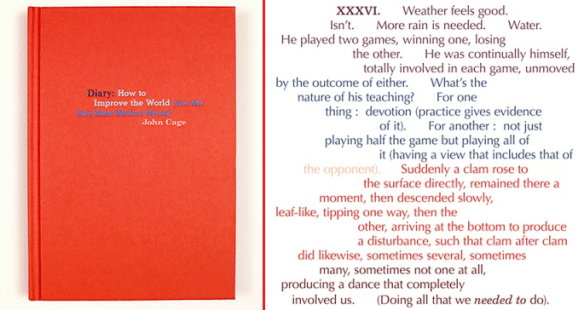
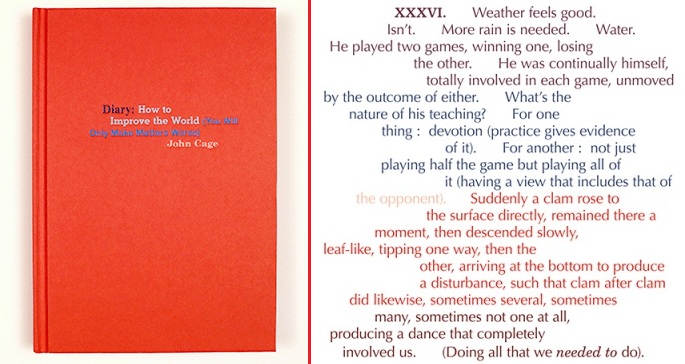
“I remember clams from the Sound exhibited years ago in a Seattle aquarium (near the Farmer’s Market, admission ten cents): their movement, their timing of it,” Cage recalls in his diary. “They were a bed, immobile, one on top of the other, two feet deep in a tank of water, sand on the bottom of the tank. We were told to wait.”

In other words: silence.

Cage all but changes the subject entirely before returning to this anecdote later on in his diary entry. He talks about the weather, the rain, education, devotion, and a game of chess before he meanders back to his Seattle aquarium story:

“Suddenly a clam rose to the surface directly, remained there a moment, then descended slowly, leaf-like, tipping one way, then the other, arriving at the bottom to produce a disturbance, such that clam after clam did likewise, sometimes several, sometimes many, sometimes not one at all, producing a dance that completely involved us.”

Cage does not describe the actual sound of this dance, but he is clearly describing the music of it. The sporadic rhythm of movement, the dancing, the descent—what else could it be? Perhaps the anecdote is meant to illustrate the universality of music, its existence all around us, and the ways in which we might experience music without necessarily hearing it.

After all, it was in 1952 that Cage created the first “happening”: a bold and unusual performance art event that took audiences out of the concert hall and into, well, the outside world. Like many of Cage’s works, his happenings are difficult to describe; by nature each is a completely unique performance event occurring in the present, enabling the audience to forget the past and future and instead become fully immersed in the music of the present—the music of the world around them.

Much of the specifics of these happenings were left entirely up to chance. Depending on the piece, the actual orchestration of his happenings range from television sets to toy pianos, “any number of people performing any actions” to no music or recordings at all. In fact, several of these wide-ranging happenings were part of an eight-part series he cheekily titled “Variations.”

Toy Piano

As for duration of the happenings, that was typically left up to chance, too. Although according to Cage’s philosophy, the music continues infinitely all around us, even once the specific piece has ended.

“(Music’s made it perfectly clear: we have all the time in the world,” he says dryly. “What used timidly to take eight minutes to play we now extend to an hour. People thinking we’re not occupied converse with us while we’re performing.)”

Go to the next installment: Diary: How to Read John Cage – Part III

LIVE BROADCAST: Ensemble Variances w/ Lisa Bielawa

What’s better than contemporary classical music on Second Inversion’s 24/7 stream?Ensemble-Variances10cMichel-Pellaz

LIVE contemporary classical music from Town Hall Seattle, straight to your living room, kitchen, mobile headphones, anywhere with an internet connection.

Tonight, tune in at 7:30pm PT for Ensemble Variances with Lisa Bielawa for Cri Selon Cri. This production is the brainchild of France’s Thierry Pécou and the United States’ Lisa Bielawa — a work which brings together their compositions, performance, and, quite literally, their cries of pain. This tour, sponsored in part by the French government, demonstrates the power of music to bring people closer.  In addition to works by Bielawa and Pécou, John Zorn’s music will make an appearance on the program.

Second Inversion host Geoffrey Larson and Artistic Advisor Joshua Roman will bring you commentary from the stage and behind the scenes throughout this riveting program. Stream online through your computer or better yet, download our mobile app and stream it on-the-go!IMG_5068

Due Date: Awakening

by Joshua Roman

11221317_10153808010537089_3747878842652034556_o

#TFW you’re about to hear your first orchestral composition for the first time…

It’s alive! My first cello concerto, has come into the world – kicking and screaming – but alive. What a crazy experience. I’ve never done anything quite like this, and while it was a project that stretched me almost to the limit, it’s been worth it. I feel more in touch with my artistic sensibility than ever, and more motivated to continue the creative process than I have been in a long time.

I’ll save details of the piece for the day when I’m able to share a recording. In the meantime, there were plenty of lessons in the process.

Lesson 1: Everything Takes Longer Than You Think!
Lesson 2: Everything Takes Longer Than You Think, Even After Allowing For Lesson 1.

The other lessons were more fun, and didn’t require all-nighters. (which leads to apologies to my copyist, George Katehis, who should be sponsored by Red Bull.)

I learned that I am not so good at revision – I already kind of knew this, in relation to writing this blog (among other things). I think it might have something to do with my training as a performer, spending years developing the skill of memorizing quickly. Perhaps those neural pathways need to chill a bit, and not wear those grooves in so deeply on first hearing. Luckily, I’ve been getting better at it by necessity. The blog helps, but the concerto really was a breakthrough in that sense. The pressure of an impending performance where I’m presenting my own art led to much more scrutiny than I realized I was capable of.

12141099_10153808010572089_776989021438584347_o

As usual, Mom and Dad got the first preview via Skype.

I also learned that it takes a bit longer than the warm-up time between dress rehearsal and the concert to switch from the composing mindset to the performing one. It didn’t help that the damn composer (me) didn’t give the cellist (me) the music until very late in the game. As I rehearsed, my focus was very much on the orchestra bringing my imaginary sounds to life. Listening to hear if what I had notated was being played, and if so, was it working the way I expected? In this state of mind it’s hard to do much more than play the notes. During my break, I had time with the cello alone, and quickly realized that I needed to breathe and bring myself back into that special focus that I need to perform. It worked, somewhat, but as with everything else that week it would have been easier had the details of orchestration and rehearsal been more prepared by yours truly when we showed up for the endgame. I’ve kept careful track of these lessons, and am now super excited to apply them next time around.

In fact, I have the opportunity to do much of that as I finish my revisions before the next performance with ProMusica Chamber Orchestra of Columbus in January. I’m making changes now so there’s time to sit with them and continue modifying until it seems right. And then, I’ll walk away from it and just enjoy the continuing process as the interpretation can evolve rather than the notes themselves.

There’s not much to do: a couple of sections need an extra measure or two to develop the way I meant. And balance! I was sure, as a cellist who has played many concertos, that I would get the balance right the first time around. Lo and behold, I was overambitious and could tell immediately that adjustments were needed. Some of it was a matter of adjusting dynamics in rehearsals, but we didn’t get quite all the way to balance perfection. No way am I going to practice some of the ridiculous passagework if it can’t even be heard! Those are relatively easy fixes though. The more I hear others play my music, the more I realize the importance of detailed markings. They can convey a shape and a character that bring them out even if a dynamic is soft, or simply serve to hold a players’ attention in a way that attracts the ear of a listener.

I’m very grateful to all who made this project possible. To have created something that speaks of personal emotions is a great feeling, and the fact that I’m able to share it on such a platform and with the support of others is incredibly inspiring and uplifting. This is only part two – eventually there will be music to play for you, and I look forward to that moment. In the meantime, go create something!!

12138356_10153808010562089_4276796138960166270_o

Backstage after the premiere. That was intense! It was great to have David Danzmayr conduct.

My current playlist:
Ingram Marshall: Gradual Requiem
David Byrne and St. Vincent: Love This Giant
Barber: Essay No.2 for Orchestra

Joshua Roman’s cello concerto “Awakening” was premiered on October 17, 2015 with Illinois Philharmonic Orchestra and conductor David Danzmayr, commissioned by Illinois Philharmonic Orchestra, ProMusica Chamber Orchestra of Columbus, The Lied Center of Kansas, and The Corral Family. For more about “Awakening,” check out the Chicago Tribune preview and its first review in Chicago Classical Review.