
Second Inversion hosts share a favorite selection from their weekly playlist. Tune in on Friday, October 6 to hear these pieces and plenty of other new and unusual music from all corners of the classical genre!
Michael Gordon: Timber (Cantaloupe Music)
Remixed by Ikue Mori
 Michael Gordon could make music out of just about anything. His piece Timber, composed for six percussionists playing 2×4 planks of wood, is not just good—it’s so good it spurred an entire album of remixes by 12 different electronic artists.
This particular remix by Ikue Mori slows down the texture and explores the space between the notes, with the music slowly oscillating up and down, side to side, from one headphone to the other and back again. With an echoing, almost ritualistic pulse, Mori’s version feels ghostlier than the original. It’s almost as though the wooden planks were cut from haunted trees—evoking a spookier interpretation of the title Timber. – Maggie Molloy
Tune in to Second Inversion in the 2pm hour today to hear this piece.
Julia Wolfe: Lick (Cantaloupe Music)
Bang on a Can All-Stars
 This is an intense piece in many ways. It’s rhythmically difficult, aggressively pounding, and relentless throughout; it features no sound softer than a determined forte until possibly the very end. Generally I would abhor something like this, but the Bang on a Can All-Stars are able to give it a truly fascinating showcase: raucous and full of indomitable character.
It’s the first piece that Julia Wolfe wrote for the ensemble, hoping they would “go over the top” with the work’s “intense energy” born of the body-slamming rhythms of Motown, funk, and rock music of Julia’s childhood. I think it worked. – Geoffrey Larson
Tune in to Second Inversion in the 3pm hour today to hear this piece.
Florence Price: Dances in the Canebrakes (MSR Classics)
William Chapman Nyaho, piano
 William Chapman Nyaho: Asa is the second of five volumes curated by Ghanaian-American composer and pianist William Chapman Nyaho. All five volumes feature a fascinating and impressive collection of music of Africa and the African diaspora. This second volume is focused on dance music, and Nyaho certainly shines as he dances his hands across the keys of his piano with striking expertise.
In Florence Price’s Dances in the Canebrakes, Nyaho treats the listener to three movements that feel like a courtly cakewalk. Price, I should note, was the first black woman in the US to be recognized as a symphonic composer and to have her work performed by a major American orchestra. Price was a pioneer and is perfectly at home in this anthology of musical unity. – Rachele Hales
Tune in to Second Inversion in the 7pm hour today to hear this piece.
Ballaké Sissoko & Vincent Ségal: “N’kapalema” (No Format Records)
 I’m currently going through a months-long phase of discovering West African music, which started with Peter Gabriel’s collaborations with Youssou N’Dour and then led me through to Toumani Diabaté and Rokia Traoré. (Give them a listen!)
It looks like Ballaké Sissoko will carry the torch next. In “N’kapalema,” a collaboration with cellist Vincent Ségal for Sissoko’s album Musique de nuit, the composer plucks precise, intricate melodies on the kora while Ségal overlays the cello’s husky voice. For me, it evoked an image of a lot of families in their homes at dusk, all saying prayers before a candlelit dinner. – Brendan Howe
Tune in to Second Inversion in the 9pm hour today to hear this piece. Plus, catch the duo in Seattle when they perform as part of the Earshot Jazz Festival on Oct. 22.
 If you don’t have five hours to listen to John Cage’s sprawling, narrated sound art piece


 There is so much good music coming out of Iceland that sometimes it’s a challenge just to keep up with all of it. Icelandic composer and conductor Daníel Bjarnason is a staple on my personal playlist—his gorgeously textured, celestial soundscapes blur the line between classical and electronic musical idioms, drawing freely from the intellectual rigor of the classical tradition while living in the spontaneity and experimentalism of new music.
 It occurs to me that this track could be heard as mournful or melancholy, but I have an alternative interpretation. Despite the Donnie Darko aesthetic, Golden Times 2 seems to be a relaxed and optimistic meditation. I especially love the extra-low bass that creeps around for most of the track and the swingy cymbal groove that completely transforms the vibe upon entry. Grab a cold beverage and a seat in the sunshine and enjoy!
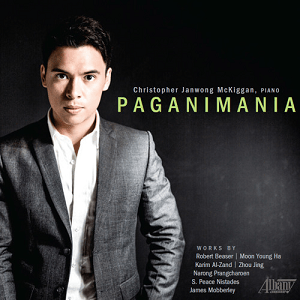 Pianist Christopher Janwong McKiggan was the 2009 collegiate gold medalist from the Seattle International Piano Competition. As he moves forward in his career, he is charting a path of new music, commissioning seven composers in 2012 to compose works for piano inspired by Niccolò Paganini’s 24th Caprice. Beaser’s Pag-Rag is both undeniably fun and a deliciously mean technical challenge for the pianist. A far cry from most listeners’ straightforward idea of a rag, this piece is full of lightning-fast changes of character and texture, giving it unexpected depth and variety. It’s a wonderful showcase of McKiggan’s playing. –