

Second Inversion hosts share a favorite selection from their weekly playlist. Tune in on Friday, January 26 to hear these pieces and plenty of other new and unusual music from all corners of the classical genre!
Adam Maness: “Shibuya” (Self-Released)
Performed by the 442s
 The title of this piece grabbed my attention because it’s a name I’ve read in Haruki Murakami’s novels and short stories—most recently 1Q84, where one of the characters, Aomame, climbs down an emergency staircase from a freeway to escape a traffic jam, where she’s been sitting for ages in a taxi. As she leaves, the taxi driver tells her to remember that “things are not what they seem,” and then she begins her decent into Shibuya, Tokyo. While I’ve never been to Shibuya, the 442s (who took their name from the standard orchestral tuning of 442 hertz) and composer Adam Maness have added another layer to my imagination of what the place is like. Plus, that glockenspiel with the plucked strings kills me. Good stuff! – Dacia Clay
Tune in to Second Inversion in the 2pm hour today to hear this piece.
Dawn of Midi: Io (Thirsty Ear)
 I’m starting to think that I will never tire of Dawn of Midi’s 2013 album Dysnomia. Exemplifying an extremely high standard of acoustic performance, this album is some of the best trance-y music anywhere, for my money. Io, in particular, is a fantastic track. Satisfying grooves give way to complex rhythms and unexpected tones that draw you in as they zone you out. – Seth Tompkins
Tune in to Second Inversion in the 4pm hour today to hear this piece.
 Gabriel Kahane: “Parts of Speech” (StorySound Records)
Kahane’s second album Where are the Arms seems aesthetically drawn to building bridges and blurring boundaries between indie rock and classical musis. His catchy pop song “Parts of Speech” highlights the everlasting theme of unrequited love with rhythmic sophistication and something distinctly Nirvana-meets-the-Killers. Kahane’s drawling voice on the driving melody punctuated by some clever rhyme schemes makes the humanness of his songwriting relatable to the casual listener while simultaneously transfixing to the poetically and musically trained ear. – Micaela Pearson
Tune in to Second Inversion in the 7pm hour today to hear this piece.
 Ben Lukas Boysen: “Golden Times 2” (Erased Tapes)
Soundscaper Ben Lukas Boysen’s “Golden Times 2” is a slow burn with a wistful, pensive core. Sleepy static and repetitious programmed piano are the jumping off point for a piece that builds as cello and drums join in the tremulous, lush unfolding of an arrangement that offers beautiful gestures of emotion rather than a blatant brandish of it. Swathe yourself in the coziest blanket and sink into Boysen’s graceful melodic minimalism. – Rachele Hales
Tune in to Second Inversion in the 9pm hour today to hear this piece.
 There is so much good music coming out of Iceland that sometimes it’s a challenge just to keep up with all of it. Icelandic composer and conductor Daníel Bjarnason is a staple on my personal playlist—his gorgeously textured, celestial soundscapes blur the line between classical and electronic musical idioms, drawing freely from the intellectual rigor of the classical tradition while living in the spontaneity and experimentalism of new music.
 It occurs to me that this track could be heard as mournful or melancholy, but I have an alternative interpretation. Despite the Donnie Darko aesthetic, Golden Times 2 seems to be a relaxed and optimistic meditation. I especially love the extra-low bass that creeps around for most of the track and the swingy cymbal groove that completely transforms the vibe upon entry. Grab a cold beverage and a seat in the sunshine and enjoy!
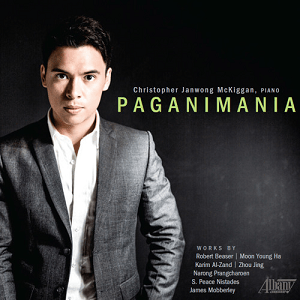 Pianist Christopher Janwong McKiggan was the 2009 collegiate gold medalist from the Seattle International Piano Competition. As he moves forward in his career, he is charting a path of new music, commissioning seven composers in 2012 to compose works for piano inspired by Niccolò Paganini’s 24th Caprice. Beaser’s Pag-Rag is both undeniably fun and a deliciously mean technical challenge for the pianist. A far cry from most listeners’ straightforward idea of a rag, this piece is full of lightning-fast changes of character and texture, giving it unexpected depth and variety. It’s a wonderful showcase of McKiggan’s playing. –