Revisiting Bates

by Joshua Roman

IMG_0905

Mason Bates, Mirga Gražinytė-Tyla, and Joshua Roman backstage at Benaroya Hall

That old familiar friend – a piece that already has a life inside of you and is ready to be teased back into the external world. For a cellist, these are usually pieces of very old music: Bach Cello Suites, Concertos by Dvorak or Haydn, Sonatas and Quartets from days of yore.

This time, I get to reignite the flame with a rather new concerto: that special work by my friend Mason Bates. I am so lucky to count wonderful composers among my friends, and to work with them regularly. Last year, Mason wrote his first Cello Concerto for me, and we gave the premiere with the Seattle Symphony. Even by the time of the world premiere, I had given the piece several test runs with pianist Carlos Avila, for small audiences with discerning ears. Now I’ve decided this is a must! I had a similar preparatory experience with “Dreamsongs”, the concerto Aaron Jay Kernis wrote for me the previous year, and on the day of a premiere it makes all the difference to have more comfort, confidence, and a deeper connection with the music.

So pulling the score back out, I had a decision to make. Listen to archival recordings from the performances with Seattle and Columbus? Or rely on memory of what worked and what didn’t? Usually, with a piece that’s already entered the standard repertory, I have a self-imposed rule that listening to other recordings is strictly verboten within a month of a performance. It may be 80% superstition, but I want to be conscious of what makes its way into my interpretation. However, is it any different when the only recordings in existence are my own? If I listen at all, I generally listen to archival recordings fairly soon after the performance to get a sense of whether my intentions come across or not, and try to take notes for later.

An experiment began to take shape: I started by looking at the score as if it was the first time, and began to practice before listening to any recordings. This way, at least I could leave room for any accidental discoveries, which are always fun! Of course, there were a few – opportunities for color changes or subtleties I missed the first time around. Or did I?

Going back, listening to the recordings, it was fun to see what recollections were spot on, and what memories had taken on the subjective hue of emotions surrounding certain moments or performances. Listening to oneself can be a painful process, but the illuminating effect it has is well worth it. There were plenty of sighs of relief on my part, as well as the usual grimacing. Definitely something that I prefer to do alone in the privacy of my own room!

The fact that I had some insight into my own previous interpretations (hued or not) helped me get past my concern about the unseen influence recordings can otherwise have. If anything, it has helped even more as I discover what gestures, colors, and emotions come across in the sound and what is only internal. From now through the time of the last performance of the season, I’ll be listening back to run-throughs, rehearsals, and performances, chipping away at the edges of this particular work of art.

You’ll see in the list below that I’ve chosen to listen to other works by Mason. While I do have certain hesitations regarding listening to a specific piece I’m playing, if I can find other pieces by the same composer, or works that I know have influenced, I find it a good way to absorb more of their style and voice. And of course, being in constant communication with Mason to get ever closer to the heart of his musical soul.

The best part of being with such a new “old friend”, is that I get to introduce so many people to these new sounds for the first time. Long live new music!

CPJWwEIVEAAEzOo

Eric Jacobsen and Joshua Roman getting ready for Mason Bates at Greater Bridgeport Symphony.

Joshua performs the Bates Concerto throughout the 15-16 season, beginning Saturday, September 19 with the Greater Bridgeport Symphony under the baton of Eric Jacobsen – check Joshua’s calendar for a city near you!

LISTENING TO: Mason Bates
Stereo is King (whole album)
Violin Concerto with Anne Akiko Meyers, violin

John Luther Adams’ Inuksuit: Q&A with Melanie Voytovich

by Melanie Voytovich

Inuksuit

A very special performance of John Luther Adams’ Inuksuit is taking place on Saturday, September 19, 2pm at Seward Park Amphitheater. It is FREE and open to the public! Melanie Voytovich organized the performance and we wanted to turn the blog over to her for a little background on the piece and what to expect! 


What is Inuksuit?
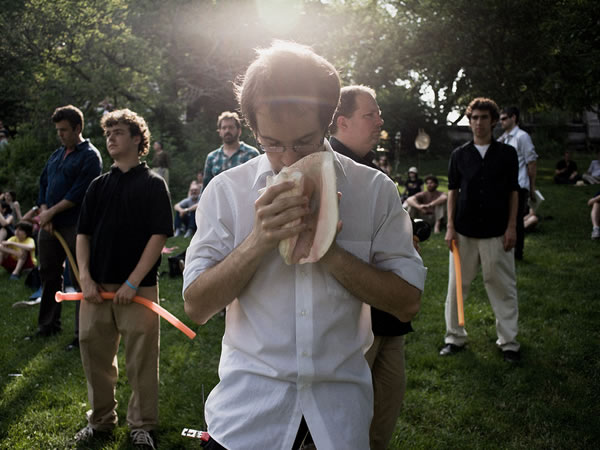
163Inuksuit is a 79-minute masterpiece written for 9 to 99 percussionists composed by John Luther Adams. The title refers to a type of stone landmark used by native peoples of the Arctic region; listeners discover their individual listening points as they, too, move freely during the performance. This work is designed to heighten our awareness of the sights and sounds that surround us every day, and deeply influenced by the composer’s belief that “music can contribute to the awakening of our ecological understanding. By deepening our awareness of our connections to the earth, music can provide a sounding model for the renewal of human consciousness and culture.” Adams has notated in Inuksuit that the piece should only be performed outdoors. The piece uses a mix of standard and less common instruments, including glockenspiel, toms, cymbals, conch shells, whirly tubes, vuvuzelas, and sirens.


What can people expect?
Inuksuit_Shawn_Brackbill_BPeople can expect a really unique listening experience. Often when we attend concerts we’re asked to sit in a single location and tune out any extraneous sounds to enjoy the performance. Inuksuit is completely different: There is no designated area for the audience, and attendees are encouraged to walk around and discover the varied aural experiences. Additionally, the sounds of bird chirping, raindrops falling, and branches breaking below your feet are now part of the piece and not something to be disregarded. Everyone should feel encouraged to listen differently.


What inspired you to lead this production?

tumblr_ln7fsy1Fzp1qka8qbo1_500My biggest inspiration for producing this piece was my experience at the Chosen Vale Percussion Seminar in the summer of 2014. Doug Perkins and Amy Garaphic are the organizers of this seminar, and also very involved with JLA and have produced a number of performances of Inuksuit. That summer, Adams was invited to be a composer-in-residence for the program and we had the privilege of playing through the percussion parts of his piece Sila: The Breath of the World before the premier performance at Lincoln Center. Sila is written for large ensemble and voices, so we only represented a fraction of the final product, and the experience was really moving for us all. I was able to learn about his experiences and inspirations first hand, and developed a deep interest in learning more and performing this major work for percussion.

Seattle is so fast-paced that many of us rarely, if ever, take a moment to take in the sounds around us. As many of my friends and coworkers could tell you, I often notice and appreciate (often by mimicking) the sounds around me – the accidental clink of a glass, interesting rhythms created by birds or builders, and anything else that sounds interesting in my environment. You could say perhaps I’m living in an eternal state of 4’33”, and I’m often curious how others don’t take the time to hear the beauty or intrigue in any of these sounds. Inuksuit requires that the listener engage the sounds of their environment. It’s a really exciting to me to invite people to listen this way, in a “shape-your-own experience” environment.

I’d also like to throw thanks out to the organizations that helped make this presentation possible. The Seattle Office of Arts and Culture, Seattle Youth Symphony Orchestra, Washington State Percussive Arts Society, and the Seattle Symphony.

STAFF & COMMUNITY PICKS: September 17, 2015

A weekly rundown of the music our staff and listeners are loving lately! Are you interested in contributing some thoughts on your favorite new music albums? Drop us a line!

Joshua Roman on JACK Quartet’s recording of Tetras by Iannis Xenakis:

From the insanity of the opening glissandi, or slides, to the final whimper, it’s hard to imagine a more captivating 17.5 minutes than Tetras. The precision and intensity brought to this performance by the JACK Quartet are almost frightening. If you can pull your jaw off the floor long enough to get past the shock and awe factor, the innovative structure and sounds of the piece kick in. Fantastical glissandi of all shapes and sizes, wild percussive sounds (using many parts of the instruments not traditionally in play), tremolo and hitherto unheard of scales are provocative and forceful in their narrative roles. Underneath all of that, Tetras creates a space where your imagination can go wild, at times wailing, at times full palpable tension, or in chaotic ecstasy.


Maggie Molloy on Florent Ghys’s Télévision:

ca21104_television_front

I listen to the weather forecast pretty much every morning—but I have never heard it like this before. French composer and bassist Florent Ghys’s eclectic new album “Télévision” begins with a piece composed for double bass, voice, guitars, percussion, and, oh yeah, five weather forecasts. Yes, five weather forecasts.

But it’s not all just sunshiny, warm weatherman banter—the piece actually serves as an introduction to Ghys’s idiosyncratic compositional style. As the title of the album suggests, his music is like a mashup of video and sound clips, sampled speech, multi-tracking, found sound, and more—and it’s all tied together with perfectly groovy pizzicato basslines and subtle yet witty social commentary. The colorful and unapologetically contemporary works live somewhere in the realm between chamber music, minimalism, sound art, and seriously catchy pop tunes.

So the next time you’re looking for something new, turn off your TV and tune into Florent Ghys’s musique concrète masterpiece, “Télévision.”


Maggie Stapleton on Ballaké Sissoko and Vincent Segal’s Musique de Nuit:

19922-Ballake_close_up_w_kora

This duo is one of my go-to musical pick-me-ups. The delicate, sprinkling sounds of the kora along with the low, resonant cello is a soundscape that can turn around a glum day or transport me to a centered place.  Musique de Nuit is a spectacular follow-up to their debut album, Chamber Music (which, BTW, was on our pilot playlist for Second Inversion when we created the project three years ago!) and was recorded in a mere TWO sessions – one on Ballake Sissoko’s rooftop in Bamako, and one in a studio. Who does that? These guys. With infuence from West African folk traditions, a hint of Baroque music, and a fresh take on the concept of “Night Music,” rest assured you can listen to this morning, day, or night and retreat to a world of enchantment.

ALBUM REVIEW: Unremembered by Sarah Kirkland Snider

by Maggie Molloy

sksnider unremembered

Childhood is a time of youthful innocence, joyous discovery, and wondrous possibility—but along with that unbridled and enchanting sense of imagination can also come dark creatures, mysterious horrors, and haunting memories.

Composer Sarah Kirkland Snider braves these mystical terrors and takes on the full beauty and vast musical scope of childhood imagination in her latest release, “Unremembered.” The album is a 13-part song cycle, and each piece is its own narrative—a tender memory, a ghostly mystery, or a haunting message. Together, the cycle is a rumination on memory, innocence, imagination, and the strange and subtle horrors of growing up.

Composed for seven voices, chamber orchestra, and electronics, the songs were inspired by the poems and illustrations of writer and artist Nathaniel Bellows, a close friend of Snider. The poems depict poignant memories of Bellows’ own childhood upbringing in rural Massachusetts—tales which in turn triggered memories from Snider’s own childhood, giving shape to her musical settings of the text.

The album was released on New Amsterdam Records, a label Snider co-created with Judd Greenstein and William Brittelle in 2008 to promote classically-trained musicians who create outside the confines of the classical music tradition. The album features vocalists Shara Worden (of My Brightest Diamond), Padma Newsome (of Clogs), and singer-songwriter DM Stith gliding above the instrumental talents of musicians from contemporary ensembles like ACME, Alarm Will Sound, ICE, The Knights, and Sō Percussion.

A follow-up to Snider’s critically-acclaimed 2010 song cycle, “Penelope,” the new album lives somewhere in the mystical, mythical world between classical and pop genres. Each song is its own vividly colored vignette, a mesmerizing narrative brought to life through Snider’s rich textural and temperamental palette.

“I think that all of my music is narrative driven—that’s what I’m the most interested in musically—mood and storytelling and atmosphere,” Snider said in an interview with Molly Sheridan of NewMusicBox. “I’m fascinated by complex emotions—the places where affection crosses over and merges with dread, or regret merges with gratitude.”

From the ghostly echoes and somber lyricism of “Prelude” to the surreal dark carnival dance of “The Barn,” each piece tells a different tale of childhood; a memory embellished, ornamented, and altered over the years. In a way, Snider also embellishes memories of the classical genre—musically she recalls the strict rules and structures of the classical tradition, but she does so in a way that is blurred, broken, and beautifully contorted. Her collaboration with Worden helped breathe life into this eclectic collection of musical influences.

“Shara [Worden] had become my closest friend and we’d had so many conversations about classical versus pop music, and all of the frustrations that we had dealing with the lack of infrastructure to support music written in the cracks between those worlds,” Snider said in her interview with NewMusicBox. “She also just so comfortably can inhabit both worlds, which is something that so few singers can do, so I felt like I could really let it rip.”

Worden’s operatic voice drifts above the restless woodwind motives and dreamlike themes of “The Guest,” glides gracefully above the delicately swelling orchestral backdrop on “The Swan,” and echoes just as sweetly above the subtle, soft strings of “The Song.”

The album climaxes with “The Witch,” a ruthless and rhapsodic witch hunt played out across a programmatic musical arc. Worden’s low voice hisses against the aggressive strings and militant drums of the orchestra. She sings the ghostly tale of a witch hunt while the strings and percussion chase after her, brewing with melodrama and theatrical orchestral nuances. The piece ends with twinkling celeste motives as the haunting witch hunt fades back into a distant memory.

“The Slaughterhouse” is similarly grim, though it begins with a sweet reprieve: a gorgeous, achingly tender solo piano melody. The gentle rumination gives way to a somber tale of slaughtered animals, a collection of beasts buried beneath the winter ice—the cold memory and throbbing melodies sending shivers down the listener’s spine.
“The Girl” tells of a tragic small-town suicide—a girl hanged in an entire forest of musical timbres. Snider paints a vivid musical picture of the wind blowing through the trees, birds chirping in the early morning sky, and inquisitive animals peeking out behind woven beds of flowers. “The River” tells another solemn tale, with somber vocals flowing above fragmented melodies and a slowly rumbling bass.

The album comes to a close with “The Past,” a fractured montage of childhood memories echoing musical fragments from earlier songs in the cycle. But this time, the piece sounds hopeful—like a lullaby alive once again with the warmth and sweetness of childhood.

And just like that, the melancholy requiem of “Unremembered” evaporates into a softly twinkling silence, like an enchanting music box tenderly closing—and while the exact details of the memories may fade with time, the album itself is unforgettable.

Programming a Classical Season

by Joshua Roman

Joshua Roman by Hayley Young 7

My mandate from the beginning was clear and concise: Town Music’s programming should reflect my musical interests. A live iPod playlist, if you will. Well, my interests are broad and evolving! What can I say?

Nine seasons in, I’ve seen the development of an audience that comes for an experience. We’re lucky, in this sense, to be tied to an organization like Town Hall Seattle, which fosters community discussion and debate around issues important to Seattle. This spirit of engagement naturally flows over into the music series, and has prompted me to explore musical connections that might not be obvious based on traditional metrics. When an audience member leaves one of the Town Music concerts, I want them to have had an experience that generates curiosity and excitement. Hopefully, they will have been surprised at some point, whether by unknown sounds or their own reaction to something of which they previously had a different expectation.

But how to do this without having a total mishmash of unrelated projects? There are several things which remain consistent from season to season:

Every season includes music by J.S. Bach, whether it’s a concert of Bach or mixed in other programs. I love Bach, and find it an ideal anchor for explorations of many kinds of music. In past seasons, Bach has been played by Baroque specialists like Catharina Meints and paired with other music, like Karen Gomyo’s evening of Bach and Piazzolla. This season, Johnny Gandelsman plays all six Sonatas and Partitas. Yesss…

Every season ends with a commission. A musical series which seeks legitimacy must, in my mind, be a part of the continuing tradition of creativity and innovation which is classical music. This means commissioning and/or performing new works. End of story!

Every season has at least one concert where I perform. My relationship with Town Hall Seattle began with a solo performance, before I was asked to join the team as an Artistic Director. My identity is very much wrapped up in performance, and I learn so much from sharing the stage time and time again in front of an audience that I know, and that knows me.

So how to bring it all together? Several of my past seasons have had an arc, or a particular focus. The season of extra-musical influence comes to mind, where concerts had textual, dance, or other non-musical influence. Or the season where each concert had a different number of players. However, I find that these ideas work best when they develop naturally during the planning process. I like to start with one or two intriguing performers or programs, and then find the connections (obvious or not, at this point) to at least one other idea that’s been on my mind. From there, I might consciously begin to search for other performances that will enhance or contrast the developing theme.

My best example of this process is a season from several years ago, where each concert featured a composer/performer playing their own work and works that had inspired them. I had already decided on a couple of the performers when I realized the commonality: they were also composers. It wasn’t hard to find other people I’d already wanted on the series who also composed. In the end, we had Derek Bermel, So Percussion, the JACK Quartet, Gabriela Lena Frank, and to bring it all back home to Seattle, players from the Seattle Symphony who also compose.

Which leads me to the last piece of the puzzle: maintaining a connection and sensitivity to the community I serve with this series so I can properly inhabit my role as provocateur. Some of that comes from talking regularly with friends and colleagues in Seattle, during my many (many!) trips there or over the phone and email. I also like to find special occasions to highlight local musicians, whether in an all-cello ensemble or the composer/performer concert. One of the more gratifying endeavors was in June, where we managed to pull Seattle Youth Symphony players, alumni, and mentors from the Seattle Symphony and other orchestras together to share the stage in a program of inspiring string ensemble music.

And, my most frequent activity as an Artistic Director: listening. Hours are spent scouring the internet for music and musicians I haven’t heard. Following trails of interesting ideas to see where they originate. Going to concerts when I can (usually at home in NYC) and asking colleagues what’s new and what’s great as I travel around the country.

In the end, I’m on the hook for the programming decisions, and I take this job very seriously. This is a never-ending path of discovery that has taken me far beyond simply programming my own recitals, and it has had a profound impact on how I see my artistic voice developing. Sharing is such an important part of being human, and as an artist I see opportunities to improve that quality in myself, and they are certainly not limited to the concert stage. I love the the feeling of giving someone else a chance to share their voice with an audience and enjoy the dialogue this beautiful interaction spawns.

Take a look at this upcoming Town Music Season and past concerts.

Music I’m listening to:
Ieyoka: “Say Yes Evolved”
Bela Fleck: “Bela Fleck and Abigail Washburn”
Xenakis: Complete String Quartets (JACK Quartet)